


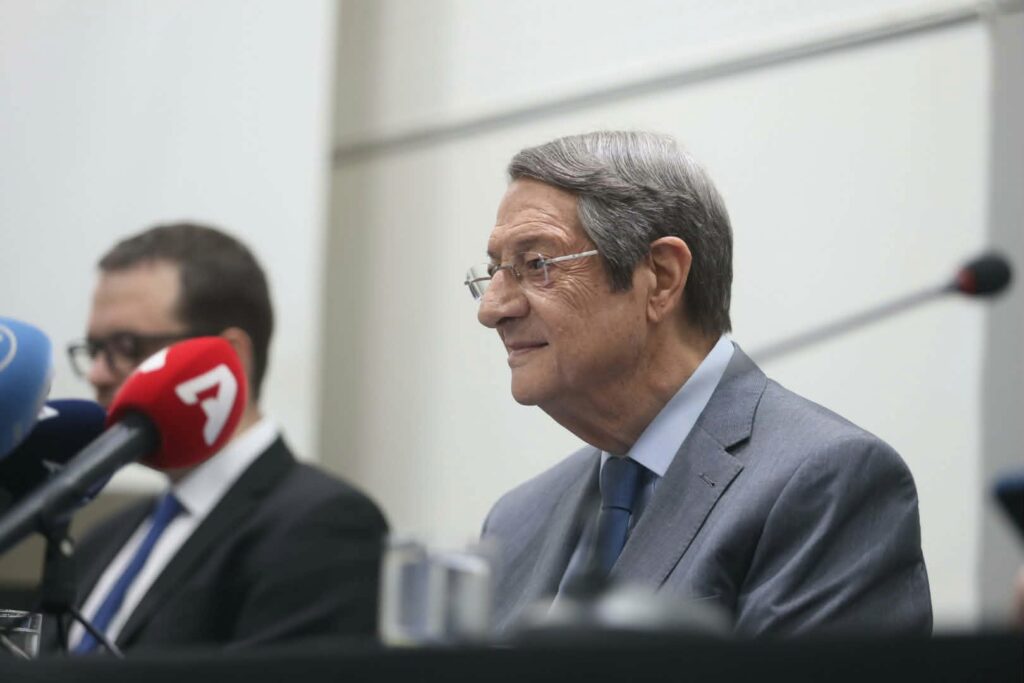
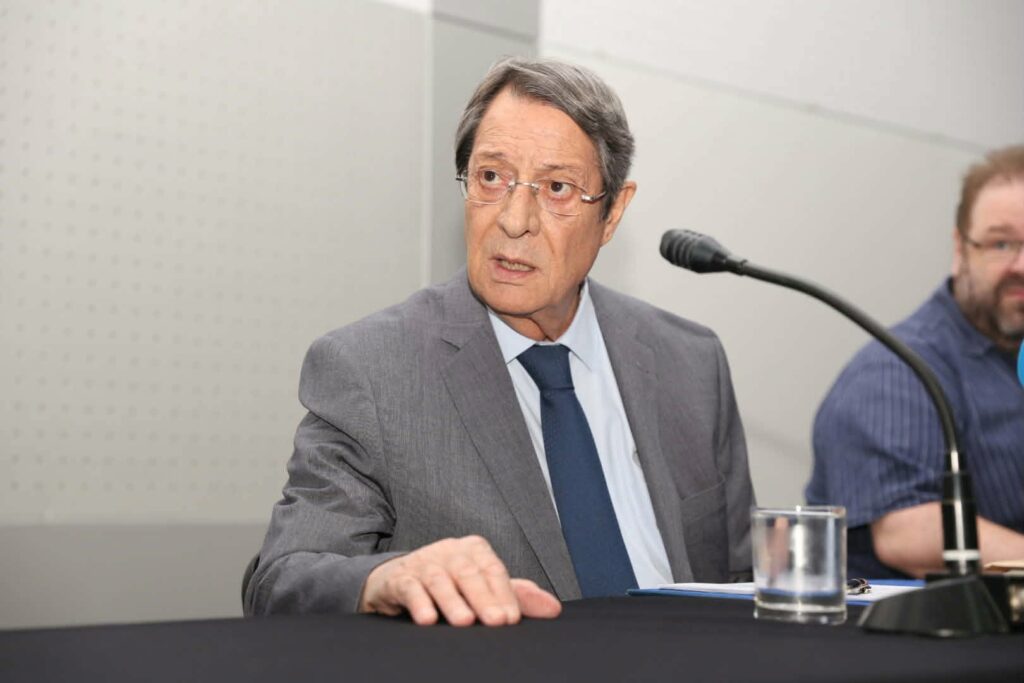
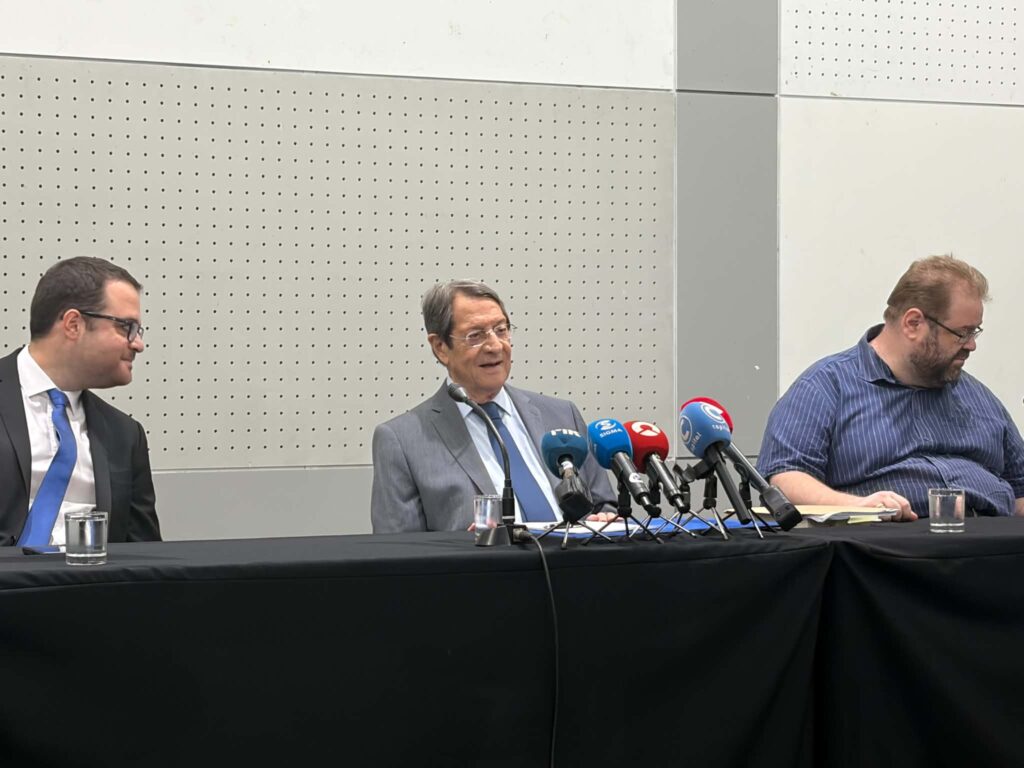
Former President Nicos Anastasiades opened his press conference on Tuesday by accusing unnamed parties of publicly crucifying him and engaging in character assassination in the wake of the Anti-Corruption Authority’s findings, one week after the report’s publication.
Speaking at the Journalists House in Nicosia, Anastasiades said some people had set up “kangaroo courts” and reached their own verdicts without needing the report to do so. He said what had followed the report’s publication was an intensification of toxicity, the tarnishing of reputations, character assassination, and the heroisation of the person he described as the inventor of the Sandy affair.
Anastasiades stressed that the standard of proof in investigative proceedings is the balance of probabilities, not proof beyond reasonable doubt, and that the inspectors and the Authority had the presumption of innocence in mind, with guilt a matter for a court to determine. He said no one had stated that the defamatory claims in the book Mafia State had been rejected as false.
The SMS allegation
Anastasiades moved on to address directly the inspectors’ finding on an SMS message, saying the linking of events in the report had led to incorrect conclusions. He said a message attributed in the report to “No. 1” — a designation he said was arbitrarily implied to refer to him — read: “I hope the President of the Republic will not intervene.”
He said the inspectors had wrongly connected that message to a separate SMS from a person named Hatzikyriacos relating to a trip, and had reached what he called an entirely unfounded conclusion that he may have committed the offence of trading in influence.
The report found, on the balance of probabilities, that an agreement existed between Anastasiades and Rybolovlev to cover the costs of a Brussels-to-Athens flight, and that the agreement was facilitated by Andreas Hatzikyriacos, according to Anastasiades’s account of the findings.
The Rybolovleva arrest allegation
Turning to the allegation concerning the arrest of Rybolovlev’s wife, Anastasiades said the claim had collapsed given that the relevant decision had been approved by parliament with only two votes against.
He said the narrative in the report referred to his alleged knowledge of and involvement in the arrest of Rybolovlev’s wife, but that at no point did the report cite any action by him towards any authority or body that would indicate such involvement. He added that the Authority itself had stated that nothing could be proven without supporting evidence.
The press conference follows the Anti-Corruption Authority inspectors’ recommendation that Anastasiades face scrutiny on seven counts: three of trading in influence, one felony count of abuse of power, and three counts of abuse of power as a misdemeanour or attempted criminal offence.
The oligarch and the private jet flights
Anastasiades turned to the chapter of the book titled “The oligarch demands explanations,” in which Drousiotis writes that an emergency meeting with Rybolovlev was arranged on March 6, 2014, to take place at a European People’s Party congress Anastasiades was attending.
Anastasiades said Drousiotis claimed on page 52 of the book that among the financial benefits he allegedly secured from a new arrangement with the oligarch was an agreement for Rybolovlev to pay for private jet travel, with a one-way flight cited as an initial example.
The trading in influence finding collapses
Anastasiades said the conclusion on trading in influence could not stand, arguing that the arrest of Rybolovlev’s wife had taken place on February 24, 2014, and that the alleged illicit advantage was therefore not connected to that arrest.
He said the finding was based on what he called false claims by Drousiotis regarding the formulation of a new plan developed at a later date.
The Focus case
Anastasiades addressed the Focus case, saying the book’s narrative was that Focus had been used as a vehicle through which a person named Vgenopoulos funded political parties in Cyprus.
Following the negative publicity and reactions in 2014 after the contributions were made public, the then Attorney General ordered investigations to determine whether criminal offences had been committed and by whom.
Former Attorney General Kostas Clerides subsequently announced that the evidence did not point to the commission of any offences.
The €550,000 allegation
Anastasiades addressed what he called a defamatory claim that he had misappropriated 550,000 euros intended for DISY to cover voter transport and campaign needs ahead of the 2009 elections. He said the inspectors had rejected those claims but nonetheless concluded that a potential offence of abuse of power may have arisen.
He said the finding was based on an allegation that he had met the then Attorney General and expressed strong dissatisfaction with the progress of an investigation, asking for it to be terminated on the grounds that no criminal offences had been identified. The report also found, he said, that the intervention may have constituted presidential interference capable of influencing the course of the investigation, the administration of justice, and the public interest.
Anastasiades said this allegation had never been put to him during his appearance before the inspectors, meaning he had no opportunity to refute it or challenge what he called the Authority’s erroneous conclusions.
He also pointed to what he described as a contradiction within the report itself, noting that page 41 of the findings referenced evidence of possible personal or political benefit that could reveal his involvement in funding for DISY, while other findings by the Authority concluded that he had not gained so much as a cent and had not committed any offence. He asked what benefit he could have had and why he would have sought the termination of a criminal investigation on that basis.
No motive to intervene, says Anastasiades
Anastasiades turned to the allegation that a potential abuse of power finding rested on evidence that he had intervened with former Attorney General Kostas Clerides, expressing dissatisfaction with the progress of an investigation. He said the reasons why he had no motive to intervene had already been set out.
He said responsibility for investigations rested exclusively with the Attorney General, and questioned how he could have expressed dissatisfaction in that context. He also asked why Clerides, with whom he said he did not have the best of relations, had not reported the alleged interventions at the time.
Anastasiades said it was regrettable that the inspectors had reached findings of a potential felony against him without giving him the right to be heard.
Vgenopoulos, Laiki Bank bribes and fictitious invoices
Anastasiades addressed the chapter on alleged bank bribes, saying he had responded to the overall narrative in his own book.
He said the inspectors’ report referred to a transaction with Laiki Bank allegedly for his benefit, described as appearing to be intended as support for his 2013 election campaign and presented as a fee or commission. The sum of 250,000 euros was alleged to have been agreed between him and Vgenopoulos, he said.
The report also alleged that two fictitious invoices had been used to present the payment in a misleading way, and that he had abused his influence and was implicated in the commission of passive trading in influence.
Anastasiades said the matter had again not been put to him by the inspectors, denying him the opportunity to respond. He said the alleged offence of passive trading in influence required the existence of an illicit advantage, and asked what that advantage was, noting that the alleged offence did not relate to the period during which he was President.
He said the Authority’s findings did not specify what the then presidential candidate had given in exchange for the payment allegedly received from Laiki Bank. He also questioned how he could have borne general responsibility and oversight of the firm’s work given that from the moment he was elected DISY leader he had devoted all his time to that role.
Anastasiades said he considered the Authority’s finding to be entirely unfounded.
Abramov money laundering allegation
Anastasiades addressed what he described as the facts behind an OCCRP platform article published on August 14, 2019, which alleged that his law firm had facilitated Alexander Abramov in laundering millions. The Guardian had reported that the scheme involved 70 shell companies, he said.
He noted that the OCCRP article itself stated there was no proof that his law firm had committed any offence, but that the opposition had exploited the publication to create an outcry and attach what he called false characterisations to him.
Unaware that MOKAS had already opened an investigation on its own initiative, he said he had requested an inquiry into the publication to establish whether offences had been committed and by whom.
He said the Anti-Corruption Authority had reached what he called an unacceptable conclusion: that his use of his office and his instigation of the MOKAS investigation had increased pressure and raised serious concerns about arbitrary political interference, influence, and abuse of power.
Anastasiades said the most noteworthy aspect of this finding was that the Attorney General had agreed with it. He said the inspectors had concluded that his public statement calling for an investigation could form the basis for potential criminal liability for abuse of power, and described it as unacceptable that a call for allegations to be investigated could be treated as an abuse of power.
He added that he had no wish to attribute ulterior motives but said he had been denied the right to be heard.
Anastasiades said the inspectors had examined the naturalisations of Abramov and Lebedev and reached what he described as the most arbitrary findings, contrary to all logic.
The Christofias question
Anastasiades said he was genuinely sorry to have to raise what he called difficult questions. He asked whether it was possible to maintain that a member of parliament had requested a meeting with a minister and influenced the illegal naturalisation of investors, and whether a Council of Ministers decision taken under then President Demetris Christofias could be attributed to his own influence as opposition leader. He asked from when and in which country power was exercised by the leader of the opposition, and why the then President and the then minister were not included among those under scrutiny.
Drousiotis should have been found unreliable, says Anastasiades
Turning to the credibility of the book’s author, Anastasiades said the inspectors’ finding was false and based on a writer who should have been deemed unreliable. He noted that paragraph 80 of the Authority’s concluding remarks stated that claims in the book not included in the announcement had not been proven to the required standard.
He said Drousiotis had removed an entire chapter — chapter three — from the second edition of the book and later reintroduced it in a corrected form. The original claim, he said, had been that his goal, in collaboration with a multi-party trust, was to seize a vast area of Turkish Cypriot land.
After two and a half years of investigations at a cost of 1.5 million euros and with numerous individuals heard, Anastasiades said the conclusion was that Drousiotis’s claims had not been confirmed to the slightest degree and were therefore unsubstantiated.
He also raised the question of whether the Authority had investigated whether Drousiotis had violated Article 22, which he said explicitly provides that a person who intentionally supplies false information to the Authority, knowing it to be false or inaccurate, is guilty of an offence carrying a prison sentence of up to three years.
Anastasiades questions Drousiotis credibility and challenges abuse of power findings
Anastasiades said the inspectors’ finding on abuse of power or attempted abuse of power rested on the conclusion that his interventions, while described in the report as well-intentioned and not for personal gain, fell outside his duties. He said he questioned whether the charges levelled against him were even worth addressing.
He noted that the inspectors had again not considered it necessary to hear him.
Rule of law or rule of the internet, Anastasiades asks as press conference closes
Anastasiades closed his press conference by asking whether Cyprus wanted the rule of law or what he called the rule of the internet. He said the time had come to decide whether to protect the rule of law.
He questioned how the presumption of innocence was consistent with the Authority’s decision not to hear those under investigation in a series of cases, and accused the inspectors of lacking the required will to resist what he called the populism generated by character assassins and malicious internet users.
Anastasiades demands immediate appointment of criminal investigator
Anastasiades closed by demanding the immediate appointment of a criminal investigator with, in his words, a strong personality, and called for the process to be completed quickly.
He added that he hoped he would not face a fresh accusation of abusing power simply by calling for an investigation.
Read more :

