


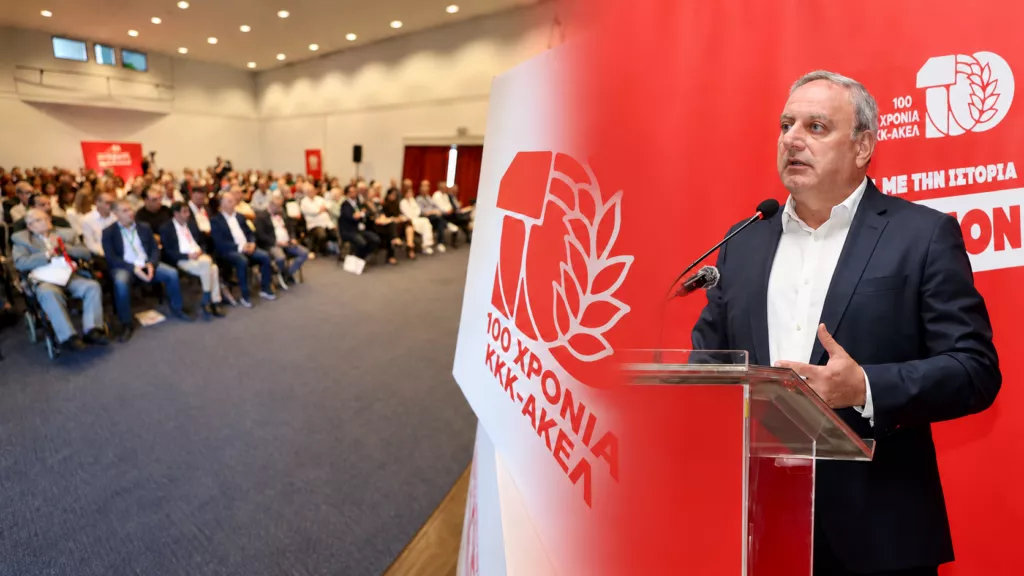
Left-wing AKEL will seek political alliances and agreement on a common programme before choosing its candidate for the 2028 presidential election, party general secretary Stefanos Stephanou said on Sunday, contrasting his party’s approach with the turmoil surrounding DISY’s nomination process.
Speaking at AKEL’s Famagusta district conference, Stephanou rejected suggestions that his party had fallen behind in preparations for the election and outlined a five-stage plan for building what he described as a progressive alliance.
His comments come amid continuing divisions within conservative DISY following party president Annita Demetriou’s decision on 8 October to withdraw from the contest for its 2028 presidential nomination.
Demetriou stepped aside after a meeting with former DISY president Averof Neophytou and George Pamboridis at party headquarters in Nicosia. She said her decision was intended to preserve party unity and denied coming under pressure.
Her withdrawal left Neophytou and Pamboridis competing for the nomination, although further candidacies remain possible. Nominations are due by 26 October, with DISY’s internal election scheduled for 28 November.
The controversy has also involved questions about discussions held before Demetriou’s withdrawal, including the presence of Alithia newspaper publisher Frixos Koulermos at party headquarters and references to an earlier dinner at a fish restaurant.
Demetriou has defended those meetings, saying she had never refused to meet party figures and that her decision to withdraw was her own.
Against this backdrop, Stephanou insisted AKEL had no intention of rushing to select a presidential candidate.
“No, we have not delayed! We still have almost a year and a half until the elections. We are proceeding according to our plans and will be ready in good time to enter the election battle,” he said.
Stephanou said the party was working to bring together political forces and organised groups that shared its belief that Cyprus needed a change of direction.
“We are working to join forces with all those parties and organised groups that share our conviction that things must and can change,” he said.
He argued that political priorities should focus on long-term planning rather than short-term responses to everyday problems.
“We must invest in the future instead of simply managing day-to-day affairs through temporary policies that lack vision and fail to take care of future generations,” he said.
Seven priorities for progressive change
Stephanou outlined seven policy priorities that AKEL intends to use as the basis for its proposed progressive alliance.
The Cyprus problem
AKEL supports a bizonal, bicommunal federation with political equality that would end the occupation and reunite Greek Cypriots and Turkish Cypriots.
The party wants negotiations to resume from where they left off, pointing to UN Secretary-General António Guterres’s assessment after the Crans-Montana talks that the two sides had come within a mile of an agreement.
With Guterres’s term due to expire at the end of the year, Stephanou said preserving the progress and understandings already achieved in negotiations was an immediate priority.
Strengthening the welfare state
AKEL wants stronger protection against inequality, poverty and financial insecurity, alongside measures to support workers’ incomes and low-income pensioners.
Its proposals include reversing labour market deregulation, strengthening employment rights and addressing the housing and energy crises.
Sustainable development
The party proposes a new economic model combining growth with environmental protection and the preservation of national resources.
It is also calling for comprehensive solutions to energy security, waste management and water supply.
Rule of law and institutional reform
AKEL wants stronger institutions, action against corruption and conflicts of interest, and an end to favouritism, which Stephanou said was undermining young people’s aspirations.
Foreign policy
The party is calling for a multidimensional foreign policy based on international law and an end to policies that, in its view, make Cyprus dependent on foreign interests or expose it to conflicts involving other countries.
The position also represents an indirect criticism of the government’s geopolitical orientation.
Foreign investment funds
AKEL opposes transferring critical infrastructure and national wealth to foreign investment funds, arguing that such arrangements undermine national security and the prospects of future generations.
The far right
Stephanou called for an end to what he described as the far right’s growing influence within centres of power, accusing the government of tolerating and encouraging it.
He also criticised parties cooperating with the far right, indicating which political forces AKEL would exclude from potential alliances.
AKEL’s five-stage roadmap to 2028
Stephanou’s remarks outlined the sequence AKEL intends to follow before entering the presidential campaign.
First stage: Internal party preparations
The party will hold district conferences and other internal consultations aimed at mobilising officials and strengthening party unity.
Second stage: Talks with potential allies
AKEL will hold discussions with political parties and organised groups that oppose government policies and support progressive change.
Third stage: Agreement on a common programme
The party will seek to identify shared policy priorities based on the seven principles outlined by Stephanou.
He stressed that political cooperation must be built on common goals rather than negotiations over political offices.
Fourth stage: Selection of a presidential candidate
Only after reaching agreement on a common programme will AKEL begin discussions about who should lead the electoral effort.
Fifth stage: The election campaign
The final stage will be the presidential contest, which Stephanou said AKEL would enter fully prepared, with determination and optimism.
The approach puts agreement on policies and potential partnerships ahead of selecting a candidate.
Stephanou stressed that political cooperation should be based on shared objectives rather than the distribution of positions of power.
Stephanou attacks DISY over fish restaurant meetings and political deals
Stephanou also took aim at the controversy surrounding DISY’s presidential nomination process, accusing figures on the centre-right of engaging in backroom negotiations over political positions.
He referred to “backroom gatherings in fish restaurants and under-the-table deals along the lines of ‘you take the presidency of parliament and give me the presidency of the Republic’.”
His remarks followed days of controversy involving Demetriou, Neophytou and Pamboridis, with attention focusing on an earlier fish restaurant dinner and the involvement of individuals outside DISY’s formal leadership structures in discussions surrounding the nomination.
Neophytou had raised questions about the dinner and an alleged commitment involving Chris Panayiotou, described as a close associate of Demetriou. The matter subsequently became part of the dispute surrounding the party’s presidential nomination process.
Questions were also raised about Koulermos’s presence during discussions at DISY headquarters on 8 October, before Demetriou announced her withdrawal.
Pamboridis subsequently criticised aspects of the negotiations and said he had tried to persuade Demetriou to remain in the contest. He had previously expressed willingness to withdraw if Neophytou also stepped aside in her favour.
Stephanou used these developments to criticise what he described as the centre-right’s approach to public office.
He said some political figures treated positions of power as a means of accommodating themselves and their political parties.
“Obviously, this is how vested and powerful interests are served, behind closed doors and through the mediation of major media owners,” he said.
His remarks appeared to refer to the controversy involving Panayiotou and Koulermos, although the allegations of political bargaining have not been independently established.
Stephanou concluded by accusing the right of conducting political deals rather than building cooperation around policies.
“That is how the right does political business,” Stephanou said.

