


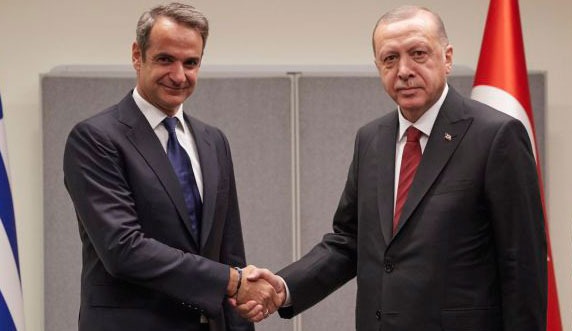
The effort from both sides to keep things civil in Greek-Turkish relations was plain to see. That’s the main takeaway from the Ankara meeting between the Greek Prime Minister and the Turkish President. And it’s being recorded as the most significant result of Mitsotakis’s much-discussed visit to the Turkish capital.
Obviously, they didn’t agree on the big issues at the meeting. Nor was that ever expected. Both Greek Prime Minister Kyriakos Mitsotakis and Turkish President Recep Tayyip Erdoğan laid out their positions, didn’t shy away from articulating the differences between the two countries—but they did so diplomatically.
The divergent approaches and objectives were clear. They gave greater emphasis, however, to the positive agenda and bilateral agreements. Agreements which, as announced, were signed within the framework of the 6th High-Level Cooperation Council in Ankara.
The Greek Prime Minister, seizing the opportunity, referred publicly—if indirectly—to the casus belli. He stated that the time has come to lift “every threat, formal and substantive, in our relations,” adding: “If not now, when?” It’s significant that this was said publicly.
We must also note the Greek Prime Minister’s reference to the Cyprus problem. An issue that was clearly discussed during his meeting with the Turkish President. He repeated Greece’s position on the UN framework in Erdoğan’s presence—at a time when, as we know, the occupation side is pushing for a two-state solution on the Cyprus issue.
The Turkish President may have avoided repeating the occupation side’s positions on the Cyprus problem. He confined himself to stating that regarding the Aegean and Eastern Mediterranean, Turkey’s positions were put forward “openly and honestly,” claiming that the issues, “whilst complex, are not unsolvable within the framework of international law, provided there is good will, constructive dialogue, and the will to resolve them.”
In terms of optics, the meeting went very well. In the sense that the diplomatic mode of expressing differences was deployed. Weight was given to the positive agenda and “good faith” was emphasised. With this tactic, they may well end up sweeping the differences under the rug. Differences that exist by choice of occupying Turkey.
A good atmosphere is an ally. As long as it’s not time-limited. As long as it lasts beyond the meeting, beyond the visit.
What matters most, first and foremost, is the day after—when we’ll see what Turkish behaviour actually looks like. If Turkish behaviour changes, that would be… a miracle.

