


There is one issue in Cyprus that has proved remarkably useful, time and again. It comes back whenever an appeal to emotion is needed and a political debate needs a charge. It is a drug that sends memory to sleep and lets everyone serve whatever political purpose suits them at the moment.
At times it can even carry part of the progressive camp and the wider Left into a strange political intoxication. It is a high that can briefly wipe out everything else at the prospect of a shared vision: meadows in bloom, with Greek Cypriots and Turkish Cypriots skipping carefree towards their common promised land.
Emily Yiolitis’s podcast appearance is a good occasion to examine the phenomenon. Among other things, she said she disagrees with the use of the Greek national anthem in Cyprus and would vote for a Turkish Cypriot as president. Averof Neofytou’s candidacy, built around the Cyprus problem, is another. Fidias is a similar case. For a while he served as a symbol of rapprochement, whether through a podcast with the Turkish Cypriot Urban Cypriot or the moment he sat down opposite Ersin Tatar.
“Why don’t we find the solution ourselves? […] I think we need to come to an understanding with the Turkish Cypriots and unite as a people so that we can demand self-determination,” Yiolitis says. The YouTuber MEP asks her: “Do you think Turkey will let us?” “Why, have we tried?” she replies. These remarks, of course, flatly contradict what she said earlier in the same podcast. There she said Nikos Christodoulides did a very good job as foreign minister, “but of course, you can’t really do anything, because everything depends on Turkey”. She also said Konstantinos Kombos is highly capable and one of the government’s best ministers, “but there are few things we can do, because it doesn’t depend only on us”.
The interesting part, though, lies elsewhere. Why did the former Justice and Public Order Minister not voice these views when she served the Republic of Cyprus in that key post, from June 2020 to June 2021? That year had no shortage of notable events. It was also marked by one incident that concerned her directly and touched on the very bicommunalism she now defends so vigorously.
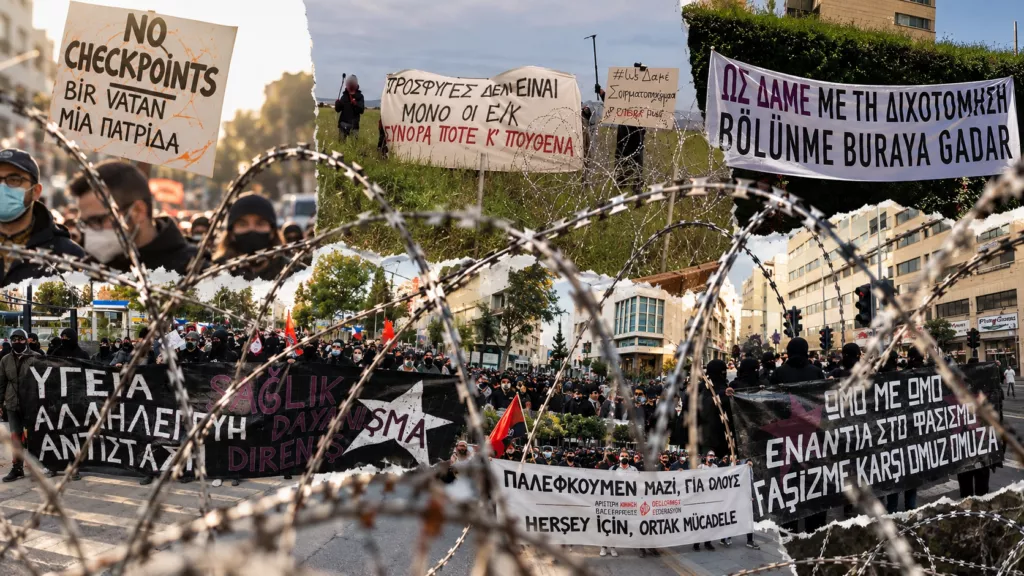
It was the violent crackdown on the “Os Dame” protest. Police used batons, chemicals and the “Ajax” water cannon, and protesters were injured. The protest was made up of eight groups, bicommunal ones among them. Greek Cypriots and Turkish Cypriots marched together. The mobilisation centred on corruption, authoritarianism, state repression and partition. The slogans were in Greek and Turkish.
Among them was “Kıbrıs’ta barış engellenemez!” (“Peace in Cyprus cannot be stopped”). It was a movement met with a torrent of “patriotic grandstanding”. That is the same grandstanding the former minister now objects to when it is used to criticise her remarks.
Which is where Averof Neofytou comes in. His announcement for the 2028 presidential election starts, in essence, with the Cyprus problem. It speaks of “a closed window of hope”, “deadlock”, “national awakening”, “patriotic vigilance”, “reunification of the homeland”, “an end to the occupation” and, finally, a “sacred struggle”. Yet four years ago, when he was also running for president, Neofytou offered a different version of this same “national vigilance”. At an event in Emba on migration, he roared at the crowd, demanding “a fence along the entire length of the buffer zone”.
Is that the picture Averof Neofytou has in mind for our reunified homeland when he joins the AKEL leadership at the same rally, with a shared demand for talks to resume? A fence cutting the island in two from one end to the other? It is telling in its own way that Giorgos Loukaides had to be asked publicly whether AKEL could back Averof Neofytou in the 2028 presidential election.
The answer was categorical: “Of course I rule it out.” And yet the question was asked. That is because the Cyprus problem has a strange power: it turns a position on a settlement into a passport to political kinship.
A politician is not just their latest statement. They are also the decisions they took when they held power. Yiolitis’s current positions cannot be discussed as if her political life began the day she sat down opposite Fidias. They include the people she walked alongside. They include the policies she defended and still defends. She said it is “a little unfair that everything gets torn down and we talk about a man [Nicos Anastasiades] accused of corruption, while the great political legacy he left is not recognised”.
Nor is Averof Neofytou just his current candidacy, with its talk of reunification and a “sacred struggle”. In the same way, Fidias is not only the YouTuber who meets Turkish Cypriots in a spirit of rapprochement. He is a whole set of political positions, choices and public interventions that anyone with basic political intelligence can judge as a whole.
The Cyprus problem may stir different memories, wounds or hopes in each of us. But it is not a political laundry for any public figure, ready whenever a convenient moment offers the chance to wash away whatever they would like us to forget.

