


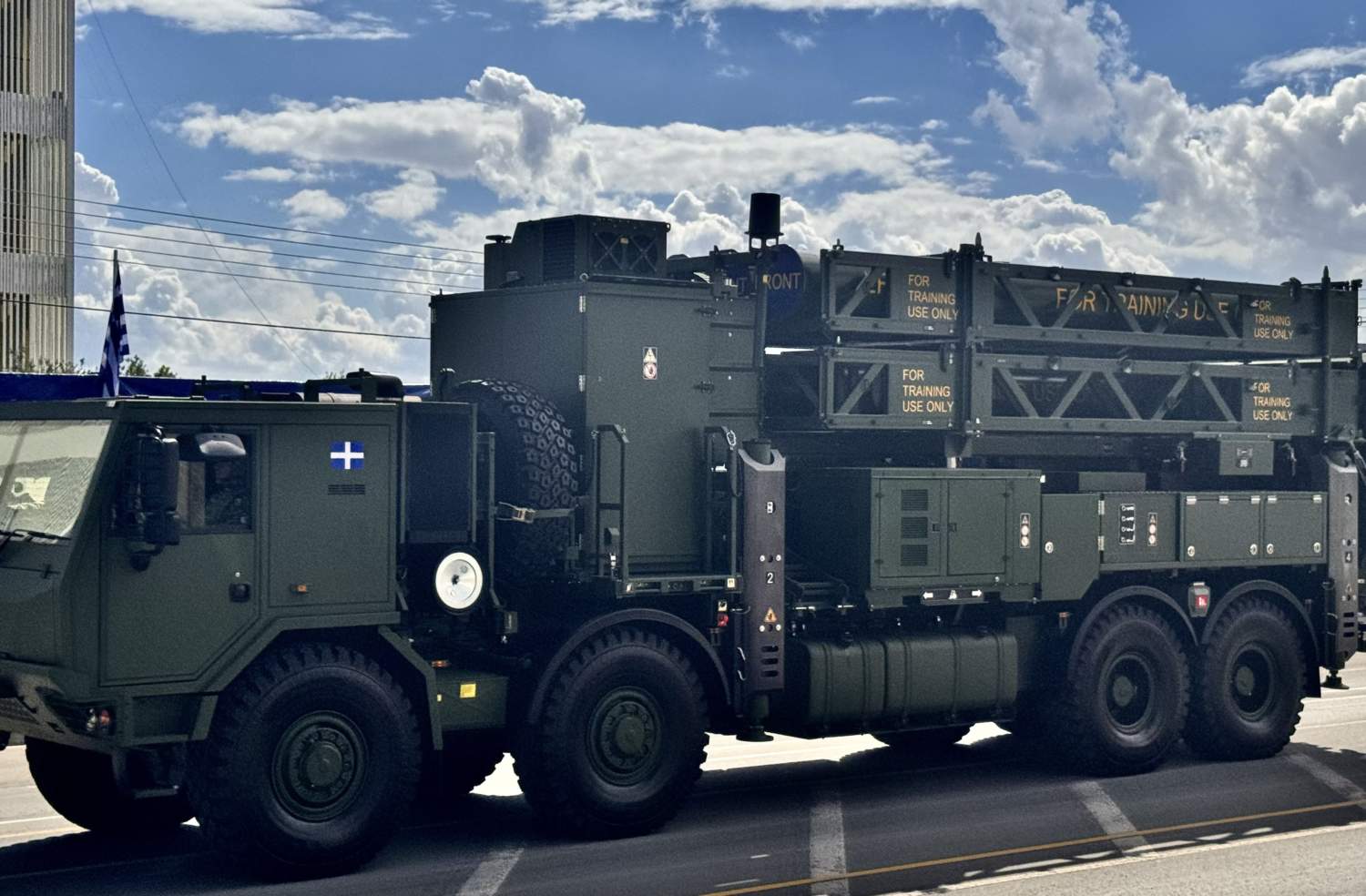
The significance of Thursday’s military parade in Nicosia for the Independence Day of the Republic of Cyprus was not merely that the island, an EU member state, displayed Israeli weapons.
It was that it chose to show them off – and how it was done.
On Thursday, the Republic of Cyprus publicly paraded part of its BARAK MX air-defense system, manufactured by Israel Aerospace Industries and already integrated into the Cypriot National Guard.
Alongside it were other Israeli-made systems already familiar in Cypriot service, including Rafael’s SPIKE LR2 anti-tank missiles and IWI Tavor X95 assault rifles carried by Cypriot commandos — weapons whose presence in the National Guard has long been public knowledge.
Around them, a broader display of military modernization unfolded: new Exocet coastal-defence missiles, drones and unmanned systems, while Greek F-16s crossed the sky above Nicosia. Military contingents from the United States, France, Britain and Egypt also took part.
That combination matters.
Defence procurement is usually technical, discreet, and deliberately unromantic. A national day parade is the opposite. It is political theater by definition: a state chooses what to present to its citizens, its partners, and, most of all, its adversaries. Cyprus chose to deploy an Israeli system there, making it, communications-wise, the parade’s highlight.
At a time when most of the international conversation about Israel centers on diplomatic friction, sanctions, and political controversy, and while Turkey keeps threatening the island precisely because of its alliance with Israel, Nicosia chose not to hide one of the most important new components of its air-defence architecture.
The opposite, rather. It presented it as a crucial element of the Republic’s growing deterrent capability, alongside the rest of its Israel-made arsenal.
President Nikos Christodoulides said after the parade that Cyprus’s deterrent power was being strengthened continuously and that the presence of foreign military contingents reflected both the country’s partnerships and its upgraded international standing.
Greek Defence Minister Nikos Dendias, meanwhile, said that freedom, sovereignty and security require deterrent power, adding that Greece “is and will remain close.”
In Nicosia, Israel appeared not as an awkward or isolated supplier, but as a vital part of a wider security network involving Greece, the United States, and other nations.
Israel, Greece and Cyprus signed expanded military-cooperation plans for 2026, while Israel and Greece have since concluded the roughly €3 billion Achilles Shield agreement for a multilayered air-defence architecture built around Israeli systems, including BARAK MX.
Weapons sales do not automatically create alliances. But they do create training, maintenance, interoperability and long-term strategic habits.
And that has been in the making for a long time.
Oren Anolik, Israel’s outgoing ambassador to Cyprus, spent five years on the island working hard to reinforce this relationship under extremely challenging conditions.
He must have felt deeply satisfied watching this parade.
In short, the actual story wasn’t about an Israeli missile system moving through a Cypriot street; that was just the media’s selling point.
It was that Cyprus was comfortable making it part of the picture it wanted the region to see — proof that, even under today’s political pressures, Israel still has considerable room to deepen, expand, and visibly project strategic partnerships of this kind.

