


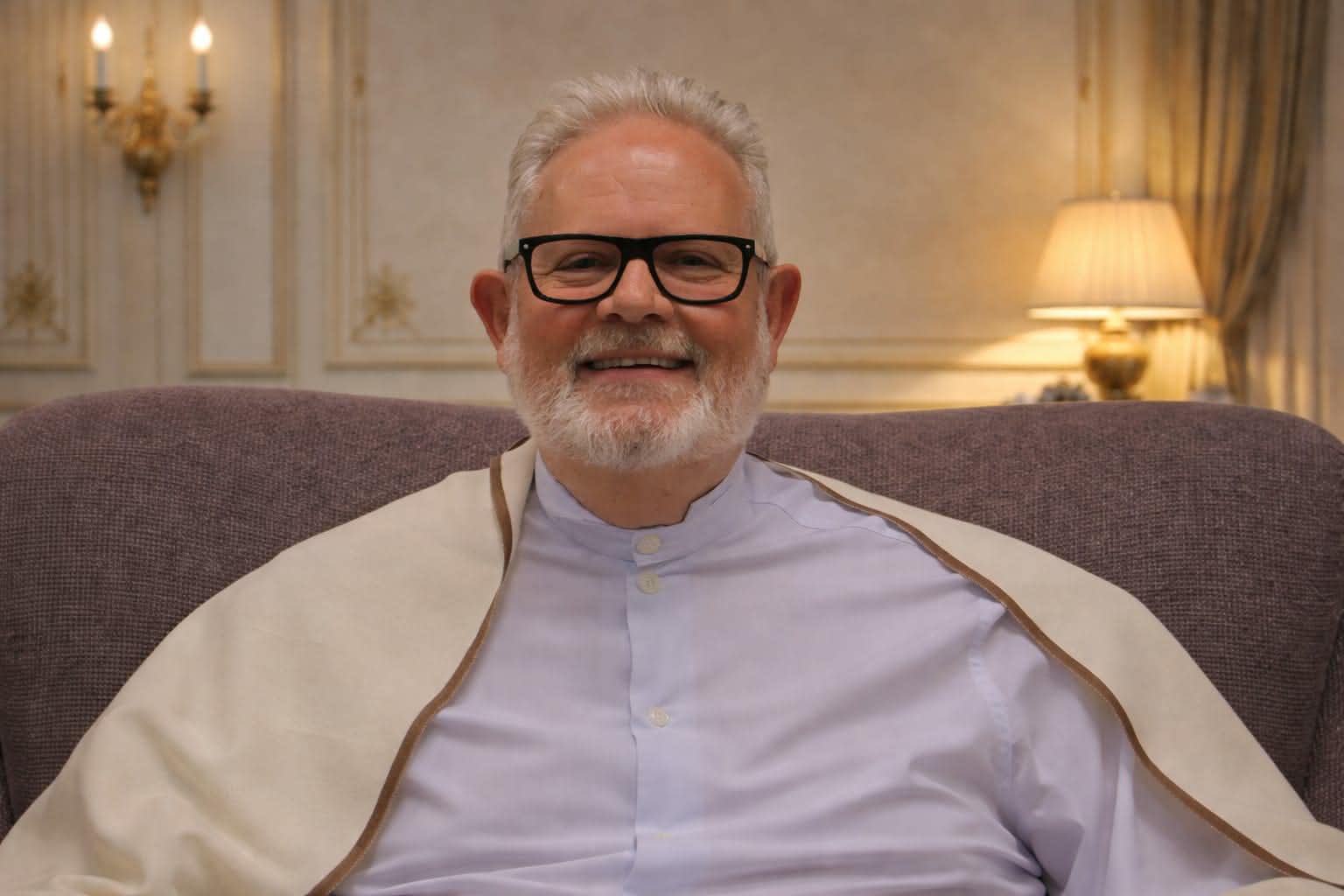
By Guru Rajesh Ananda
Edited and adapted by Constandinos Tsindas
Editor’s Forward
‘If humanity embraced meditation on a global scale, we could change the world very quickly’. Guru Rajesh Ananda
When the guru’s article, more of a psyche epiphany really, landed in my email on the back of yet another exhausting day of covering the Iran war latest, it suddenly dawned on me how our brain has been geared towards destruction over the past decade of conflict, damaging the core of our being, as we now watch civilians across the Middle East, bear the brunt of the fear, infrastructure and home demolition, death and injury, whatever the logic or the truth of all this may be in geopolitical, military or human rights terms. The unfolding humanitarian and financial crisis is clear for all to see. And even if it ends soon, the reverberations will cause massive tremors in the years to come.
Guru Rajesh Ananda, a master of meditation heading the international FISU organisation for decades, brings forth a critical question. If we fail to find the psychological calmness within us, setting aside all other political considerations, approaches or goals, then conflict will always be around the corner. And given who our leaders are today, that is a terrifying thought. Unlike many, the Guru offers simple, meditation and self-realisation solutions, opened up by the brain itself. They might go a long way towards healing and rebuilding, as we fight with our worst selves.
As he says, war does not begin on the battlefields, it begins in perception’.
The War Within Us
As the world watches the unfolding tensions and violence surrounding Iran, many are asking a deeper question: how do we find peace—not just politically, but humanly? Why do we continue to see one another as continued threat rather thanreflections of the same life?
From my perspective as a meditation teacher of over four decades, the answer lies not only in geopolitics but in the structure of the human mind itself.
Modern neuroscience has shown us that the brain operates through two distinct hemispheres, each with different functions. The left hemisphere is analytical, logical, and focused on survival. It categorises, separates, and defines boundaries. This is essential for functioning in social terms—but it also has a shadow. When over-dominant, it creates a sense of “self versus other,” feeding the ego and reinforcing division.
The right hemisphere, by contrast, is holistic, intuitive, and relational. It perceives connection rather than separation. It is the seat of empathy, compassion, creativity, and what we may call higher awareness. Where the left brain says, “I must protect myself,” the right brain whispers, “we are not separate.”
In times of conflict, it is the left-brain mode of thinking—rooted in fear, identity, and self-preservation—that becomes amplified. Nations begin to act like individuals under threat. Differences become exaggerated. The “other” becomes dangerous. And from this perception, war becomes not only possible, but justified.
But what if the wider issue is not just political or cultural—but neurological and spiritual?
I speak here not theoretically, but from direct experience. Through meditation, I have witnessed a profound shift in consciousness—a quiet awakening of the right hemisphere. As this awakening deepens, something extraordinary happens: the boundaries of the self begin to soften. One no longer lives purely for oneself, but begins to feel, naturally and effortlessly, for others.
This is not ideal. It is a measurable transformation.
Research in neuroscience has shown that meditation increases activity in brain regions associated with empathy, emotional regulation, and compassion—such as the prefrontal cortex and right-hemisphere regions. Simultaneously, there is a calming of the amygdala, the centre of fear and threat detection. In simple terms, meditation reduces reactivity and enhances understanding.
This is precisely what the great masters have taught for millennia. The Buddha spoke again and again of compassion arising from awareness—not as a moral command, but as a natural consequence of seeing clearly. When the illusion of separateness dissolves, love is no longer something we try to practise—it is something we cannot help but express.
I know what I am about to say may sound bold, even unrealistic: if humanity embraced meditation on a global scale, we could change the world very quickly.
Why? Because war does not begin on battlefields. It begins in perception. It begins in the subtle belief that “I am separate from you,” that your existence threatens mine. Change that perception, and you change the foundation upon which conflict is built.
Through my own practice and through guiding thousands of individuals, I have seen that when the right hemisphere awakens, people naturally become more giving, more compassionate, and more aware of the consequences of their actions. They begin to share more, judge less, and act with a sense of unity rather than division.
This is not imposed. It arises spontaneously.
Many seek this connection through prayer, and prayer is beautiful. It opens the heart and establishes a relationship with the divine. But as I often say: in prayer, you speak to God; in meditation, God speaks to you. It is the same communication—just flowing in a different direction.
And what of those who do not pray? Those who do not follow a religious path?
Meditation remains accessible to all, and our FISU Meditation system is non-religious. It requires no belief system, no doctrine, no identity. It is a direct experience of stillness, and from that stillness, a deeper intelligence begins to guide us. Whether one calls it consciousness, awareness, or simply clarity, the result is the same: a shift from self-centred thinking to a more inclusive, compassionate way of being.
Let us be realistic. Meditation will not stop the current war overnight. The forces at play are complex and deeply entrenched. But if we are serious about the future of humanity—about reducing conflict, division, and suffering—then we must address the root cause.
And the root cause lies within us.
If we continue to operate primarily from the left hemisphere—driven by fear, identity, and separation—conflict will persist, regardless of treaties or negotiations.
But if we begin to awaken the right hemisphere—through meditation, through awareness, through inner work—we lay the foundation for a different kind of world.
A world where we do not merely tolerate one another, but recognise ourselves in one another.
Peace, ultimately, is not something we impose externally. It is something we realise internally—and from there, it radiates outward into every action, every relationship, and every society.
The war we see is a reflection of the war within. And that is where it must be resolved.
And if we might dare to add, ‘honestly resolved’. With no let up.
English: www.fisumeditation.org
Greek: https://dialogismos-fisu.org/
Author Site: www.rajeshananda.guru

