


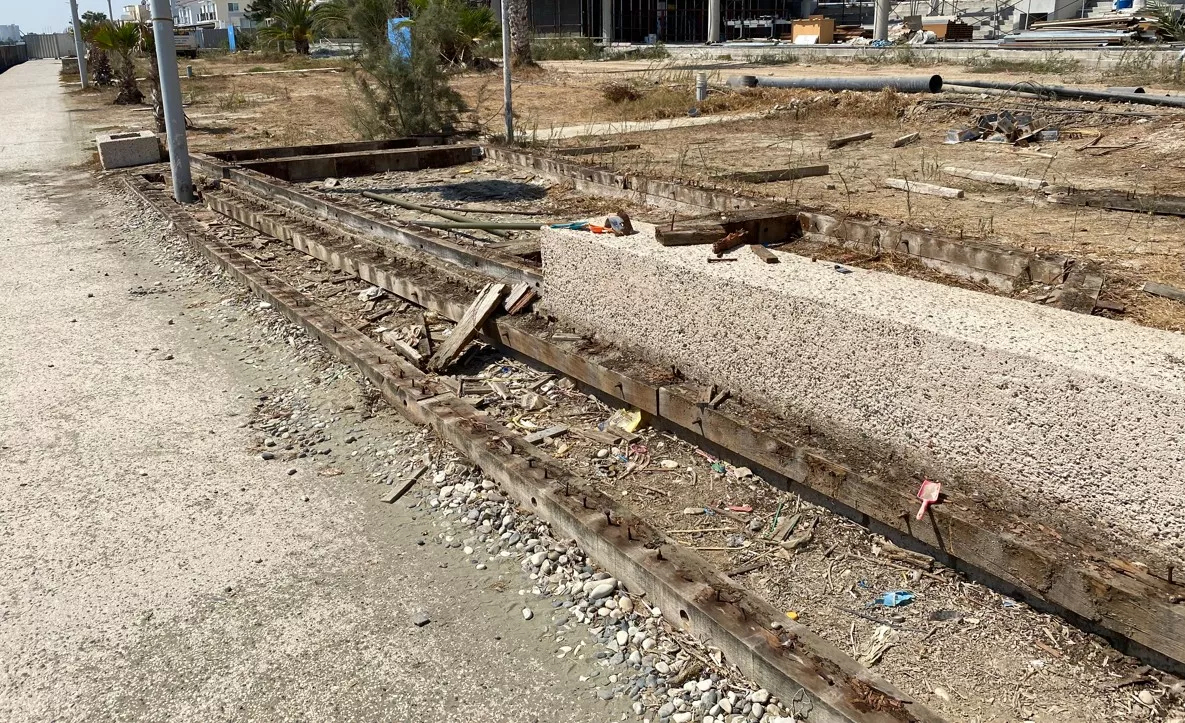
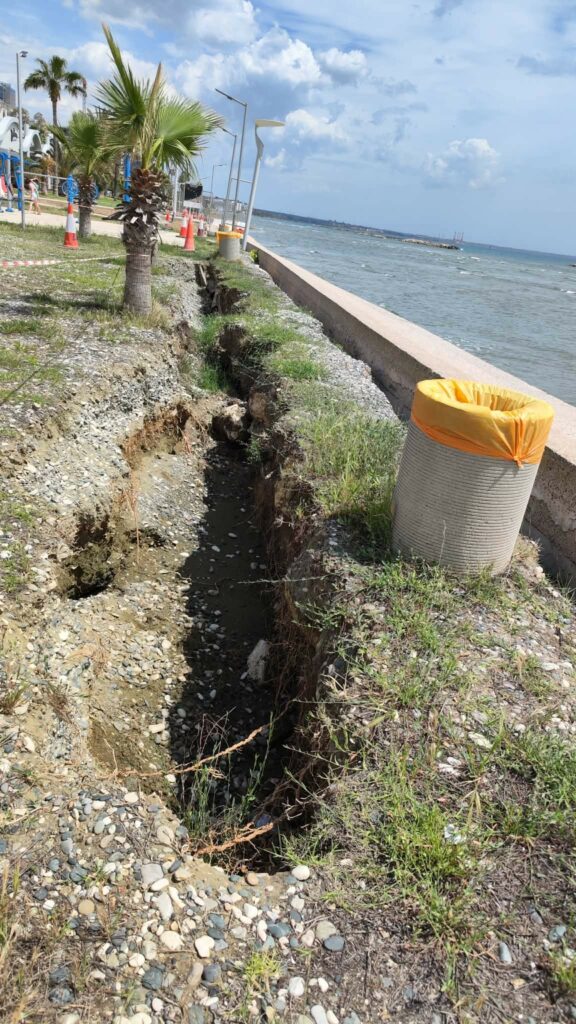
Part of the Oroklini coastal promenade has been closed due to the risk of collapse, as erosion spreads to nearby hotel grounds and the structure’s architects go public with allegations of unauthorised encroachments, a lack of maintenance, and uncontrolled vehicle access causing subsidence.
The section near the outdoor gym has been shut after erosion rendered it structurally unsafe. The damage has reached hotel grounds in the area, with sinkholes appearing in the lawn of at least one property.
According to experts, the erosion may be linked to the removal of a perpendicular breakwater and the subsequent construction of parallel ones, which caused the beach to disappear and the promenade to erode.
At the point most affected today, there was once a sandy beach roughly 25 metres wide. The promenade was built in the early 2000s and later extended towards the Lebay Hotel; a planned third phase reaching the former refinery area near the Marcellou building remains on hold.
The promenade is the work of architects Margarita Danou and Sevina Floridou. It represented Cyprus in the European Mies van der Rohe competition in 2003, won the State Architecture Award in 2004, and has been published in international architecture titles including the Phaidon Atlas of Contemporary World Architecture.
Speaking to Phileleftheros, Danou rejected claims that the promenade itself is responsible for the erosion. She said the structure was designed in accordance with the principles governing sensitive coastal environments, ensuring compatibility with the natural dynamics of a changing coastline.
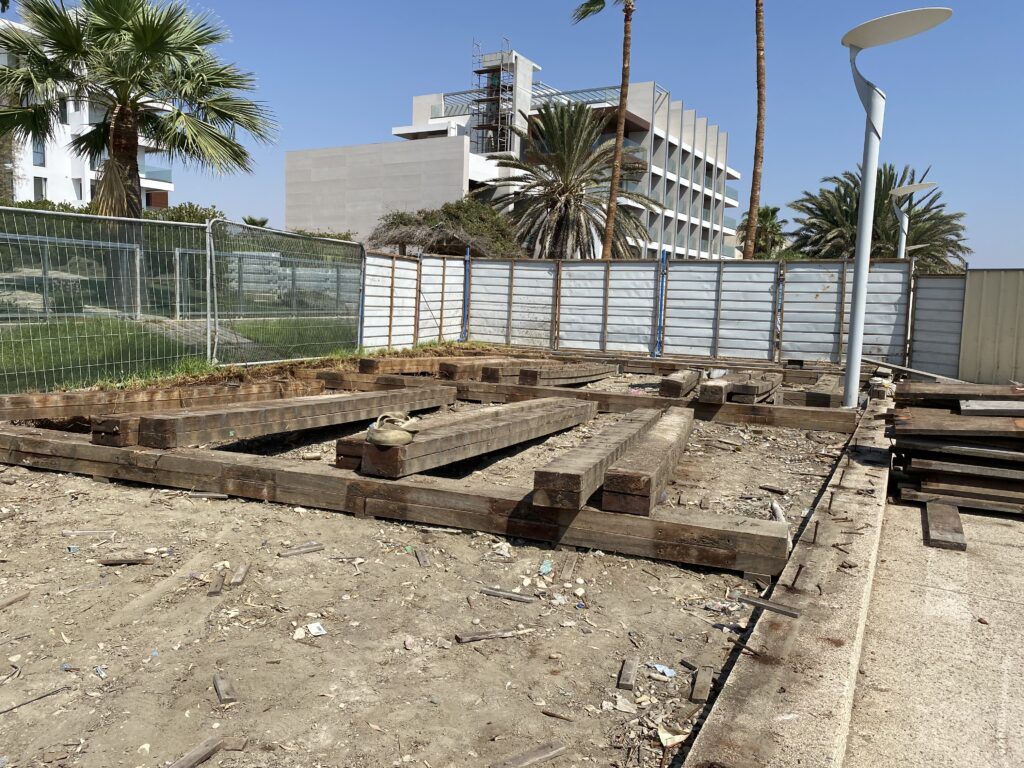
“The hidden construction infrastructure beneath the promenade allows the unobstructed movement of both seawater and rainwater from inland. At sensitive points such as the edges, perforated wooden pier-type structures extend outward,” she said, adding that the project was built after receiving approval “from all competent state authorities, including the Marine Works Branch of the Department of Public Works, as well as private coastal engineering experts.”
‘The state must intervene’
Danou pointed to a pattern of encroachment and neglect as contributing factors. Over time, she said, private coastal properties adjoining the promenade have expanded unauthorised into the beach zone.
“Although the original design aimed to create a public recreational walkway that would simultaneously serve as a clear boundary between private development and public coastal space, that balance has today been undermined,” she said, citing the absence of systematic maintenance and oversight as having “led to the gradual deterioration of a public work of high architectural value.”
She gave the promenade’s kiosk area as an example of what she described as wholesale alteration bearing no resemblance to the original design. “Wooden structures have been cemented over to avoid the need for wood maintenance. The canopies that provided shade and amenities have been removed with no thought given to replacing them. The wooden platforms, which are critical both for use and for protecting the structure from coastal erosion, were dismantled to serve private interests, with sun loungers and umbrellas put in their place. The dominance of private exploitation over public design is a clear departure from the fundamental social purpose of this work,” she said.
Danou also flagged what she described as uncontrolled vehicle movement along the promenade to serve private construction sites, causing subsidence and structural damage.
“This is not an incidental problem but a sign of the absence of oversight and respect for public space. The result is the gradual degradation of an award-winning work that once served as a model of coastal design with international recognition,” she said.
She called on the state to act. “At a time when public spaces are becoming increasingly important for citizens’ quality of life and environmental balance, the need to protect and meaningfully upgrade them is urgent. The state must intervene immediately, not only to repair the existing damage but also to ensure respect for the public character, the architectural quality, and the sustainability of the work,” Danou said.
Larnaca municipality awaits guidance
Larnaca Municipality will carry out the remedial works, but Mayor Andreas Vyras said the municipality is waiting for instructions from the relevant state departments. Vyras directed pointed criticism at the Department of Public Works.
“We had an arrangement with the Deputy Director of Public Works, Stelios Zervos, that he would send an officer and confirm some guidance on how the problem would be resolved, as well as on funding for the repairs. Since then, I have tried to reach him many times and have not managed to do so,” he said.
The promenade came under the municipality’s remit following Larnaca’s merger with Oroklini. “Our engineers have not previously dealt with erosion works, and whatever corrective works were carried out in the past by the Oroklini Community Council were unable to stop the sea. If we do not have clear guidance from the relevant department, which also carried out the studies for the breakwaters, I do not know what we can achieve,” Vyras said.
He added that the municipality is coordinating with the Larnaca District Local Government Organisation on legal action against hotel owners who failed to carry out compensatory works on the promenade, despite this being a condition of their permits.
The Department of Public Works had previously proposed three solutions to the municipality. In a report published by Phileleftheros in April, Zervos said that as the erosion had worsened, a new site assessment had been carried out. “We will come back to the municipality with recommendations on what can be done,” he said, adding that all works carried out in the area had been preceded by studies.

