


Military systems already deployed in Cyprus, along with additional assets expected to arrive in the coming days, will remain in and around the island for as long as deemed necessary, depending on developments in Iran and the wider Middle East.
Although Tuesday was relatively calm in Cyprus compared with the limited tension seen on Monday during the incident near the British base at Akrotiri, authorities say efforts to strengthen the island’s protective shield against potential threats from Iran continue.
Following Greece’s immediate response, three additional European countries announced the dispatch of military assets aimed at strengthening Cyprus’s security.
Nicosia views the most significant development of the past day as the tangible support from European partners and institutions, particularly from countries that moved quickly to send military systems capable of offering protection to Cyprus in the event of any hostile action originating either directly from Iran or from Lebanon through Hezbollah.
Government spokesman Constantinos Letymbiotis said the assistance provided by partner countries would remain in Cyprus for as long as necessary and that the situation would continue to be monitored in close consultation with the countries involved.
Military assets deployed by partner countries
Greece:
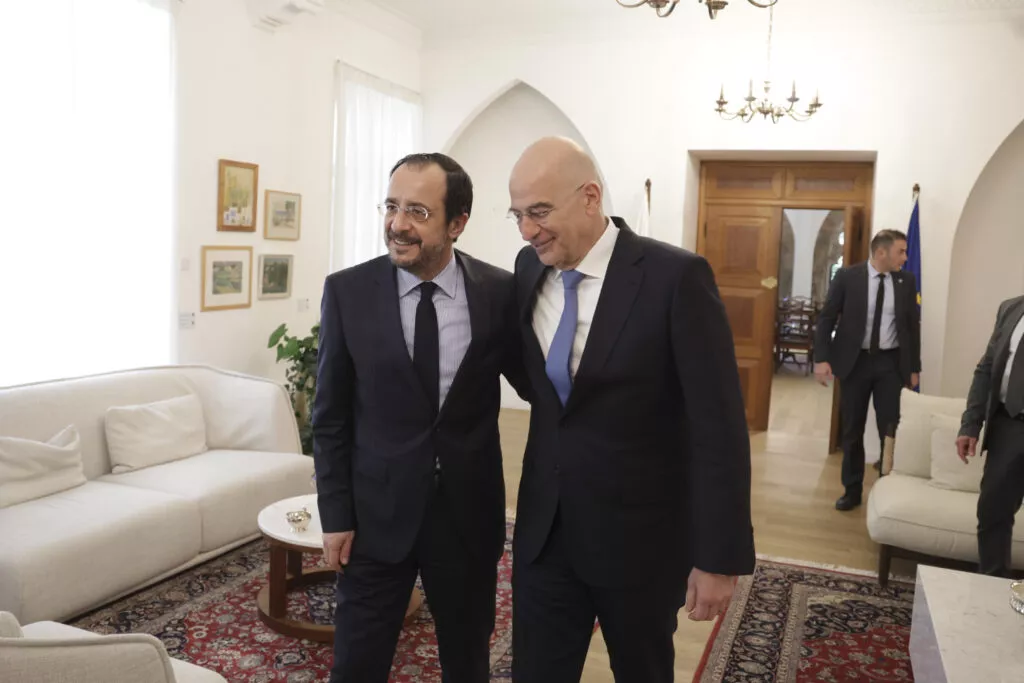
Greece responded immediately following a telephone conversation between President Nikos Christodoulides and Prime Minister Kyriakos Mitsotakis. Two pairs of F-16 Fighting Falcon fighter jets landed at Paphos airport late on Monday afternoon, while two frigates of the Hellenic Navy — HS Kimon and HS Psara — arrived near the island late on Tuesday night. Greece’s defence minister, Nikos Dendias, visited Cyprus on Wednesday.
France:
President Emmanuel Macron responded to a call from Christodoulides requesting support to reinforce Cyprus’s air defences after what were described as provocative actions by Iran. France said additional air defence capabilities would be provided and that the frigate FS Languedoc would sail toward Cyprus. Macron also said France would work with European partners, starting with Greece, to strengthen security in the eastern Mediterranean. The aircraft carrier Charles de Gaulle is also expected to operate in the wider region.
United Kingdom:
Prime Minister Keir Starmer informed Christodoulides during a second telephone conversation that Britain intends to deploy helicopters capable of countering drones in the region. The destroyer HMS Dragon is also expected to be deployed off Cyprus.
Germany:
Military chiefs from Cyprus and Germany have already held discussions on possible support from Berlin. A telephone conversation between the two countries’ defence ministers was expected to finalise arrangements for German assistance, which is believed to include the deployment of a German naval vessel.
Italy:
Rome is currently supporting Cyprus diplomatically but has indicated its intention to consider sending military equipment to assist the island.
Clarifications following contacts with London
After tensions and misunderstandings earlier in the week regarding statements and actions by British officials, contacts between the two sides appeared to clarify the situation.
Telephone calls took place between the president of Cyprus and the British prime minister, as well as between the two countries’ foreign ministers.
Letymbiotis said Christodoulides also spoke on Tuesday with Ursula von der Leyen, Austrian Chancellor Christian Stocker and Macron.
Foreign Minister Constantinos Kombos has also held a series of diplomatic contacts in recent days, including with EU foreign policy chief Kaja Kallas and the foreign ministers of India, the United Arab Emirates, Serbia, the United Kingdom, Greece and France.
Countries consider evacuation operations via Cyprus
Nicosia also considers it significant that several countries have sounded out Cyprus about the possibility of transferring their nationals to the island if evacuations from Middle Eastern countries become necessary.
Among the countries mentioned are China, Japan, the United States and Romania, though officials say other countries have also made inquiries.
According to diplomatic sources, the willingness of countries to use Cyprus as a transit point for evacuations reflects confidence in the island’s safety and in the cooperation mechanisms available there.
Officials note that countries evacuating their citizens typically move them temporarily to locations where they believe they face no security risk before arranging their repatriation.

