


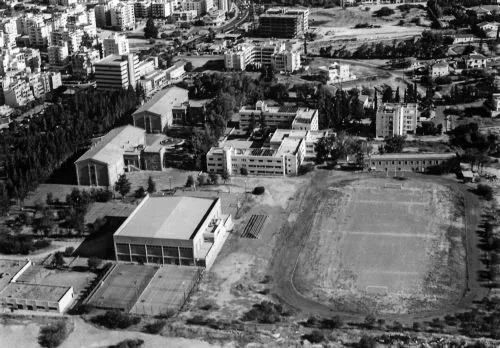
A commemorative album on the Melkonian Educational Institute has brought renewed attention to one of the most important institutions in the history of Cyprus’s Armenian community, preserving the story of a school created for children uprooted by the Armenian Genocide.
Published by the Press and Information Office, the album traces the history of the institute from its foundation in the 1920s through to its closure in 2005, documenting its educational work, buildings, library, teachers, graduates and wider cultural role.
Speaking at a recent presentation at the Presidential Palace, Press and Information Office director Aliki Stylianou said the Melkonian was more than a school.
It was, she said, a place where the trauma of displacement was transformed into education, security and a new beginning for children who had survived upheaval and loss.
The institute was founded by brothers Krikor and Karapet Melkonian at a time when thousands of Armenian Genocide survivors were seeking safety and the chance to rebuild their lives.
Stylianou said Cyprus was not chosen by chance. Its long history as a meeting place for communities and cultures made it a place of refuge and hope for hundreds of orphaned children.
Within a few decades, the Melkonian developed into one of the most important centres of Armenian education and culture in the diaspora.
“The Melkonian was an integral part of the modern history of Cyprus,” Stylianou said.
“Thousands of young people from dozens of countries passed through its classrooms, lived in Cyprus and left carrying with them not only knowledge, but also a deep relationship with our Cyprus.
“This is perhaps the Melkonian’s most enduring legacy: that it created people who became ambassadors for the values of education, solidarity and peaceful coexistence.”
A memorial to survival
Stylianou also highlighted the symbolic importance of the institute’s Memorial Grove.
“Every corner tells a story of generosity and humanity,” she said.
“The Memorial Grove has a particular symbolism, where the cypress trees were planted by the first orphans of the Genocide in memory of the families they lost.
“To this day it remains a unique memorial of remembrance and survival, not only for the Armenian people, but for every people who has experienced the pain of displacement.”
Following the closure of the institute, the Republic of Cyprus moved to protect the historic site, ensuring that most of it would remain listed because of its historical, architectural and social importance.
Stylianou said this formally recognised the Melkonian as an integral part of Cyprus’s cultural heritage.
She described the commemorative album as a “treasure of memories” that reconstructs the life of the institution through photographs, testimonies, documents and historical material.
“It is not simply a record of events,” she said. “It is a narrative of human stories; stories of loss, but also of hope, hardship and creation.”
Stylianou said the photographs freeze time while also bringing it back to life, allowing readers to see faces, moments and places that might otherwise disappear from collective memory.
Shared memories of war and displacement
For Cyprus, Stylianou said, the messages carried by the Melkonian have particular resonance because of the island’s own experience of war, displacement, refugeehood and loss.
She referred to the Turkish bombing of the institute in 1974 as a painful reminder that communities in Cyprus share wounds that have helped shape mutual respect and the longstanding presence of the Armenian community on the island.
She described that community as an integral part of Cypriot society that has contributed substantially to the country’s development and cultural life.
The institute’s history
The album’s 35 chapters cover the institute’s development from its establishment to its final closure in 2005.
They recount its links with the Armenian Genocide, its educational programmes, graduates, teaching staff, buildings and library, as well as the daily life of an institution that became known both in Cyprus and abroad.
The foundation ceremony took place on Friday, 15 February 1924, in the presence of High Commissioner Sir Malcolm Stevenson.
The foundation document was signed by benefactor Karapet Melkonian, Stevenson, Metropolitan Saradjian, Moushegh Seropian and Garo Balian.
According to the album, Krikor Melkonian first conceived the idea of establishing a school to educate Armenian children and support survivors of the Armenian Genocide committed by the Ottoman Empire.
On 2 June 1921, Karapet Melkonian announced his decision to establish schools for girls and boys in his own name and that of his brother.
A plot of land on the road from Nicosia to Limassol was purchased on 8 February 1924.
The buildings were designed by architect Garo Balian and constructed by contractor Leon Rollin.
The boys’ school opened on 3 February 1926 under the general direction of former Armenian Patriarch of Constantinople Archbishop Zaven Der Yeghiayan and the supervision of Levon Tadjian. The girls’ school opened several months later.
‘From the obscurity of oblivion’
Writing on behalf of the Melkonian Educational Institute Commemorative Album Committee, Vartan Tashjian said the publication was intended to bring the institute “back from the obscurity of oblivion” and pay tribute to the Melkonian brothers and the institute’s teachers.
“Sharing the widespread pain caused by the closure of the Melkonian Educational Institute, we hope that a bright day will dawn when its doors reopen, its rusted bell and the school hymn ‘Anmah Luso – Immortal Light’ will continue to be heard forever,” he wrote.
Vartkes Mahdessian, the Armenian community’s representative in the House of Representatives, also said in a message included in the album that the institute had played an important role in relations between Cyprus and Armenia.
“The Melkonian Educational Institute played a valuable role as a centre of interaction between Cyprus and the Republic of Armenia, thereby strengthening the strong relationship between the two countries,” he wrote.
Mahdessian noted that the two school buildings, the headmaster’s residence and the grove in front of the school are protected by the Republic of Cyprus as part of the island’s national heritage.
He said the trees in the grove had been planted by the first orphaned students in memory of their parents and families, and that the site remains a powerful reminder to younger generations of the tragedies of the Armenian Genocide.

