


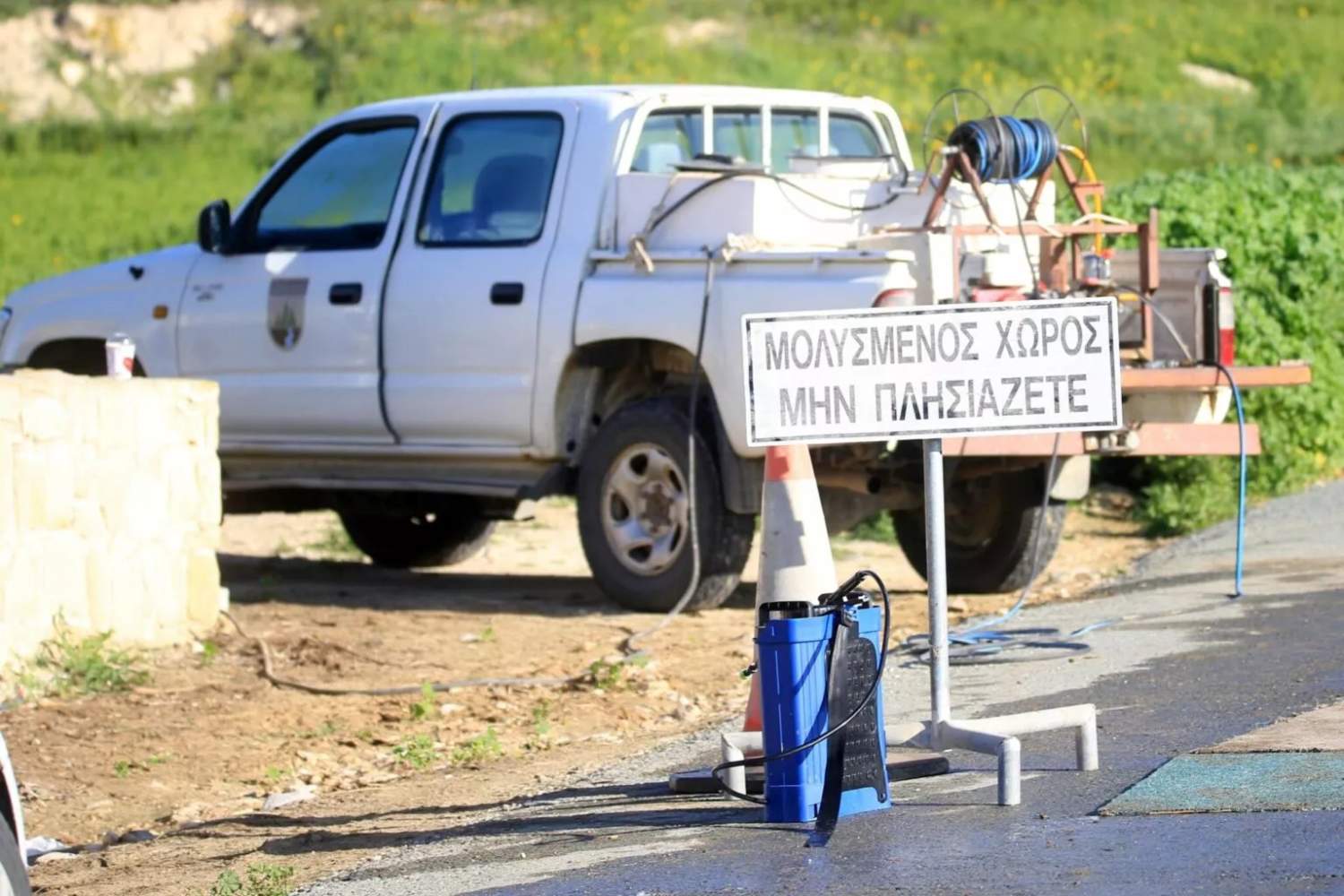
European Commission experts have recommended that two sheep and goat farms in Avgorou and Pentakomo be officially declared foot-and-mouth disease outbreaks, leaving the final decision to the director of the Veterinary Services.
Director Christodoulos Pipis is expected to decide within days, possibly as early as Tuesday, based on the opinions of the relevant EU body. His decision will cover three holdings that the authority has classed as suspect, in Pentakomo, Alethriko and Avgorou. It will also decide whether positive cases in traditional breeds of sheep and cattle can be spared from culling. The EU’s Standing Committee on Plants, Animals, Food and Feed (PAFF) met on September 17 and 18.
The Veterinary Services had initially held off declaring an outbreak and sought the opinion of the European team instead.
The outbreak has so far affected 121 farms, and 80,133 animals have been culled. The most recent case was recorded in Mammari on June 9.
Test results
The recommendation comes in a report by the Commission’s EU Veterinary Emergency Team (EUVET), dated August 10 to 13, which says the two farms should be managed under EU legislation. The first suspicious findings at both farms were recorded in mid-July and were followed by a series of laboratory tests.
At Avgorou, 33 of the 50 animals tested on July 16 using the ELISA NSP method were seropositive, or 66 per cent. A repeat test on July 21 found 129 of 263 samples positive, or 49 per cent.
At Pentakomo, the first sampling on July 16 also found 33 of 50 animals seropositive, or 66 per cent. Retesting on July 22 and 23 found 74 per cent positive.
Molecular tests (rt RT-PCR) on swabs taken on July 18, 21, 22 and 23 were negative, and there were no obvious clinical signs or direct epidemiological link. But the Commission said the seropositive results confirmed that the herds had been exposed to the virus or were going through an infection. EUVET noted that in sheep and goats the disease can spread without obvious clinical signs, and that the absence of an epidemiological link does not rule out contact with the virus or its introduction.
Wider picture
Elsewhere, the situation is showing signs of stabilising, allowing a gradual easing of restrictions. A sixth decree, issued on September 7, allows free grazing outside the affected zones. It also lets animals be moved to restock farms under strict veterinary supervision.
The infected farms comprise 104 sheep and goat farms, 14 cattle farms and three pig farms in western Nicosia. Of the sheep and goat farms, 73 are in Larnaca, one of which was illegal, 30 are in Nicosia and one is in Limassol. Of the 14 cattle farms, nine are in Larnaca and five are in Nicosia, and one of them was illegal.
Of the infected farms, 31 are very small, with fewer than 50 animals, and four are livestock trading units, one of them for fattening. The infected animals account for 11.5 per cent of all adult sheep and goats, on 4.5 per cent of farms. They also account for 3.5 per cent of cattle, on 3.5 per cent of farms, and about 7.8 per cent of pigs, on 5.4 per cent of farms.
The culled animals comprise 52,632 sheep and goats, 3,018 cattle and 24,483 pigs. So far, 438 animals have been spared from culling. These are 405 fattening cattle on one farm in Dromolaxia and 33 native-breed cattle on another farm, also in Dromolaxia.
Surveillance and compensation
Countrywide epidemiological surveillance, which began on June 18, is continuing and is expected to finish in mid-October. Compensation payments to farmers are also continuing and have already passed 17.5 million euros.
The Animal Health and Welfare Section has set the sample for the countrywide survey and sent each district the share covering the farms in its area. For biosecurity reasons, pig farms will not be sampled unless one falls within 3km of a new case. In that event, every measure in the protocols will be strictly applied.
Rebuilding the sector
A report by the Special Scientific Committee for the Reconstruction of Livestock Farming after the foot-and-mouth crisis sets out a support scheme to restock farms with animals of high genetic value. The aim is that farmers who want to return can do so on a more productive footing. The scheme is part of wider plans to support the sector.
According to the report, the outbreak clearly exposed weaknesses in the current model. The concentration of large numbers of farms and animals in limited space, especially in densely developed livestock zones, was a key factor in speeding up the spread of the virus. Cases were recorded in seven areas, five of them organised and particularly dense livestock zones, and 84 per cent of affected farms were inside livestock zones. The committee said these figures show a direct link between how concentrated farms were and how fast the disease spread.
High densities of animals and farms, combined with shared routes for people, vehicles, feed, equipment, milk and waste, turned these zones into single high-risk epidemiological zones, the committee found. Inadequate fencing, weak control of entry and exit, and poor cleaning and disinfection helped the disease spread further.
In high-density conditions, the report says, biosecurity cannot depend solely on measures taken by individual farms. Its effectiveness depends on overall spatial planning, the distances between farms, separation by species and type of production, and collective control of movements.

