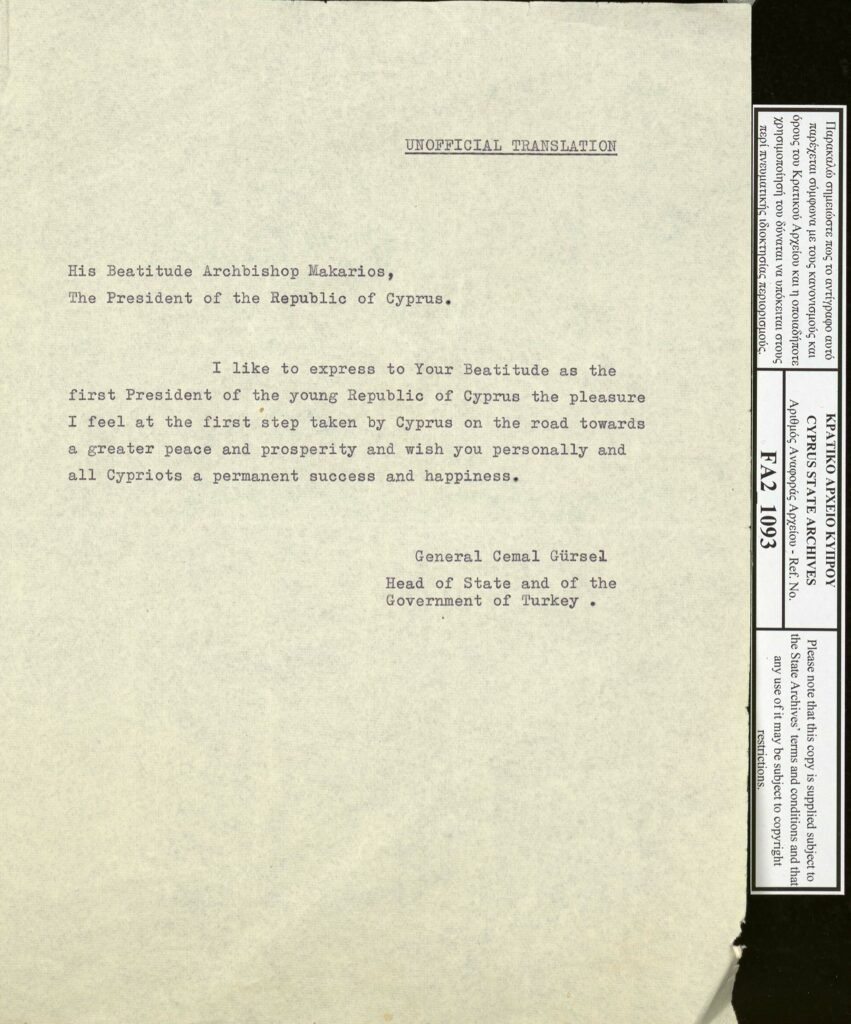
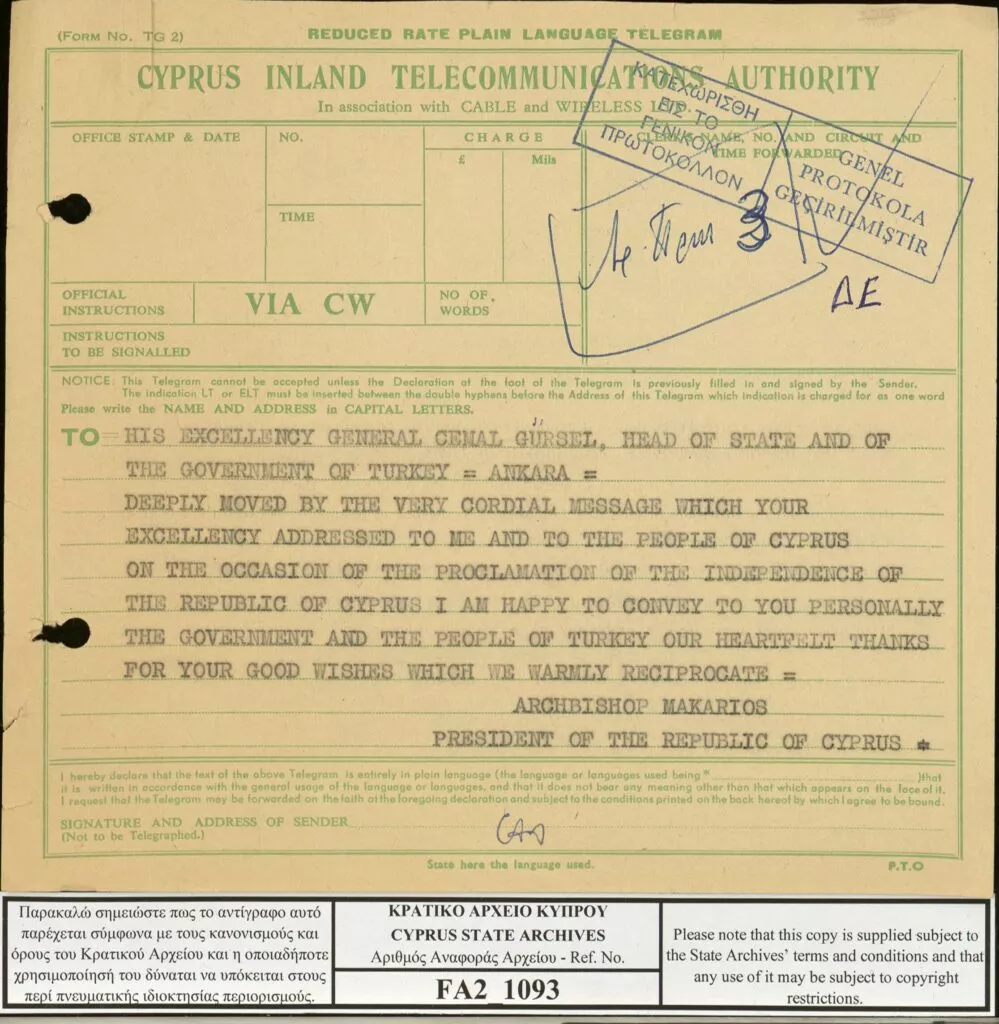
Two telegrams exchanged between the newly established Republic of Cyprus and Turkey in August 1960 reveal the underlying tensions surrounding the island’s independence. While the messages were formal and congratulatory, they masked the complex reality and the intentions of the parties involved.
Turkey, one of the guarantor powers, had long been skeptical of the Republic of Cyprus, viewing it merely as a transitional phase before implementing its division plans. The avoidance of Cyprus’s union with Greece—a scenario that would have bolstered Greece’s influence—was a key concern for Ankara during this period.
The telegrams were sent from the Turkish President Cemal Gursel to Cypriot President Archbishop Makarios and received a formal response from the latter. Gursel’s message expressed happiness over Cyprus’s initial steps towards peace and prosperity, while Makarios responded with gratitude, emphasizing the importance of the diplomatic ties between Turkey and Cyprus.
Greek Prime Minister Konstantinos Karamanlis also sent a congratulatory telegram, urging unity and cooperation among the communities of the new state. He reassured that Greece would continue to support Cyprus as it had in the past.
Despite the seemingly cordial exchanges, tensions were palpable. Turkey raised concerns about the actions of the Greek side, claiming violations of agreements. At the same time, reports surfaced indicating that Rauf Denktas, a key figure in the Turkish Cypriot community, was establishing a fund for arms procurement, reflecting the brewing discord.
Moreover, there were incidents such as the unloading of munitions in the coastal village of Xeros from a Turkish ship, which went unimpeded by British forces, raising alarms about the Turkish community’s military preparations.
Turkey’s demands regarding the composition of the Cypriot government and the legitimacy of certain political entities further illustrated the friction. Ankara sought assurances from Athens, urging it to guide Nicosia amid escalating tensions.
On August 16, 1960, celebrations erupted as Cyprus marked its independence from 82 years of British colonial rule. The midnight ceremony on August 15, attended by Sir Hugh Foot, the last Governor of Cyprus, Archbishop Makarios, the first President of Cyprus, and Fazıl Küçük, the first Vice President, formalized the birth of the Republic. Representatives from Greece and Turkey were also present to witness the historic signing.
The newly formed Republic of Cyprus faced significant challenges from its inception, largely inherited from its colonial past. Reflecting on these difficulties, it becomes evident that mistakes were made by the Greek side as well. From the outset, Turkey appeared reluctant to see the new state function effectively, as it did not support collaboration between the Greek Cypriots and Turkish Cypriots. This became apparent almost immediately, with tensions simmering even before the ink had dried on the independence agreements.
The next day, the atmosphere was festive as Sir Hugh Foot read Queen Elizabeth II’s inaugural address, while the Royal Artillery’s 42nd Regiment fired 21 salute shots. Thousands gathered outside the Public Information Office (now the House of Representatives) and in the Metaxa Square (now Freedom Square) in Nicosia to celebrate. Makarios, along with the Greek Ambassador George Christopoulos and other dignitaries, addressed the jubilant crowd.
At 10 AM, the new Parliament convened for its first session, electing Glafcos Clerides as its inaugural President, while Dr. Müderrisoğlu was chosen as the Vice President of the Assembly.
The path to independence was fraught with struggle, particularly the EOKA liberation movement from 1955 to 1959, which initially aimed for union with Greece but ultimately resulted in a compromised independence.
August 16 was initially designated as Cyprus’s national day, but for practical reasons and with Turkish agreement, the official celebration was later moved to October 1. On the day of independence, military contingents from Greece and Turkey arrived on the island, and the tripartite headquarters was activated. The last British governor departed from the port of Famagusta, marking the end of colonial rule.