


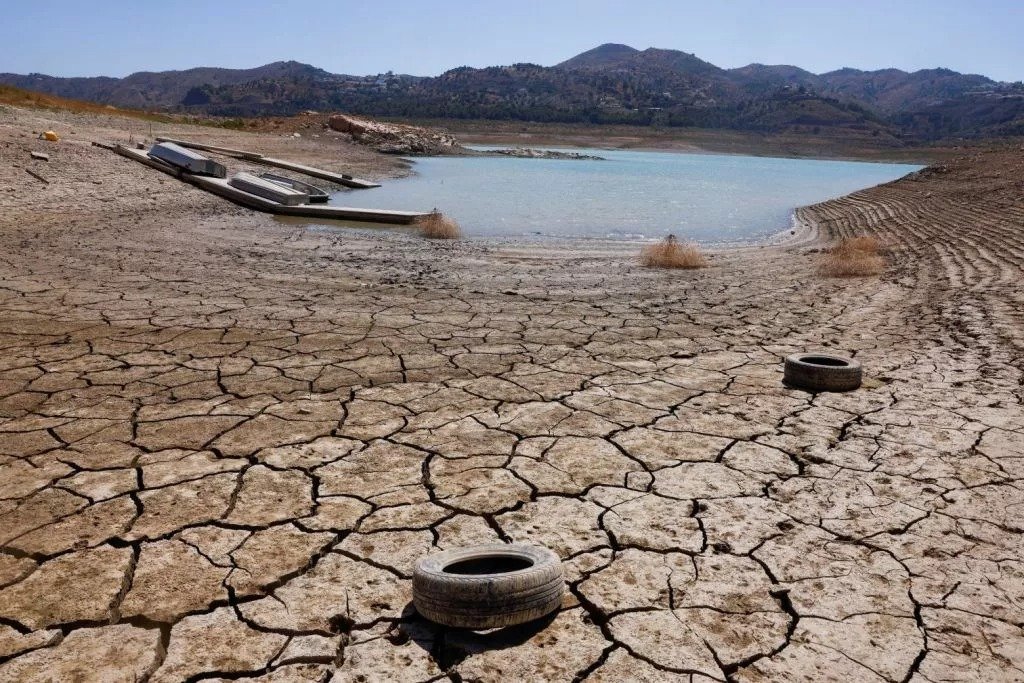
The water levels in Cyprus’s dams have reached critical lows, with overall capacity in some reservoirs now between 10% and 15%.
The situation is further aggravated by wastage, including recycled water being used on golf courses or discharged into the sea, alongside significant water losses from leaks—600 of which were recorded in Larnaca alone in one month.
Data from the Water Development Department shows that stored water has dropped significantly, with the current level at 34% of total capacity, compared to 57.3% this time last year. Out of a total dam capacity of 290 million cubic meters, only 98.7 million cubic meters are currently stored, a reduction of 67.775 million cubic meters compared to last year.
Some dams are particularly hard-hit. The Kalopanayiotis dam is at just 10.5% of its capacity, down from 57.6% last year. Similarly, the Argaka dam has fallen to 14.6%, compared to 54.6% last year, while Vyzakia has dropped to 16.3% from 64.1%. Agia Marina is at 16.8% (down from 23.8%), and Achna is at 18.5%, compared to 34.7% last year.
In contrast, the Lythrodontas dam, an emergency reserve, holds 59.5% of its capacity. Other dams are below 50%, with the highest levels recorded at Kannaviou (42.5%), Pomos (40.8%), and Asprokremmos (40.1%).
Kouris, Cyprus’s largest dam, is in a precarious state, holding just 35.3 million cubic meters of water—30.7% of its total 115 million cubic meter capacity—down from 53.1% last year.
Dams connected to the Southern Pipeline (Kouris, Kalavasos, Lefkara, Dipotamos, Germasogeia, Arminou, Polemidia, and Achna) are at 31.4% capacity, compared to 53.5% last year. Paphos dams (Asprokremmos, Kannaviou, and Mavrokolympos) hold 40.2% of their capacity, down from 65.9% last year, while Chrysochou dams (Evretou, Argaka, Pomos, and Agia Marina) are at 37.1%, compared to 59.4%.
Nicosia dams (Vyzakia, Xyliatos, and Kalopanayiotis) are at 22.6%, significantly lower than last year’s 67.1%.
Read more:

