


The Committee on Missing Persons (CMP) is determined to use all available technological means to locate potential burial sites, as time runs out, witnesses become scarcer, and relatives pass away one after another.
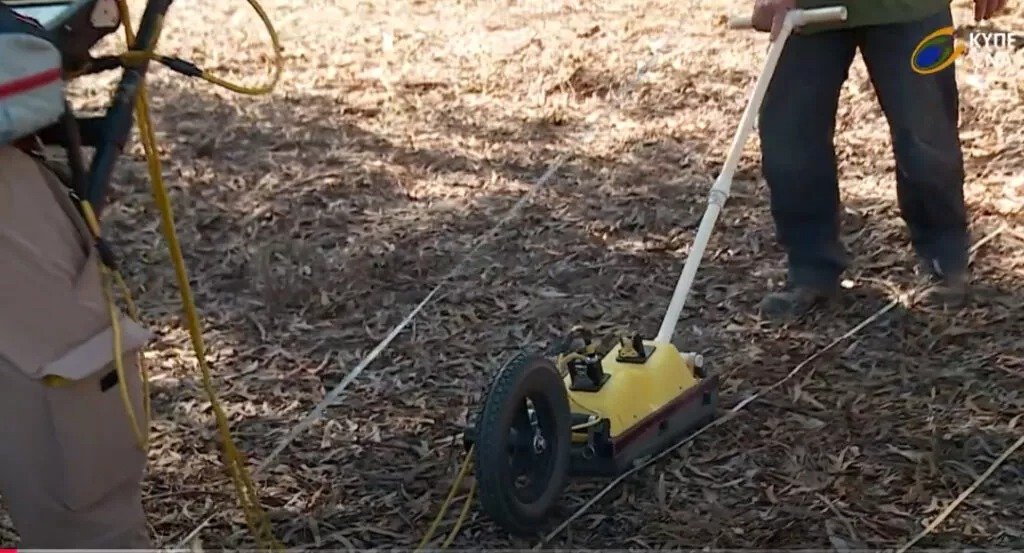
From 4 to 9 November, the CMP hosted four specialists from the United States and Canada who conducted ground surveys using Ground Penetrating Radar (GPR) and Electrical Resistivity Tomography (ERT) methods to detect soil disturbances that might indicate burial sites.
The team included Professor Harry Jol from the University of Wisconsin-Eau Claire with his student, and Eric Johnson, Senior Geoscientist from BGC Engineering in Calgary, Canada, with his assistant. Their work was conducted pro bono, with CMP covering only travel and accommodation expenses.
This marks Professor Jol’s third visit to Cyprus. The CMP aims to evaluate the reliability of these methods before investing in specialised equipment. The scientists are preparing a report on their findings, which will determine whether the CMP proceeds with excavations.
The team investigated four locations:
- Turkish-occupied Nicosia, near the prison, where information suggests a mass grave of Greek Cypriots from 1974
- Ayia Irene in Kyrenia, searching for Turkish Cypriots from 1974
- Assia, between the Muslim and Greek Cypriot cemeteries
- Athalassa, below Aronas, where two Turkish Cypriots were reportedly buried in 1964
Speaking to CNA, Professor Jol explained that GPR uses FM radio waves to detect subsurface changes. “The radar and ERT systems will provide data that we’ll combine to determine if a site is suitable for excavation”, he said.
Eric Johnson detailed how ERT works by inserting steel electrodes every 50 centimetres, injecting current at different distances to image up to 6 metres below ground. “If the material has been disturbed, it will contain more air and be looser, showing resistance”, he explained.
Currently, CMP teams are working at Galatia lake in Karpasia and Komi, investigating information about civilian Greek Cypriots who disappeared after August 1974. The Committee continues its work across various locations, using these advanced technologies to prevent the loss of evidence due to development and natural deterioration of sites.
Read more:

