


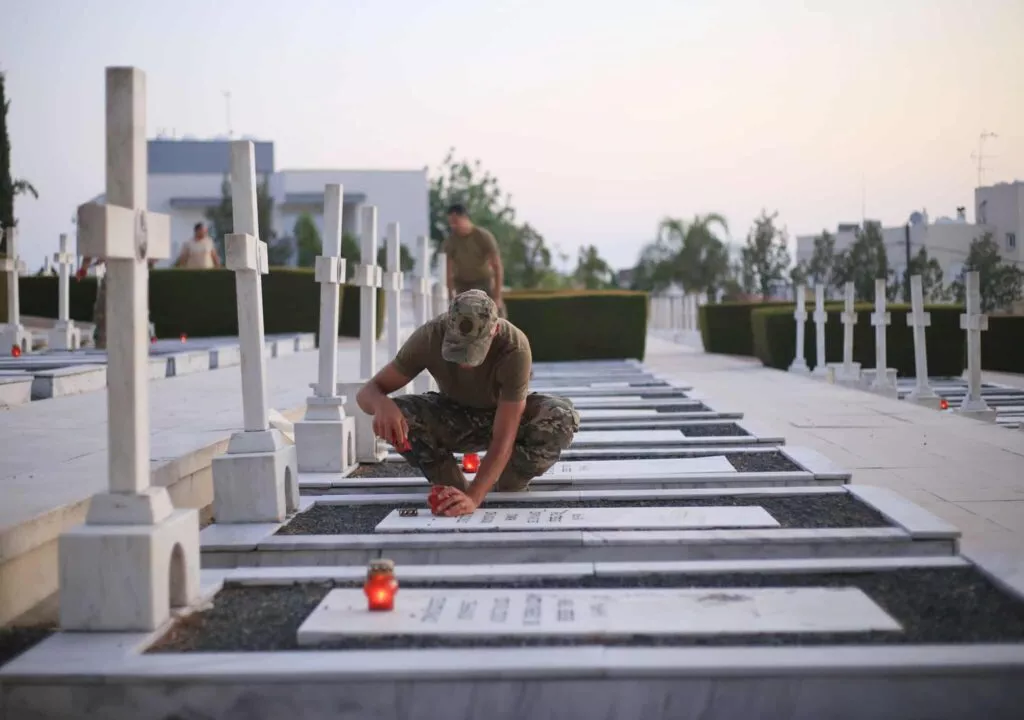
Today marks 51 years since that tragic Saturday morning of July 20, 1974, when the Turkish invader trampled upon the sacred lands of our country, and, disregarding international law, partitioned the island with the force of arms and violence.
The people of Cyprus, still experiencing the consequences of that fateful day, today condemn the crime and honor the fallen. Sirens sounded in all cities with the alarm signal at 5:30 in the morning, the time when Turkey invaded Cyprus in 1974, violating the United Nations Charter.
Turkey’s divisive plans spread death and forced 200,000 Greek Cypriots to abandon their ancestral homes. The Turks bombed, destroyed, looted, raped, and devastated churches and monasteries. 37% of Cyprus’s territory still remains in the hands of the conquerors.
Today, in all cities of free Cyprus, events are organized in memory and honor of the fallen and prayers are held for the ascertainment of the fate of the missing persons of the Cypriot tragedy.
The President of the Republic, accompanied by Members of the Council of Ministers, will attend, initially, at 8:00 AM, an official prayer at the Tomb of Makedonitissa and, subsequently, at 10:00 AM, the annual memorial service for those who fell during the Turkish Invasion, at the Cathedral of Apostle Barnabas, in Nicosia.
At the memorial services that will take place at 8:30 AM, the Government will be represented by government officials, with the laying of wreaths, on behalf of the President of the Republic, as follows: In Limassol, the Director of the Press Office of the President of the Republic, Victor Papadopoulos, at the Metropolitan Church of Panagia Pantanassa (Catholic); in Larnaca, the Minister of Justice and Public Order, Marios Hartsiotis, at the Holy Church of Agios Georgios Kontos; in Paphos, the Government Spokesperson, Konstantinos Letymbiotis, at the Metropolitan Church of Agios Theodoros; and in Paralimni, the Minister of Energy, Commerce and Industry, George Papanastasiou, at the Holy Church of Agios Georgios for the memorial services of those who fell during the Coup and the Turkish Invasion.
Political parties and civil society organizations have issued statements condemning the Turkish invasion and are organizing events in memory and honor of those who fell in the Cypriot tragedy.
On this day, Turkish soldiers landed on the coasts of northern Cyprus in a “peacekeeping operation” codenamed “Attila.” Turkish transport planes carried paratroopers between 5:15 AM and 5:20 AM in the area of the Turkish enclave of Nicosia-Agios Ilarionas. The paratroopers fell en masse while Turkish infantry forces landed on the beaches of Kyrenia. At 5:20 AM, the landing of Turkish forces began at Pentemili, with soldiers advancing towards Kyrenia.
With the slogan “Ayşe can go on vacation,” Turkey sowed destruction on the island. Within three days, the conqueror unleashed absolute devastation with brutal executions, rapes, arrests of prisoners, destruction of churches, and uprooting. The “government” of the coup plotters of Nicos Sampson resigned under the weight of developments on July 23, 1974.
In New York, on the afternoon of July 20, the Security Council convened and approved Resolution 353, which called for a ceasefire and the withdrawal of foreign troops from Cyprus, the cessation of all foreign military intervention, and the commencement of talks between the three Guarantor Powers of Cyprus to restore peace and the constitutional Government on the island. In Brussels, the Council of Permanent Representatives of NATO member countries convened, but avoided taking a substantive stance.
In Geneva, feverish consultations began to find a peaceful solution under the auspices of British Foreign Secretary John Callaghan. The Greek Cypriot side, represented by Glafcos Clerides, demanded for the first time since 1963 the implementation of the Zurich-London Treaties and the Cypriot Constitution. Turkey refused and put forward its standing demand for the geographical separation of the island.
Turkish Foreign Minister Turan Güneş counter-proposed a plan, according to which the Republic of Cyprus would be a bi-communal federal state of many cantons, in which Turkish Cypriots would control approximately 34% of the island. Clerides requested a postponement of 36 or 48 hours to consult the Council of Ministers. The Turks rejected his request and subsequently, in a pre-planned move, after withdrawing their delegation at 3:30 AM on August 14, 1974, they proceeded less than 1 1/2 hours later (4:35 AM on the same day) with the second wave of invasion under the codename “Attila 2,” with the occupation of Morphou, Famagusta, and Karpasia.
The most tragic consequence of the Turkish invasion is the missing persons. Thousands of Greek Cypriots had been arrested and held in concentration camps in Cyprus, while over 2,000 prisoners of war had been illegally transferred and held in prisons in Turkey. The fate of a significant number of missing persons has not yet been ascertained to this day.

