


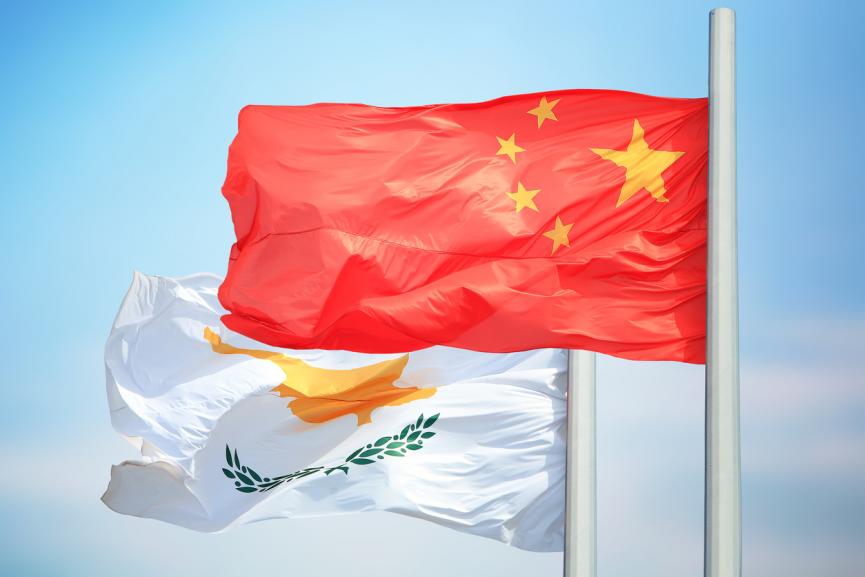
In every interaction between Cypriot and Chinese officials—whether political, social, or economic—there is no shortage of pleasantries about the good relations between the two countries. Nicosia and Beijing view each other positively, with numerous areas of cooperation. In reality, however, this is an inevitably asymmetrical relationship, given the vastly different size and, more importantly, influence of the two countries, Plamen Tonchev, Head of the Department of Asian Studies at the Institute of International Economic Relations (IIER) and author of the report “More Than Meets The Eye: Behind the Façade of Sino-Cypriot Relations,” tells Phileleftheros.
As he argues, Nicosia lacks a clear picture regarding Beijing, and an understanding of China’s true ambitions is inadequate. There is a tendency, he said, to present everything as positive and to view Beijing as a benevolent giant coming to help Cyprus with innocent intentions. China clearly sees its own interests, which Cyprus must also do. “It would be naive to expect Beijing to support Cyprus against Turkey in the waters of the Eastern Mediterranean,” he emphasised, adding that the recent strengthening of relations between the US and the Republic of Cyprus certainly does not please China, which seeks to create a community of European countries friendly to it in order to influence decisions made in the European Union.
Additionally, Tonchev’s report extensively discusses how China has managed to deeply penetrate major infrastructure projects in Cyprus, as well as the telecommunications sector. Regarding the Vasilikos project specifically, he noted that it is “it is an instructive case because it shows that Chinese companies are not necessarily synonymous with reliability and quality. It turns out their standards align much more with countries of the Global South than with the requirements of the European market.”

In your study “More Than Meets the Eye: Behind the Façade of Sino-Cypriot Relations,” you have documented extensively the relationship between Cyprus and China. Could you tell us the main conclusions of this report?
The first obvious conclusion is that Cyprus-China relations are inevitably asymmetrical, given the vastly different sizes of the two countries. This alone is not surprising, as it applies to the overwhelming majority of countries worldwide. China is the second most populous country in the world and the second largest economy, with advanced technologies and considerable political weight. It has a strong one-party state, which allows it to conduct its foreign policy in an absolutely planned and coordinated manner.
However, I would say that a key problem I identified when studying Sino-Cypriot relations is the inadequate understanding of China’s real ambitions in Europe and specifically in Cyprus. As a result, I observed an uncritical attitude towards China, a predisposition to present everything—or almost everything—related to China as positive, with Beijing viewed as a gentle giant coming to help Cyprus with innocent intentions. Things are not exactly like that. I attribute this lack of understanding, at least partly, to the absence of structured Chinese studies under the auspices of the Cypriot state. China enters this void with its own initiatives and agenda, which are eagerly and uncritically accepted by universities, municipalities, and cultural associations in Cyprus, as well as at the governmental level.
In your assessment, to what extent does this inadequate understanding affect the political relations between China and Cyprus?
First of all, Nicosia’s very warm stance towards Beijing is based on the expectation that China, as a permanent member of the Security Council, could be an ally in resolving the Cyprus issue. However, China will primarily look after its own national interests, not Cyprus’s interests. Let me explain immediately. First, Beijing correctly does not recognise northern Cyprus as a state entity, but this position is related to the Taiwan issue, which it considers an integral part of its own territory. Hence the—admittedly clever—slogan “One China, One Cyprus” that Beijing promotes.
Second, the Chinese government consistently refers to the “One China principle,” which does not exclude the use of force to seize Taiwan. In contrast, the EU is committed to a “One China policy,” meaning the peaceful resolution of differences between Beijing and Taipei. Note: “policy,” not “principle.” And in many cases, officials of the Republic of Cyprus seem to forget this “detail,” which nevertheless has great political significance.
Third, Cyprus cannot expect any support from Beijing in the dispute over exclusive economic zones in the Eastern Mediterranean. This is because while China has signed the International Convention on the Law of the Sea, in practice it has reneged on its commitments through its continued expansion in the South China Sea. It would therefore be naive to expect Beijing to support Cyprus against Turkey in the waters of the Eastern Mediterranean.
In which sectors of the Cypriot economy does China have a strong presence? Why has Beijing emphasised these particular sectors, and does this constitute a dangerous dependence on China?
We are talking almost exclusively about one sector—real estate! If one looks at the structure of Chinese foreign direct investment in Cyprus, amounting to €5 billion by the end of 2023, one will find that from 2019 onwards, the share of real estate consistently exceeds 90%. This includes the casino in Limassol and hotels, as well as the purchase of property by Chinese citizens in exchange for Golden Passports and Golden Visas. In contrast, there is no Chinese investment in Cyprus’s manufacturing or agricultural economy. Regarding bilateral trade relations, Cyprus’s trade deficit in goods continues to increase, although this trend is recorded across the EU. Things are clearly better for Cyprus in the services sector, but even there the balance has shifted in China’s favour, with the gap steadily widening from 2018 onwards.
Does this constitute a dangerous dependence? The answer in these cases is diversification and broadening the range of options—both for imports and exports. Being a member of the EU’s common—and tariff-free—market, Cyprus has the luxury of seeking many other options in its economic relations.
Do you consider it dangerous for Cyprus that Chinese companies have a dominant role in important infrastructure projects, such as in technology (5G networks) and energy projects (Vasilikos)?
In my report, I present a graph that vividly shows Cyprus’s “first place” across the entire EU in terms of using Chinese equipment in 5G infrastructure—100%, albeit in the peripheral networks called RAN in English. The use of Chinese equipment in 5G infrastructure does not necessarily contravene the relevant EU “toolkit,” which does not name specific suppliers but advises member states to precisely identify which companies are “high risk.” Additionally, this toolkit draws member states’ attention to companies that have close ties with third-country governments—an implicit but clear reference to Chinese companies. You know, Chinese legislation requires all businesses, even private ones, to have “party cores,” so Communist Party commissioners co-manage with the owners and promote government policy. The discussion about the Chinese presence in 5G infrastructure is continuously intensifying across Europe, while the new Trump administration has increased pressure on Brussels on this issue.
As for the Vasilikos project, as it has evolved over the last six years, it is a story that is detrimental to Cyprus and at the same time instructive. Detrimental because this strategically important project should have been completed in September 2022 and is already in its third year of delays. And it is an instructive case because it shows that Chinese companies are not necessarily synonymous with reliability and quality. It turns out their standards align much more with countries of the Global South than with the requirements of the European market.
Will the warming of relations between Nicosia and Washington, and the fact that the two countries are coming closer together, affect Cypriot-Chinese relations?
The strengthening of relations between the US and the Republic of Cyprus recently certainly does not please Beijing, which seeks to create a community of European countries friendly to China in order to influence decisions made in the EU. However, I believe that the—largely verbal—support that Beijing provides to the Republic of Cyprus will not diminish, as I have already mentioned. China will not recognise the pseudo-state of northern Cyprus because its own highest priority is the non-recognition of Taiwan as an independent state. But neither will China get involved in mediating efforts to resolve the Cyprus issue. This matter is not a priority for Beijing, plus the fact that it prefers to maintain equal distances from the Republic of Cyprus, Greece, and Turkey.
If the trade war between the US and China intensifies and EU member states are forced to align with Washington, will it be difficult for Nicosia to cut or limit its ties with Beijing?
As you well know, the EU has decided to increase tariffs on imported Chinese electric cars due to the direct or indirect subsidies that the Chinese state lavishly offers to its businesses, which constitutes unfair competition. Note that last year there were two votes in the EU on this issue. In June, Cyprus voted against the proposal to increase tariffs, but in the second vote in October, it chose to abstain—as did Greece, by the way. However, the impression I got from my interviews with numerous officials is that the Republic of Cyprus will follow the policies decided in the EU.
My view is that Nicosia does not need to reach a rupture with Beijing, heaven forbid! However, Cyprus is in the EU precisely to draw from collective European power and not to face larger countries from a position of weakness.
China wants global primacy and to replace the US
Several analysts argue that the aim of Trump’s moves is to cut the momentum of the rapidly emerging China. Is such a thing feasible?
I don’t think there is a single answer to this question. You will remember that the Biden administration imposed restrictions on China in high technologies, based on the “small yard, high fence” strategy. The results of this strategy were mixed, and the restrictions prompted China to turn towards developing domestic innovation or making fuller use of existing technologies, as seen, for example, with the emergence of DeepSeek in the field of artificial intelligence.
It remains to be seen to what extent the Trump administration’s tariffs will halt China’s further progress. On the other hand, until recently there was the certainty, not to say dogma, that by 2025, this year that is, China would surpass the US in terms of nominal GDP. This expectation has been disproved, and this goal of Beijing is being postponed to 2035, although no one can predict what our world will look like in a decade from now. Personally, I do not undertake to make such a prediction.
The enormous size, the emphasis on technology, the ease of decision-making are some of the factors that have given impetus to China. On the other hand, though, what are its weaknesses? Does it have vulnerable points?
You are right that in one-party China, decisions are made much more quickly because they are top-down orders, with no room for doubts and objections. It is also true that China has made impressive progress in advanced technologies and in many areas now competes on equal terms with the US. At the same time, however, it exhibits serious weaknesses, as seen with the outbreak of the pandemic in 2020 or the real estate bubble that weighs on the country’s economic development.
Also, there are tremendous inequalities in Chinese society—while pockets of poverty have not been eliminated, China has over 600 billionaires. Is it a coincidence, after all, that the second largest group of Golden Passport holders in Cyprus are Chinese?
As for China’s vulnerabilities, you know, authoritarian regimes are rigid. Our democratic system has many obvious weaknesses, but it is also more resilient because it has mechanisms to absorb shocks. The rotation of governments at regular intervals is such a mechanism to address citizens’ demands and any social discontent. In contrast, the unelected Communist Party of China lacks political legitimacy, and for this reason resorts to suffocating control of society with methods reminiscent of Orwell’s “1984.”
What are the aims of the Chinese leadership in the emerging global order? And what are Beijing’s red lines on economic but especially geostrategic issues?
The red lines of the Chinese regime express Beijing’s strategic objectives and there are three.
First, the eternal dominance of the Communist Party, with a fundamentally Marxist-Leninist ideology and absolute faith in “eternal victory.”
Second, the annexation of Taiwan, as a component of the “dream of national rejuvenation.” Until now, the rise in the living standards of Chinese citizens has been the exclusive source of legitimacy for the Communist Party, while national rejuvenation is the new narrative of the Chinese leadership amid the country’s slowing economy.
And, third, it is Beijing’s declared goal that by 2049, the 100th anniversary of the founding of the People’s Republic of China, the country will become the most advanced nation on earth. It is an elegant formulation of China’s ambition to claim global primacy, replacing the US.
Understanding these goals is necessary in order to read between the lines of Chinese announcements. Only then will one be able to discern Beijing’s real ambitions behind all the handshakes and smiles, behind the glossy façade of Sino-Cypriot relations. I hope it is clear now why I chose this title for the report. In short, I am trying to say this simple thing: China is looking after its own national interests—something absolutely logical and legitimate. Just as it is absolutely logical and legitimate for Cyprus to serve its own national interests, without being dazzled by pompous statements of dubious sincerity and little practical value.

