


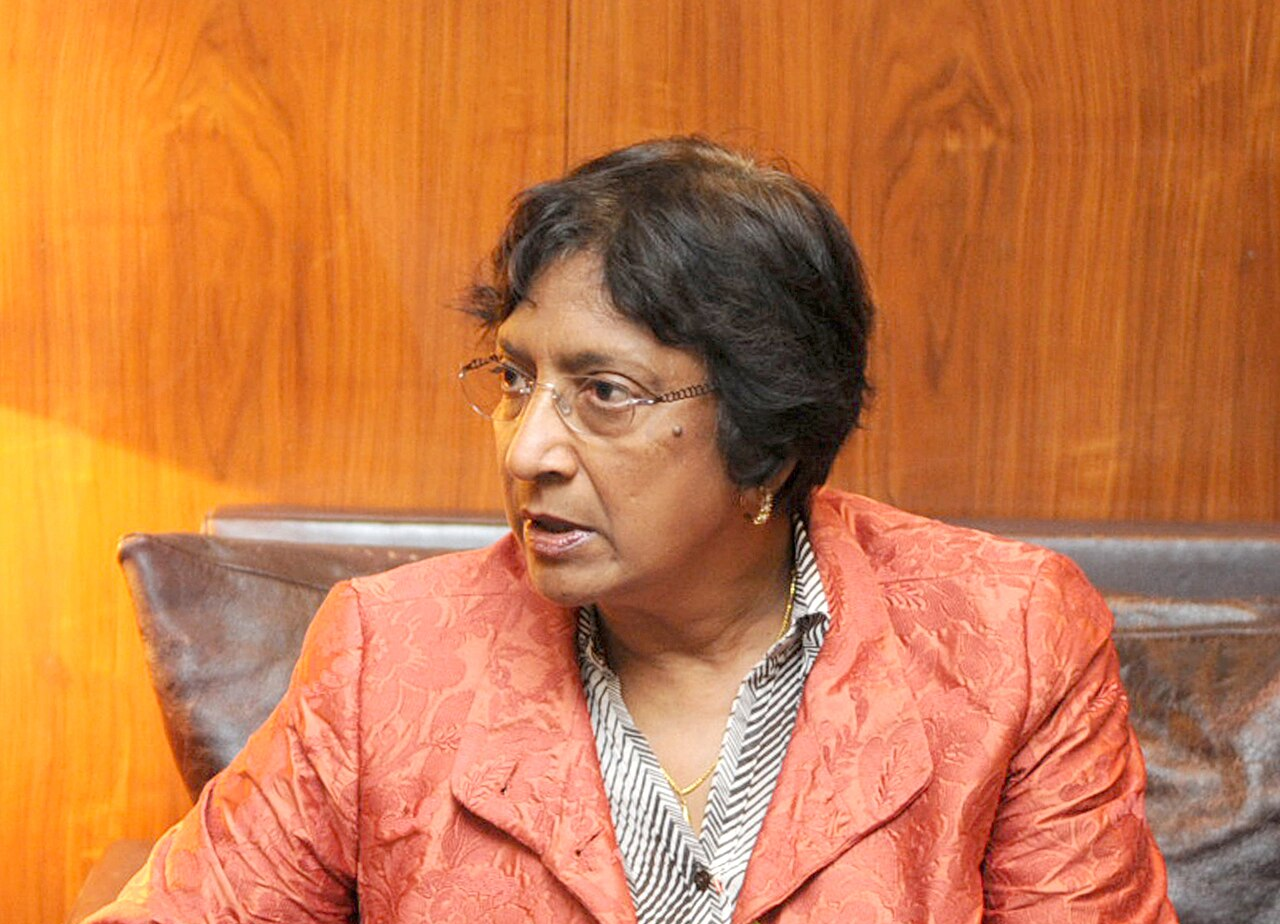
Former United Nations High Commissioner for Human Rights Navanethem “Navi” Pillay has been awarded the 2026 Nobel Peace Prize, the Swedish academy announced today.
Pillay’s decades-long career defending anti-apartheid activists, pioneering international criminal jurisprudence, and leading UN human rights operations has frequently placed her among figures cited by international observers and human rights advocates.
Born in Durban in 1941, Pillay overcame systemic racial and gender barriers under apartheid to become the first non-white woman to set up a law practice in South Africa’s Natal Province in 1967. Over nearly three decades of legal practice, she routinely defended political prisoners, anti-apartheid campaigners, and trade unionists, while working to expose the unlawful detention and torture of activists by state security forces.
Following South Africa’s democratic transition, President Nelson Mandela appointed Pillay as the first non-white female judge on the High Court of South Africa in 1995. Her judicial career rapidly expanded to the international stage that same year when the UN General Assembly elected her as a judge to the International Criminal Tribunal for Rwanda (ICTR), where she later served as president. During her tenure in Arusha, Pillay presided over landmark legal rulings, including the historic Jean-Paul Akayesu case, which established sexual violence and rape as acts of genocide and crimes against humanity under international law.
Pillay was subsequently elected as a judge to the International Criminal Court (ICC) in The Hague in 2003, before being appointed by UN Secretary-General Ban Ki-moon as the High Commissioner for Human Rights in 2008. Over her six-year term in Geneva, she maintained an outspoken stance on war crimes, political repression, and gender discrimination, frequently challenging sovereign governments over rights violations. In recent years, she has continued her global legal work, serving as Chair of the UN Independent International Commission of Inquiry on the Occupied Palestinian Territory and Israel.
2026 Nobel Peace Prize laureate Navi Pillay’s commitment to universal legal principles and her firm moral compass are constants in a long career. Born into a family of Indian Tamil origin under apartheid in Durban, South Africa, Pillay became a lawyer and legal pioneer, confronting deep structural discrimination, segregation and exclusion. A common thread runs from her early work defending Nelson Mandela and others who stood up against apartheid to her service as a judge in some of the key international court cases of our time. This year’s laureate has significantly enlarged the scope and impact of international law. She has served as a judge on the High Court in South Africa, the International Criminal Tribunal for Rwanda and the International Criminal Court. She was the United Nations High Commissioner for Human Rights and, until recently, she chaired the UN Independent International Commission of Inquiry on the Occupied Palestinian Territory. Today Navi Pillay is a judge on the International Court of Justice in the case where Myanmar stands accused of genocide. In historic international court cases, she has shown that legal measures can help prevent acts of war and violence. Navi Pillay has also contributed to strengthen the institutions of international law. Her independence, expertise and steadfastness have made her one of the most respected international jurists of our time. Learn more about the 2026 #NobelPeacePrize: https://t.co/JMjpp1jPKc #NobelPeacePrize #NobelPrize
— The Nobel Prize (@NobelPrize) October 9, 2026

