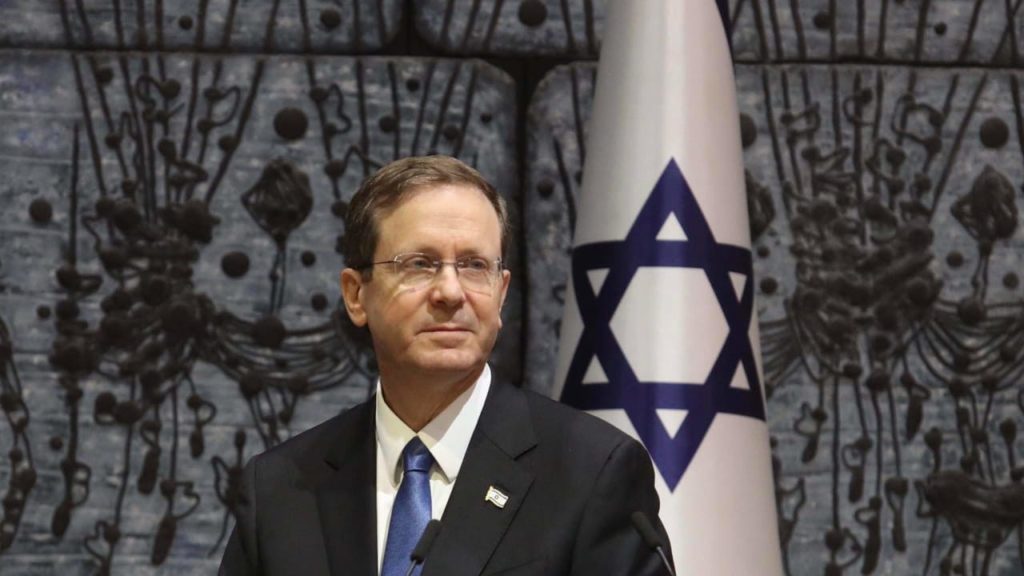
Israel’s President Isaac Herzog never forgets his relations with Cyprus, with his family’s plantations in Pissouri, which they maintained until 1974. Nor does he forget the trips by speedboat from Famagusta to Israel. His personal ties with our country can only have paid off politically, as he believes that his country’s alliance with the Republic of Cyprus and Greece is important.
He expresses optimism and analyses the current situation in “Phileleftheros”, hoping that peace can be achieved in the region.
He describes the latest UN Security Council resolution as historic, maintains that Israel’s relations with nations of the Abraham agreement have been kept strong, but declares in all directions that Hamas must leave Gaza.
Herzog praises the US President’s intervention as masterful diplomacy and appears optimistic because of recent developments that nations and people can move forward, and one day, they can reach peace.
Having followed your political career for a quite some time, I have the impression of a politician clearly oriented towards peace but also a very pragmatic one. So I would like to start by asking you this: After the terrorist attacks of October 7 and the war that ensued, is it still reasonable to talk about peace?
I would say that 7 October was, first of all, a wake-up call on a personal and national level. That is, we had to check the facts, over and over again. Why? Because the notion that we can live in peace was shattered. And it was shattered in the most violent, savage, brutal way imaginable. By massacres, by entire families being burned alive, by rapes, by kidnappings. How can you expect anyone to agree or share the land when you see what happens after such steps?
You are talking about the withdrawal from Gaza in 2005…
Yes, and I remember the withdrawal from Gaza vividly.
Which was also violent.
It was. But it was also deliberate as a step forward. And it was a unilateral step. But it failed. In many ways. Yet I am an unyielding optimist in the sense that I believe, especially in the last few weeks, that nations and people can move forward, and one day, they can reach peace.
How can that happen?
For instance, throughout the war, our relations with the nations of the Abraham Accord Covenant have remained strong. That’s an example. Against all odds. Throughout the war, the reality that we were protecting Europe, and the free world has sunk in for so many people. Even if they don’t say it publicly. So, the world leadership both knows and understands. My point is that there must be people on the other side who understand that there has to be change.
You said “last few weeks”. What has changed in the last few weeks?
President Trump’s entry into the political arena has brought about masterful diplomacy, and that in turn, has yielded the achievement of some goals that would have been unthinkable a few weeks ago. The latest UN Security Council resolution is historic. All the more so because there were no objections; there were only two abstentions, Russia and China. But member states supported by a wide range of nations, from Israel to the many Arab and Muslim states, supported it.
And what does this mean, politically?
They said, very simply, we want Hamas out of Gaza. We want to offer peace to the people of Gaza and then to the Israelis and the Palestinians. And we must find a way. This is a big deal. Despite the forces that are trying to undermine stability and peace throughout the region, there are others who believe that we can move towards peace.
Practically speaking, what about Hamas? It was supposed to be taken out of the equation. Far from it. How is that going to happen?
I know, and it’s a very delicate situation. Because they will try to use terrorism. And it’s in their DNA to destabilise, to radicalise, to never say yes. But now, they are facing a big front. An international front that is saying for the first time, unanimously, that this gang must leave Gaza. And that if that does not happen, there must be consequences. And the use of force. It’s a new balance in the equation, and it gives us a very strong sense that things can change. The U.S., the Kushner and Witkoff team are saying, and rightly so, that people didn’t think they could get so many deals, bring back all the hostages alive, hopefully now the last dead hostages. People didn’t believe that an international force could be created, that there could be a vote in the UN, and that this result. So, yes, there is hope.
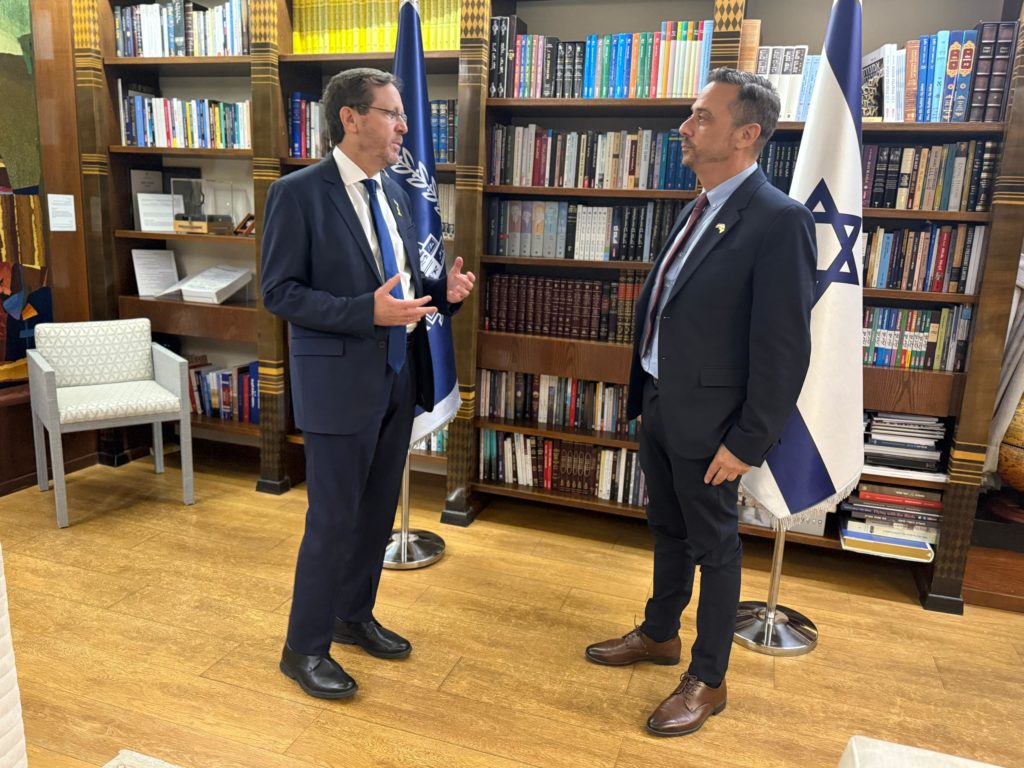
What about the two-state solution? I understand that after October 7, you no longer consider it realistic. And living in Israel now myself, I can attest that most people here share that belief.
It’s very difficult to imagine a two-state solution. Also, politicians as well as civilians are under the trauma of October 7. Therefore, their main question is, how will you ensure that whoever runs this state will not want to attack us again? It is very complicated. The UN resolution says that Hamas will not lead the Palestinian people. Okay, so how is the Palestinian political body going through reforms? These are big questions. I keep saying I want to achieve peace with the Palestinians. There has to be a day when we have to try to achieve peace with the Palestinians. But right now, you know, we are facing an evil empire from Tehran that is threatening the whole region.
Hamas is part of that evil empire. So to change the course of history, we have to work hard, and it takes time. The other day, for example, as you know, an Israeli citizen was massacred. An old man was going to do his weekly shopping. So, we are not naive about the dangers that still exist. Our enemies will not rest for a moment. Iran and all its proxies are constantly working against us.
Yet, Israel could have ended the war sooner, isn’t that so? Why didn’t it do it?
I am glad you are asking me, because it is also an opportunity for me to speak to the Cypriot people. We have enormous respect for the Cypriot people and for Cyprus. We see it as a close, dear friend. So, I know that in Cyprus, too, there is a political debate going on as elsewhere. I am trying to explain to everybody that we have to understand what happened. There was a terrible attack. This entity in Gaza was operating like a thug state for a very long time. Using many, many technologies and methods.
What about the duration though?
That’s the way war is, unfortunately, it takes time. It is something that is gruelling, difficult and complex and something, let me remind you, that started after we were attacked on seven fronts. And all these fronts aimed at one single thing: our extermination.
What about the humanitarian situation in Gaza?
You remember that, personally, from the very first moment I was involved in the effort to get humanitarian aid to Gaza. And you know this because from the very beginning, Cyprus was also part of this effort. Let me say here that Cyprus has always been very positive and constructive. And I congratulate the President and your government for constantly trying to create all kinds of spaces for humanitarian aid. Including the route between Cyprus to Gaza and so many other ideas.
At one point Israel banned aid from entering.
There was a clear and fair question from the average Israeli. Why are you supplying all these things when our sons and daughters are in the dungeons of Gaza? Get them out. Of course, we wanted to get them out. But what is the leverage? What is the leverage that can work on Hamas? One of the levers was to remove Hamas from the control of the food supply. Not to stop the food supply. To disconnect Hamas from controlling it. They were stealing the food that they were getting from the UN and other international organisations for free for the people and selling it to them at double and triple the price. To launder money and maintain their war machine. That’s what lasted a long time. We tried with the GHF, the Gaza Humanitarian Fund mechanism. But Hamas tried to destroy it. It lost a huge number of lives of its own people. Fighting around these distribution centres.
And in Gaza City? Did you need to enter?
The Israeli cabinet decided on this move which was strongly criticised by so many nations. But this move, as a result, changed the equation and showed that we are serious. And then the intervention of the Trump team was essential to getting the deal done.
Do you believe that at some point Israel will be able to prove its case on the number of casualties in Gaza and who was what?
Of course. People need to understand something: we meet every day with grieving families. And I meet wounded IDF soldiers. Incredible people, by the way. Many lost limbs and were badly wounded. Some were in a coma for months. What everybody says is, Mr President, Hamas is still there in Gaza. They have a whole war machine. Tell us how this reality will change in terms of ensuring that this does not happen again. Today, one of the hostages who came back told me: “Look, I walked in the tunnels for 12 hours.” There is a whole city underneath. The enemy is there, and the threat is there. And that takes time. How do you take out a whole underground city? How do you do that when you have so many civilians you don’t want to hurt ? Clearly, we question the numbers and we say so. I checked facts myself when Hamas reported, for example, 60 casualties and there was no shooting even that area. Tons of fake news. Tons. And we will prove the truth.
Parallel to this is the issue of Israeli settler violence. You had a very strong reaction the other day. However, these people can be controlled by Israel. Why don’t you do it?
It is something that I know very well, and I want to explain it. First of all, 99.5% of Jews and Israelis living across the Green Line, what you call “settlers”, are decent Israelis who have contributed greatly to Israel’s prosperity and to the flourishing communities. There have been many plans throughout the last 30 years on how to keep them there and move forward with peace through exchange and other ideas. But there is also a group of, let’s say, 200 to 300 young offenders and their mentors who are undermining the IDF’s activity, rebelling against their parents, fighting the police, fighting the army, fighting the district councils, fighting the community leaders.
There are two government decisions to deal with this group, called Hilltop Youth. Already since 2018, there has been an intergovernmental team working on this, from the police and security services to mental health and education services and correctional services. Very strong action is required. Following my comments and following the terrible events of a few days ago, I welcome the strong statements from the Prime Minister and the Minister of Defence. They must use all possible means to root out this phenomenon and deal with it. Either with correctional facilities or with imprisonment.
“Cooperation between Israel, Cyprus and Greece is a unique opportunity”
Cyprus, Greece and Israel have formed an alliance that would have been unthinkable even a decade ago. I remember the first time I was here in the President’s residence was back in 2015, during President Rivlin’s term, we had come with President Anastasiades. What we have seen in the last 10 years is unbelievable. However, some counter that this is a circumstantial alliance and not something deeper than that. What is your response to that?
First of all, we are three living democracies with a strong belief in the Testaments from which each of us reads and the place of the Holy Land in our minds and hearts. There’s a huge passion among Israelis for Greece and for Cyprus and for this alliance. It’s a unique opportunity. And I can add an element that I know. That was when I was head of the Jewish Agency, which is the biggest Jewish organisation in the world; we had an alliance of three diasporas, too. The Cypriot diaspora, the Greek diaspora and the Jewish diaspora, which meet together with the B’nai B’rith organisation a couple of times a year and is actually very effective. Meaning, we have a big ground to share. Now, there are very strong relations between the political systems.
And of course, very good cooperation on various levels of economy, security, science, agriculture and what not. So it’s not circumstantial at all. It’s out of love and passion. We know that this was tested during the war. That is something I want to emphasize. And we’ve seen it again and again. It’s an alliance of friends and that’s the way it should be.
“I regret not keeping the family plantations in Fasouri”
You have a special relation to Cyprus. Your family had plantations in Fasouri. Are they still there, really?
They still exist. But my family left in 1974. Because there was a boycott against Israel at that time after the 1973 war. I always regretted that we didn’t keep them. As a minister 15 years ago, I went to Fasouri and met the owners at the time. I grew up loving Cyprus and so did my wife. I remember my father taking a speedboat from Haifa to Famagusta in the late 60s, early 70s. By the way, I don’t think your readers are aware that in the morning prayer of every Jew, wine from Cyprus is mentioned. That shows the historical connection we have always had and still have.