


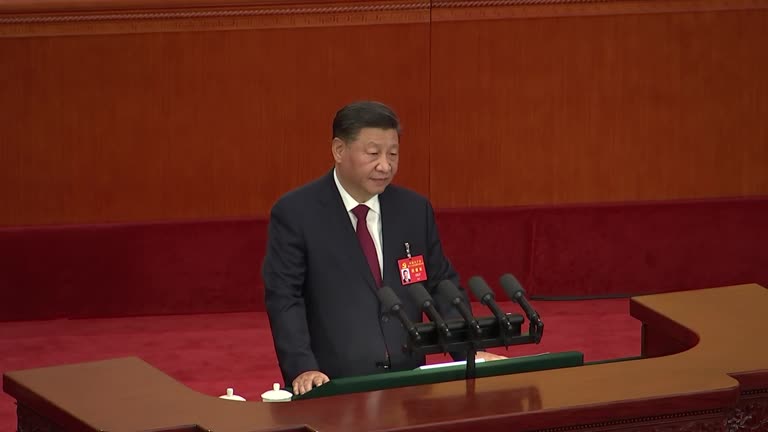
Chinese President Xi Jinping gave a wide-ranging speech as he kicked off a Communist Party congress on Sunday (October 16), focussing heavily on security and reiterating policy priorities.
Xi, 69, is widely expected to win a third leadership term at the conclusion of the week-long congress that began on Sunday morning, cementing his place as China’s most powerful ruler since Mao Zedong.
Roughly 2,300 delegates from around the country gathered in the vast Great Hall of the People on the west side of Tiananmen Square amid tight security and under blue skies after several smoggy days in the Chinese capital.
Xi described the five years since the last party congress as “extremely uncommon and abnormal”, during a speech that lasted less than two hours – far shorter than his nearly three-and-a-half-hour address at the 2017 congress.
However, he said little about COVID-19 other than to reiterate the validity of a policy that has made China a global outlier as much of the world tries to coexist with the coronavirus, which emerged in central China in late 2019.
Xi also reiterated his opposition to Taiwan’s independence, which drew the biggest applause during his speech.
On the economy, he restated support for the private sector and allowed markets to play a key role, even as China fine-tunes a “socialist economic system” and promotes “common prosperity”.
Xi called for strengthening the military, ensuring food and energy supplies, securing supply chains, improving the ability to deal with disasters, and protecting personal information.
In his decade in power, Xi has set China on an increasingly authoritarian path that has prioritised security, state control of the economy in the name of “common prosperity”, a more assertive diplomacy, a stronger military, and intensifying pressure to seize democratically governed Taiwan.
The day after the congress ends on Saturday (October 22), Xi is expected to introduce his new Politburo Standing Committee, a seven-person leadership team. It will include the person who will replace Li Keqiang as premier when Li steps down from that post in March after serving the maximum two terms.
(Reuters)

