


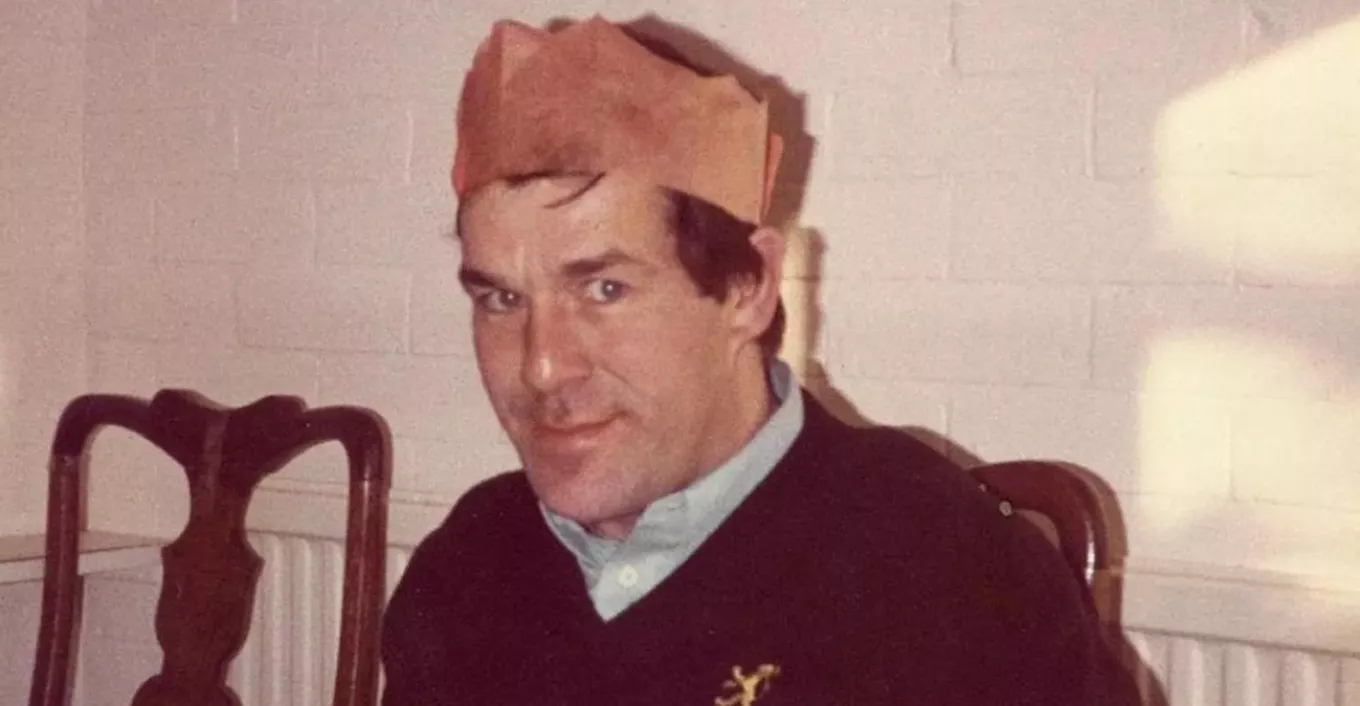
On 23 December 1975, Rob Parsons and his wife, Dianne, opened the door of their home to a 30-year-old homeless man—an act of kindness that would change their lives forever.
The incident occurred during Christmas that year, when the young couple, living in Cardiff, heard a knock at their door, the BBC reports.
Standing there was a homeless man with his belongings in a bin bag, which he held in his right hand. In his left hand, he held a frozen chicken. This was Ronnie Lockwood.
Rob looked closely at his face and faintly recognised Ronnie Lockwood, whom he had occasionally seen at Sunday school as a child and about whom he had been told to be kind, because he was “a bit different.”
“I said, ‘Ronnie, what about the chicken?’ and he said, ‘Someone gave it to me for Christmas’,” Rob recalled. “And then I said two words that changed all of our lives. I’m not sure why I said them. I said: ‘Come in’.”
Then aged just 27 and 26, the couple felt compelled to take Ronnie, who was autistic, under their wing.
They cooked his chicken, let him take a bath, and agreed to host him for Christmas.
What began as a single act of compassion turned into a unique and loving relationship that lasted 45 years, until the day Ronnie passed away. Rob, now 77, and Dianne, 76, had been married for only four years when they welcomed Ronnie into their home.
‘He was sitting at the Christmas table and he was crying’
Ronnie was nearly 30 years old at the time and had been homeless since the age of 15, living in Cardiff and the surrounding areas and constantly changing jobs.
To make him feel as welcome as possible, they asked their family to bring him a present for Christmas, anything from a pair of socks to some “smellies.”
“I still remember him. He was sitting at the Christmas table and he had these presents and he was crying because he had never felt that kind of love, you know. It was truly incredible to see,” Dianne said.
The couple planned to let him stay until Boxing Day, but when the day arrived, they could not bring themselves to turn Ronnie away and sought advice from the authorities.
The homeless centre told them Ronnie needed an address to get a job, but “to find a house, and therefore an address, you need a job. That is the deadlock that many homeless people face,” Rob emphasised.
Ronnie’s story began when, at the age of just eight, he was placed in care. Three years later, he disappeared from Cardiff. Rob, while researching his book, A Knock on the Door, discovered what had really happened to Ronnie during those years of disappearance.
He had been sent around 320 kilometres away to a specialised school where he lived for five years. “He had no friends there. He had no social worker who knew him. He had no teachers who knew him,” Rob pointed out.
Ronnie often asked: “Did I do something bad?”, something they believe he had learned from the school. “He was always worried that he had offended you or done something wrong,” Rob stated. At age 15, Ronnie was sent back to Cardiff “with nothing” and thus ended up homeless at some point.
The couple revealed that Ronnie was initially a little awkward, struggling to maintain eye contact and hold a normal conversation.
“But then we got to know him and we loved him,” they admitted.
They helped Ronnie find a job as a dustman and bought him new clothes, as he was still wearing the same clothes he had as a teenager at school.
“We didn’t have our own children, it was like dressing our children for school, we were proud parents,” Rob said.
“When we came out of the shop, Dianne said to me: ‘He found a job as a dustman and we dressed him up like he’s the hotel representative,'” Rob recounted, laughing.
Rob, a lawyer, used to wake up an hour earlier to take Ronnie to his work before going to his own.
When he returned home, Rob said Ronnie often sat there, smiling, and one night he asked him: “Ronnie, what’s entertaining you so much?”
Ronnie replied: “Rob, when you take me to work in the morning, the other men say, ‘who is that bringing you to work in that car?’ And I say, ‘oh, that’s my lawyer’,” Rob said Ronnie answered.
“We don’t think he was proud that a lawyer was taking him to work, but we think maybe no one had ever taken him to school on his first day. And now that he is almost 30… finally someone is at the gate,” Rob explained.
Ronnie would empty the dishwasher every morning, and Rob would feign complete surprise so as not to disappoint Ronnie.
“It’s hard to look surprised when you’re asked the same question on Tuesday that you were asked on Monday, but that was Ronnie. We did that for 45 years,” he said, laughing.
“He obviously had difficulty reading and writing, but he bought the South Wales Echo newspaper every day,” Dianne added.
Ronnie would buy them the same Marks and Spencer gift cards every Christmas, but every year he felt the same joy at their reaction.
Ronnie spent a lot of his free time at the local church, collecting donations for the homeless and preparing for services by arranging the chairs.
Dianne recalled a day when he came home with different shoes and she asked him: “Ronnie, where are your shoes?”
He told her that a homeless man needed them, and he gave them away. “That was his character. He was amazing,” they said.
One of their hardest moments was when Dianne was diagnosed with Myalgic Encephalomyelitis (ME) or Chronic Fatigue Syndrome, as there were days she couldn’t get out of bed.
“I had a little daughter of three years and Rob was away working,” Dianne said.
But Ronnie was “admirable” and took on responsibilities, preparing bottles for their son Lloyd, helping around the house, and playing with their daughter Katie.
Although they admitted Ronnie was addicted to gambling for 20 years, they couldn’t imagine their lives without him.
“It is not something I would recommend as a strategy, but Ronnie enriched our lives in many ways,” Rob noted.
“Ronnie had a big heart. He was kind, he was annoying. Sometimes I was his mother, sometimes I was his social worker, and sometimes I was his carer,” Dianne stated.
When someone asked the couple’s children “how did you deal with Ronnie when your friends came home” and they replied, “well, we don’t really think about it, he’s just Ronnie.”
“Our children had never known life without Ronnie. He was there before they arrived and he was there when they left, he was there with their own children,” Rob said.
Only once did the couple consider helping Ronnie live independently, a few years after he moved in.
As their two children grew older and space in their one-bathroom house seemed limited, they approached Ronnie’s room to suggest he find an apartment nearby.
But when they entered, he repeated his familiar question: “Did I do something bad?”
Rob said Dianne pushed him out of the room, burst into tears, and said, “I can’t do it.”
A few nights later, Ronnie came into their room and asked: “The three of us are close friends, aren’t we?” “I said, ‘yes, Ronnie, the three of us are close friends’,” Rob recalled.
“And we’ll be together forever, won’t we?” he asked.
“There was a pause there, probably too long, I looked at Di and said, ‘yes, Ronnie, we will be together forever’. And we were.”
Ronnie died in 2020 at the age of 75 after a stroke, and the couple maintains they miss him terribly.
A crowd wished to attend his funeral, but only 50 people were allowed due to the coronavirus pandemic. They received at least 100 condolence cards, from “Oxford University professors, politicians, and unemployed people.”
After his death, a new £1.6 million wellness centre, associated with Glenwood Church in Cardiff, was named in Ronnie’s honour, the “Lockwood House.”
The building was refurbished using funds from Ronnie’s will.
“In the end, the homeless man put a roof over all of our heads. Isn’t that amazing? I think it was all meant to be,” Dianne said.
“People ask us how this happened – 45 years – but the truth is, in a way, it happened day by day. Ronnie made our lives richer.”

