Has the recovery of the Republic of Cyprus after 1974 really been a miracle?
This piece was written in July 2018.
In Cyprus, we say that everyone knows everyone. Few people, however, know Takis Konis. He never was a professional politician. And he was never elected to office.
Now 82, he admits that his legs don’t allow him to leave the house as much as he used to. He lives with his wife Annita in their one-bedroom house in Nicosia. At first sight, with his long-white moustache, hat and calm demeanour he looks like an average Cypriot man of his age. Konis is, however, one of the people responsible for one of the most successful post-conflict restructurings of a society – and he found himself in the position to do so by chance.
The challenge was enormous. The Turkish military had invaded Cyprus on July 20, 1974, in response to the Greek junta-backed coup d’état against President Makarios, five days earlier.
The coup plotters were far-right nationalists who wanted to achieve union with the Greek state. They stayed in power for just eight days, as their government collapsed after the invasion, and Glafcos Clerides took over as acting president.
The war lasted until August 18, 1974 and resulted in Turkey capturing 37% of the island. About 7,000 people died on both sides. And around 210,000 people became refugees. Of them, 160,000 were Greek Cypriots displaced from the north.
Konis had been deputy director of the Department of Social Welfare Services before the war. But shortly after it started, he was made director as his predecessor fled into the mountains of Paphos to save his life. “When the invasion started, the government was destroyed because Nicosia was almost under Turkish control. The director fled to save his family and went to Paphos, so they made me director,” Konis explains.
He says that he would have fled as well. The only thing that prevented him from doing so was that he had already sent his family abroad. “We knew what was coming so I, personally made arrangements for my family to escape to Britain because it was really dangerous for them in Cyprus.”
Konis had links in Britain, as he studied social psychology in London, before completing a postgraduate degree in social work at Tulane University in New Orleans. He returned to Cyprus in 1966 and found work immediately.
He admits he thought about staying in the U.S. to do a PhD but decided to return to apply his expertise in Cyprus. “I had to leave. Our Cyprus was in a dangerous situation. I wanted to come back and help resolve the issues that our country was facing. I would go back when the issues had been resolved. But that never happened,” he says.
As director of the Department of Social Welfare Services, he was confronted with the biggest crisis the country had gone through. A third of the population had been displaced from their homes in 37% of the island and had to be accommodated in the remaining 60-odd per cent. Most of the families left their homes in the north with nothing but the clothes they had been wearing at the time of the invasion and were rendered immediately homeless.
The government was in a state of chaos. Mr Konis’ Department of Social Welfare Services was responsible for all the needs of the refugees. “At the beginning, I was in control of all the aspects of social support for the refugees. Everything – food, housing, clothes – was under my control. There were no social services. For me, it wasn’t a job. It was a mission, and I accepted this mission to stand by the refugees.”
Alone in Nicosia, Konis got straight to work. The flat he had been living in was too close to the front line. As his family was already in the UK he evacuated it and moved in with a friend.
In the early days, amid ongoing fighting, Konis had the task of arranging temporary housing for the displaced Greek Cypriots. “The poor refugees were living in schools, in abandoned buildings and under bridges. It was a terrifying situation. Because I didn’t have my family with me, I woke up very early. I went to work at six in the morning and left at night. It was my job, my life.”
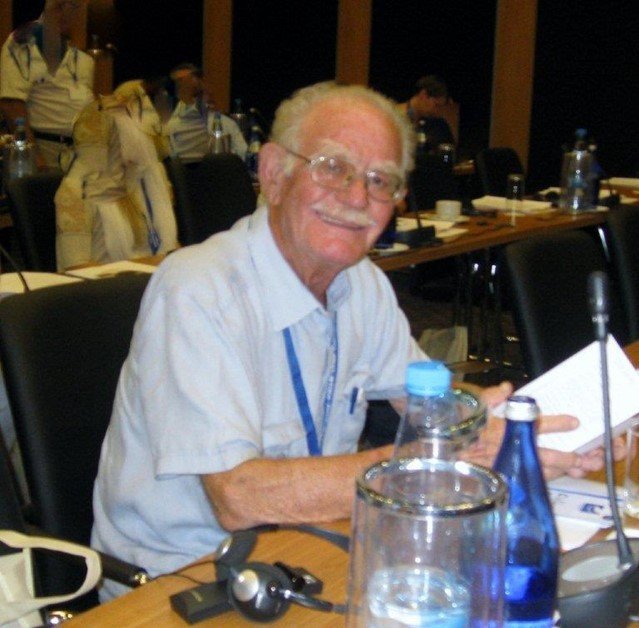
To respond to the emergency, the department made productive use of all the resources it could find. “I was responsible for finding houses for the refugees. Well, maybe not a house, but a school, an abandoned building, somewhere for them to live. These were temporary solutions,” Konis says.
When the fighting ended officially on August 18, many refugees were concentrated in areas of the south with their families and co-villagers. The government led by Clerides, together with Konis’s department decided to build refugee camps in those areas. These camps consisted of tents donated to Cyprus by the US and makeshift buildings that served as communal areas, bathing areas and kitchens.
Blankets, clothes, food, basic utilities and, most importantly, money were donated to Cyprus as international aid arrived – mainly from the US, the UK and Greece. Depending on the refugees’ employment status they were entitled to partial or full rations of food.
“I still remember the first refugees I met,” says Konis. “They were some people from Sychari and they said this phrase to me, ‘We are refugees and we don’t know where to go, what to do.”
The handling of the situation by the government at the early stages of the crisis proved to be very effective in containing the scale of the disaster. Very soon, peace and order were restored and President Makarios, who had been in London for five months, returned after securing international recognition of his administration as the rightful government of the whole island.
Two years later, in 1976, the government with its newly-created Special Service for the Care and Rehabilitation of Displaced Persons proceeded with the construction of housing projects. Between 1976 and 1986, around 11,000 families found housing in these projects. Other government programmes enabled thousands of refugees to live in ‘self-housing’ projects, on either private or state-owned land. With the self-housing scheme, the refugees received a piece of land from the government and a loan to construct a house. By 1987 more than 43,000 families, about 80% of displaced people, had been housed.
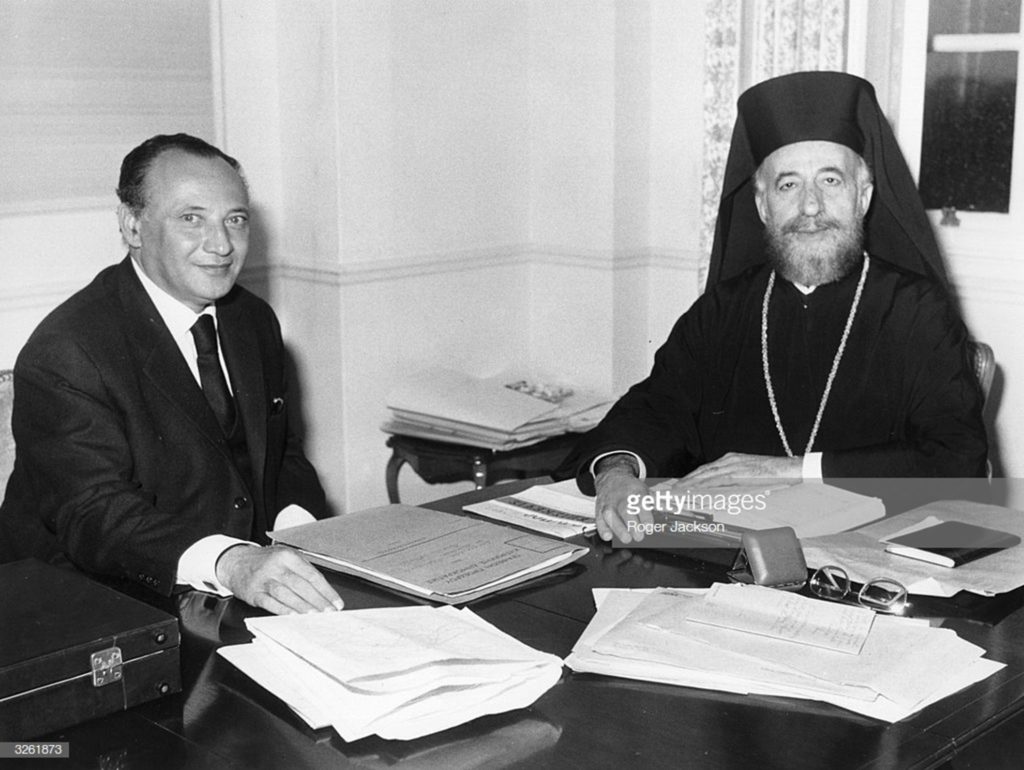
The war devastated the economy of the Republic of Cyprus. Unemployment exceeded 30% and the GDP dropped about 30%. The government drafted a series of Emergency Plans which treated the refugees as ‘development resources’ rather than an economic burden (source: Roger Zetter. 1992. The Greek-Cypriot Refugees: Perceptions of Return under Conditions of Protracted Exile. International Migration Review). Within a couple of years, most refugees were re-engaged in productive activities and could focus on the tasks of rehousing themselves.
The efficient response of the government, along with the aid received, led to an impressive recovery of the economy of the south which managed to surpass pre-war levels of development. By 1978 unemployment stood at only about 2 percent, compared with 30 percent at the end of 1974. This growth continued throughout the 1980s. Even by 1980, the GDP was about 2.314 billion USD compared to 1,066 billion USD in 1973 and 490 million USD in 1975 (source: Eric Solsten. 1991. Cyprus. Federal Research Division, Library of Congress). This remarkable rebound was described by the Economist as the “Cyprus miracle.”
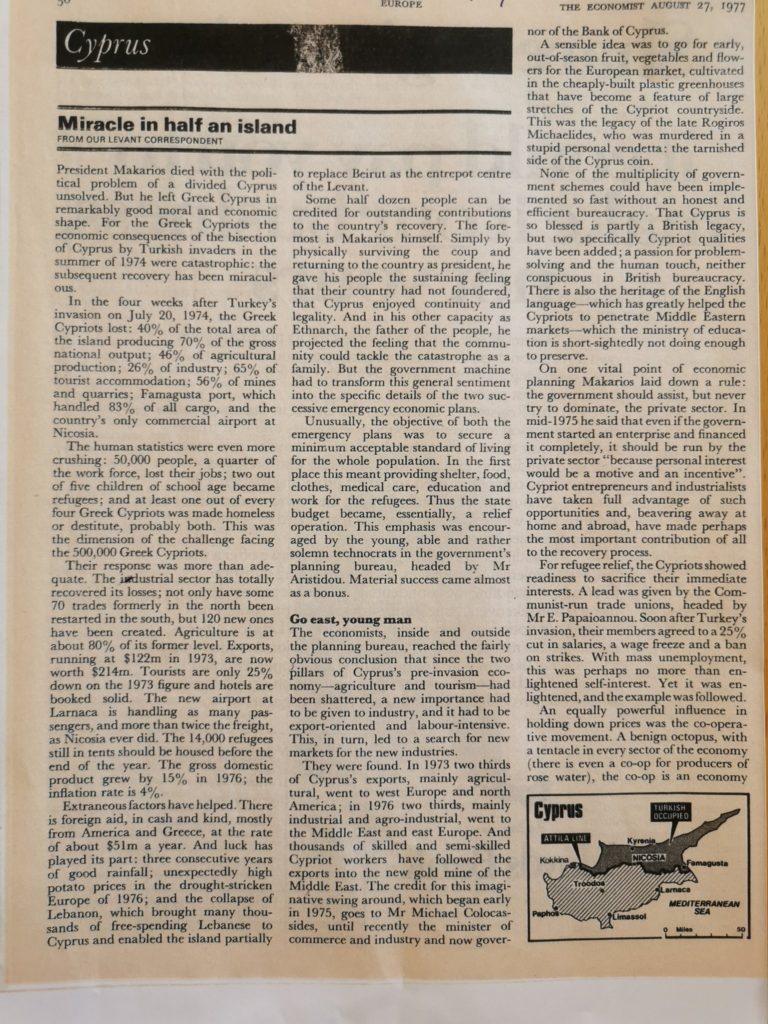
When the newly-created Special Service for the Care and Rehabilitation of Displaced Persons took over housing, Konis’s department was freed up to focus on the welfare of the refugees.
Every displaced person was given a refugee card with which he or she had access to free medicines and free transportation. Also, the children of refugees did not pay high school fees and the unemployed refugees were given greater benefits than non-displaced unemployed people. Refugees also did not pay any council tax and they could use the refugee card whenever the building they lived in or even their flat needed repair work like painting or plumbing.
According to Dr Olga Demetriou, an anthropologist at the University of Cyprus, the biggest challenge the government faced after the war was to respond to the destruction of the social fabric that had existed in the villages. “Relationships had to be rebuilt from the beginning. Whole communities were broken up. The social fabric was destroyed, and the social capital of the refugees was wasted.”
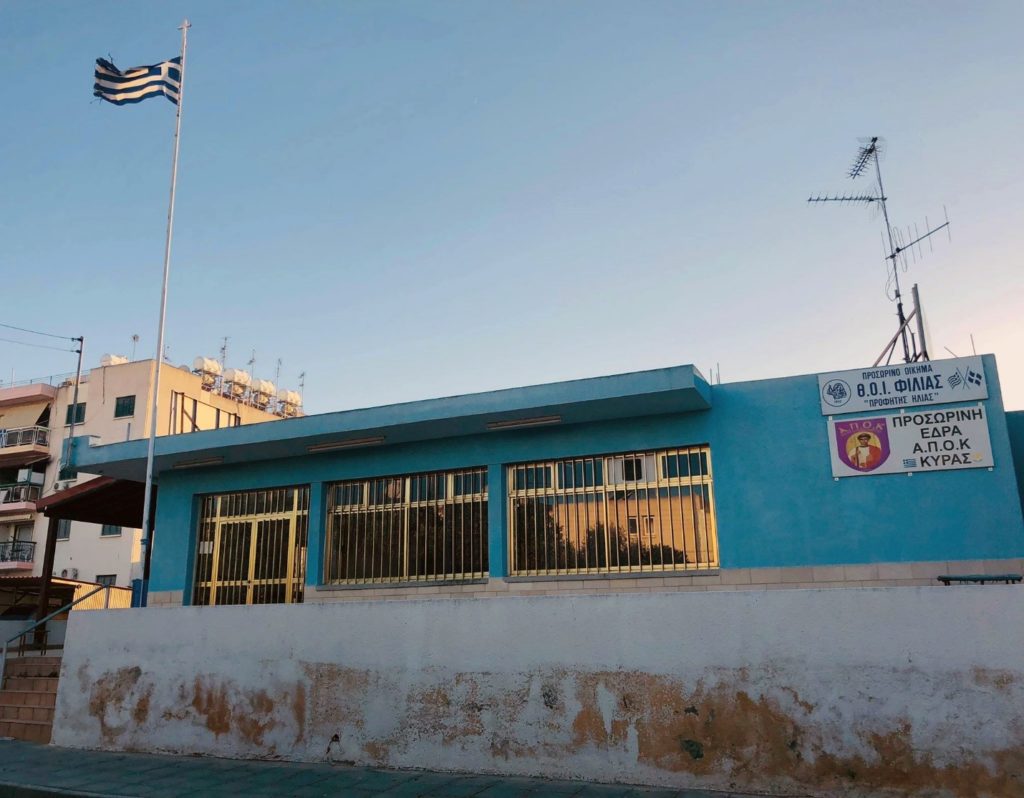
The Department of Social Welfare Services created kindergartens, youth centres, medical centres and houses for the elderly in the housing projects. Each settlement had its own central committee with elected representatives. “We tried to rebuild the social organisation, the institutions and the social relationships that people had in the villages and were destroyed because of the war. We tried to involve the refugees in the decision-making. We wanted them to participate and govern their own settlements,” says Konis.
“When a problem arose, the representatives of the committee would contact our department to resolve it. The president talked with the settlements through us. He would talk to our department and we would take him to see the settlement. These were political bodies that made the refugees feel as if somebody cared for them. This made them feel valued and encouraged them to be productive and creative in society,” he adds.
Social problems
Despite its efforts to rehabilitate the refugees, many of the government’s policies were criticised.
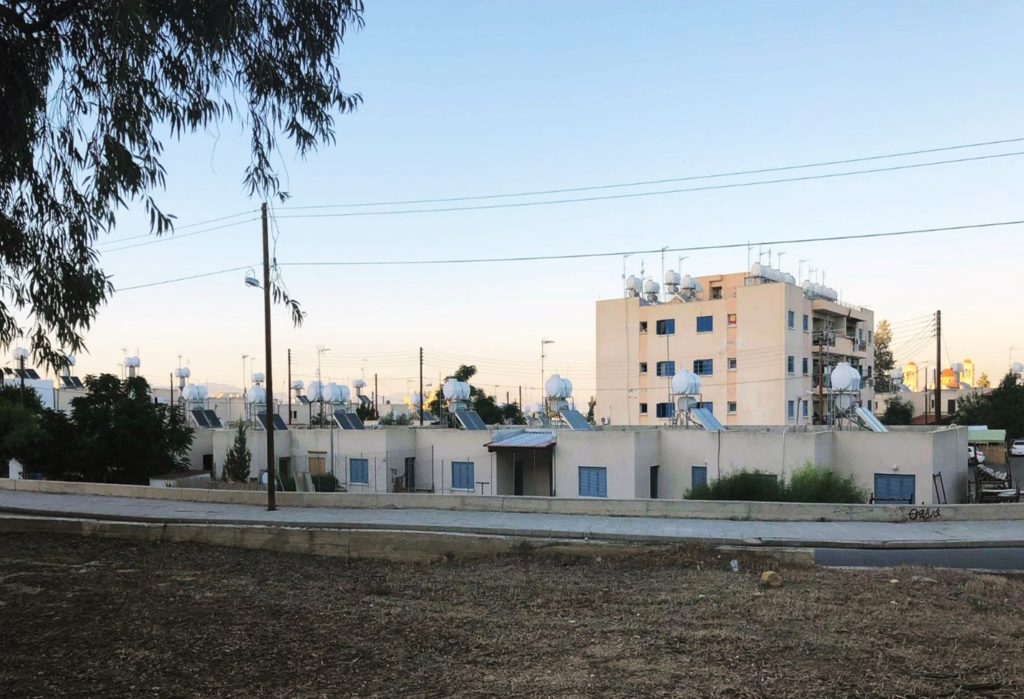
The most important criticism was that all the settlements were built close to industrial areas, away from the cities’ commercial centres. This was done to make it easy for the refugees to find work in factories. But it also led to their geographical and social isolation from the rest of the population.
“There were instances of discrimination and a moral panic was created according to which the settlements were said to be full of social problems,” says Dr Demetriou. “But I cannot see – given the scale of the problem – how the government could have avoided the geographical division of the refugees.”
Stelios, 32, a social worker born and raised in the settlement of Anthoupoli just outside Nicosia, whose parents were refugees from the village of Karakoumi, says: “The refugees experienced discrimination from the non-refugees. There used to be this phrase that parents were saying to their children: ‘Eat your food, otherwise the refugee will eat it’.”
Stelios argues that the fact that the government placed all these people who were experiencing economic, social and psychological issues together in the same areas created ghettos. “We definitely had more social problems than other areas. It was a ghetto. People could not cope with the trauma of displacement and there were no social services, no psychologists to help them. Thus, they transferred this trauma to their children. It’s no coincidence that in the neighbourhood where I grew up, everybody takes drugs to get well.”
However, Stelios adds that it wasn’t easy for the government to find a better solution, given its limited financial resources at the time and the lack of trained psychologists and social workers.
Stelios’s dad died when he was a teenager, and his mother worked as a cleaner to support him and his two brothers. Both of his brothers are unemployed, while his older brother has been addicted to drugs for many years. Stelios remembers that his brother’s friends used to break into their house and steal things like their TV or VHS to pay for their drug habits. He says that his brothers did the same.
What helped him escape this life, he says, is the fact that he was raised by their family’s neighbours. Kyriacos and Maroulla, a refugee couple from Dikomo who did not have kids of their own, let him sleep in their place and they eventually made a room in their flat for him.
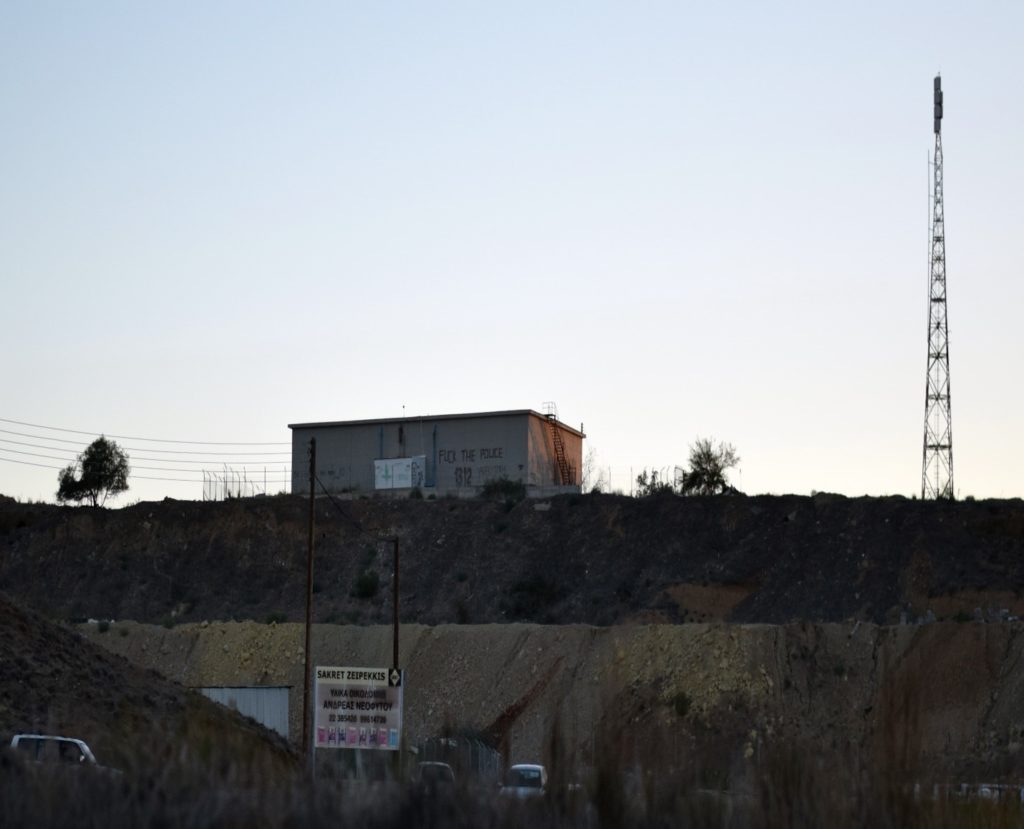
Kyriacos, 77, worked as an electrician. After living in the refugee camps for two years, he and Maroulla moved to Greece. They returned to Cyprus in 1979 to find housing in the settlement of Anthoupoli. He says that the austerity policies the government of President Anastasiades imposed after the 2013 Cypriot financial crisis had a devastating effect on the quality of their lives.
“In Anthoupoli, the settlement had a representative that would deal with all the problems. You didn’t have to do anything. If your house needed painting the government would do it, if it needed improvements the government would do it. You only had to pay for electricity and water. There was social support from the government, you felt like you were not left out. Now these benefits don’t exist. They are making cuts all the time,” he says.
According to Kyriacos, the government is now abandoning the settlements. “The youth in Anthoupoli are the 70-year-olds,” he says laughing. The local bank branch and the medical centre have been shut down, so the elderly refugees are forced to travel to the nearest town when they need them. Until recently the refugees were allowed free public transportation, but now they have to pay half price for the bus ticket. Also, the medicine is no longer free. “There are 5000 old people from 50 different villages living in Anthoupoli and they have to walk around 40 minutes to just go to the bank. Some of us cannot afford to take the bus,” Kyriacos says.
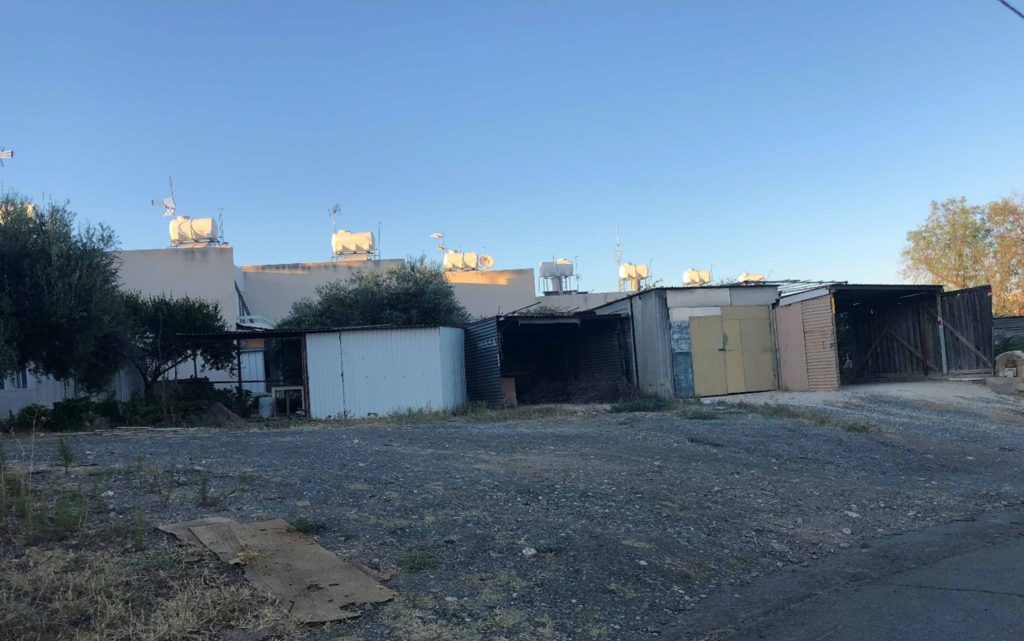
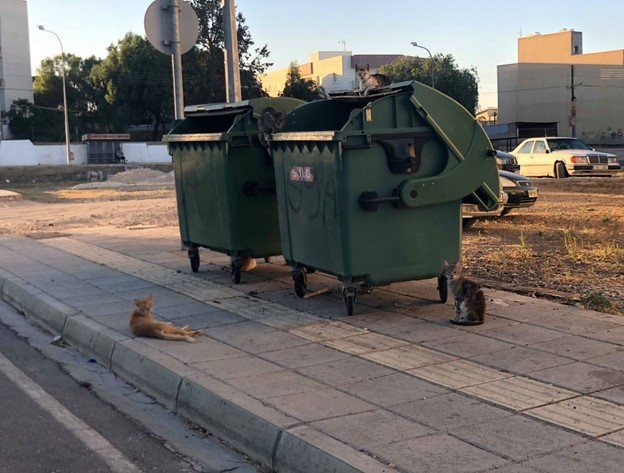
In 2016, 40 years after the first refugees started moving into the housing projects, the government started issuing title deeds for the properties. Kyriacos says that this allowed the government to start viewing the displaced people as the same as any other private property owner. “Now that we are the legal homeowners of our flat we are liable for all the expenses too. The government want us to stop being their responsibility.”
Kyriacos says that this is not fair, as he did not have the same life chances as any other property owner. “When you have to leave your home, you can never be happy. I can’t say that I enjoyed my life. My whole life I was struggling, I did not have any dreams, no potential, we just tried to live. We weren’t sure how long we were going to stay in this house. We couldn’t put our roots down. It was something temporary that became permanent.”
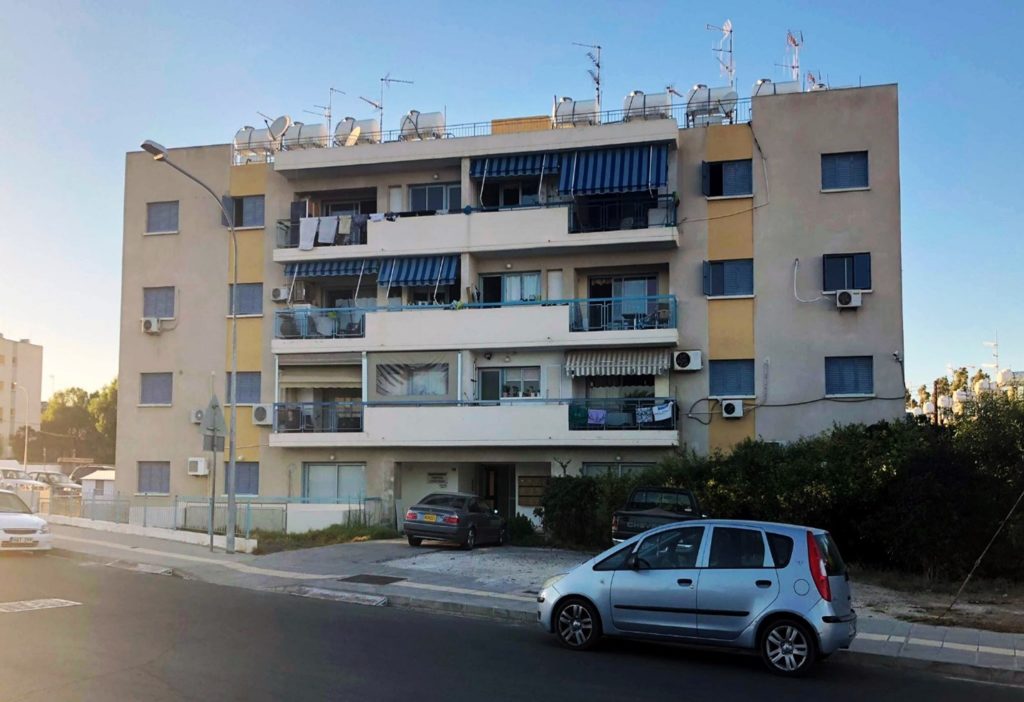
The restructuring of the society after the war and the subsequent economic development, created an underclass and a big income gap, says Dr Demetriou. However, she adds that she doesn’t see how it could have been avoided. “Cyprus, on a global level, is considered to be a very good example of how to handle displacement. It could have been a lot worse. It would need a lot of serious social politics, focused on equality for things to have been better.”
Takis Konis says that the biggest factor in the success of the policies was the spirit of cooperation, acceptance and respect between the government and the refugees. “I can say comfortably and responsibly that we did not leave any people behind. I am proud of our job. Sometimes we were economically restricted, but we did the most we could with the resources we had. We did a very good job in restructuring our society,” he stresses.
Takis Konis passed away in 2020.