


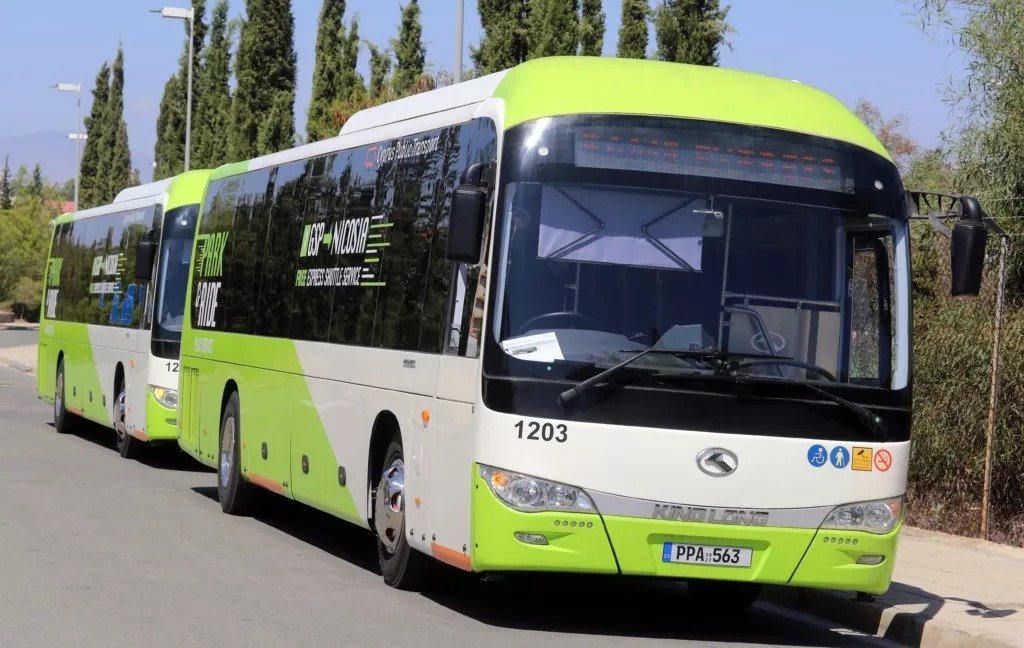
A government-backed bus service aimed at reducing traffic congestion in Nicosia has come under scrutiny for its high operating costs and low passenger numbers.
The “Pame Express” route, which runs between the GSP Stadium and Nicosia city centre, has transported an average of just 350 passengers daily since its launch in September 2023. Despite this, the service has cost taxpayers around €800,000.
In some cases, the cost of transporting a single passenger has reached as high as €38, although the average is between €7 and €9. The government has acknowledged that the initial costs were inflated but has introduced measures to reduce expenses.
In terms of reducing road congestion, the results are similarly underwhelming. During peak hours (7 am – 9 am), only 200-250 vehicles were removed from the road, out of the 4,000 that enter Nicosia daily.
Notably, there are fewer vehicles than passengers because some commuters from other cities alternate between using their cars and the bus to cut costs. Initially, the service aimed to reduce the number of vehicles by 400 per day.
A visit to GSP Stadium yesterday provided a snapshot of passenger numbers, albeit during the holiday period. The 7 am bus departed with 9 passengers, the 7:20 am service carried 13, the 7:30 am bus had 10, and the 7:45 am one carried 14.
One young woman mentioned that she started taking the bus a few months ago after her car broke down, and has since continued to use it for commuting. Another regular said that, before the holiday period, the buses were often full. It was noted that the drivers are on familiar terms with many of the passengers, creating a friendly atmosphere.
Cost
So, how is the cost calculated? The state pays the company that operates the routes around €4 per kilometre. The round-trip distance from GSP Stadium to Nicosia’s centre is 19 kilometres. With 40 routes operating daily, this adds up to 760 kilometres covered per day. At €4 per kilometre, the daily cost is €3,040.
The €38 figure is based on transporting two passengers on a route that cost the state €76, resulting in a per-passenger cost of €38. Even during peak times, buses carry between seven and 15 passengers, although there are also cases where only 2-3 passengers are onboard.
If one looks at more typical cases, passenger numbers range from 700 to 900, though in reality, the daily figure seems closer to 700-750. Assuming 350 passengers make a round trip, the state pays about €8.68 per passenger.
The cost for the state is expected to decrease
The sum of €800,000 is conservative, given that the state admits it was paying €80,000 per month during the trial period, resulting in a total expenditure of €880,000, with a cost per passenger of €2,514 over the 11 months of the programme, or around €10 per day.
However, according to Andreas Nikiforou, a Transport Ministry official, the trial period – during which charges were higher – ended in July. From this month onwards, the company will be paid less than before.
Payments will now be made according to a new formula that accounts for inflation. The contract for Nicosia’s urban transport, operated by the same company that runs the “Pame Express” routes, included a provision for services outside urban transport, hence the higher tariffs during the trial. Moving forward, the company will be paid according to urban transport rates.
From now on, the state will pay the company between €30,000 and €35,000 per month, plus the cost of passenger tickets, which will continue to be free for users but funded by the public.
Based on current passenger numbers (350 per day), and assuming a charge of €1 per kilometre, the cost per passenger would be €2.17 for the 760 kilometres covered daily. If the charge is €1.50 per kilometre, the cost rises to €3.25 per passenger, and if it is €2 per kilometre, the cost reaches €4.34 per passenger.
Read more:

