


By Eleftheria Paizanou and Evagoras Procopiou
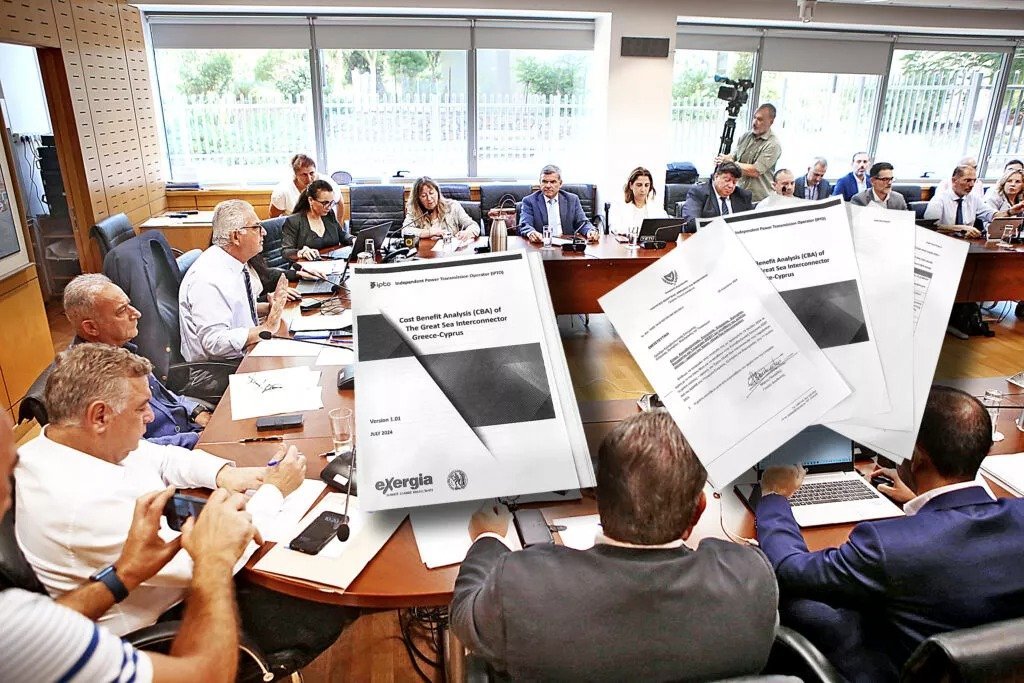
The economic benefits of the Great Sea Interconnector, a submarine power cable linking Cyprus and Greece, are estimated to range between €7.2 billion and €8 billion over a 25-year period, according to a cost-benefit analysis conducted by IPTO, the Greek Independent Power Transmission Operator, and presented to the Cypriot Ministry of Energy.
The study has been shared with the members of the Parliamentary Energy Committee.
Tenders have been launched to appoint an international firm to evaluate the study.
Dated July 2024, the analysis examined scenarios for the evolution of Cyprus’s electrical system, following consultations with relevant authorities, including the Ministry of Energy and DSMC.
It assessed whether the electrical interconnection is the optimal solution for the country’s long-term energy development.
An alternative scenario considered was the isolated development of Cyprus’s energy system with similar levels of renewable energy source (RES) penetration and increased electricity storage capabilities.
The first scenario identified potential socio-economic benefits of up to €7.2 billion. The second scenario yields corresponding benefits of €8 billion.
As demonstrated by the study, in both cases, the benefits from the electrical interconnection are more than double those achieved by developing an isolated system, even with high RES penetration.
According to the analysis, the Cyprus-Greece electrical interconnection will effectively connect Cyprus to continental EU energy markets, ending the country’s energy isolation (Cyprus being the only EU member state not interconnected with others).
It will enhance the security and reliability of the energy supply system, support increasing electricity demands, and facilitate the transition to new energy uses like electromobility and hydrogen production.
Additionally, the interconnection will contribute to ambitious RES targets at national and European levels, paving the way for the complete decarbonisation of Cyprus’s energy system.
The study also highlights broader geopolitical benefits, including the strengthening of Cyprus and Greece’s strategic alliance with Middle Eastern countries, particularly Israel.
It is noted that the project can counterbalance Turkey’s plans for interconnection with the occupied areas.
IPTO to assume responsibility
During the Energy Committee meeting, the Ministry of Energy supported the Energy Regulatory Authority (CERA) regarding the potential geopolitical risk involved. They asserted that the existing regulatory framework, as set by CERA, appropriately assigns the risk factor to the Implementing Entity (IPTO).
CERA Chairman Andreas Poulikkas clarified that the issue of geopolitical risk is not a regulatory matter and that CERA will consider it when making its decision, once the state accepts its existence.
He emphasised the significance of the word “may,” indicating that it does not predetermine their decision. He also referred to discussions with IPTO, where they accepted four out of six points of change in the regulatory framework.
Diverging views between Ministries
The discussion revealed a divergence of opinions between the Ministry of Finance and the Ministry of Energy regarding decisions about this €2 billion project.
George Panteli, Permanent Secretary of the Ministry of Finance, pointed out that determining the economic implications at this stage is premature due to pending studies and evaluations.
He also noted that they are unaware of IPTO’s agreements with financing organisations and the shareholding structure of the implementing entity. He emphasised the importance of assessing the interconnection’s impact on the Cypriot economy.
In contrast, Energy Minister Giorgos Papanastasiou declared that the electrical interconnection is a project of common interest to the EU.
He asserted that there is no philosophical difference with the Ministry of Finance and that many aspects of the implementation would soon be clarified.
Read more:

