


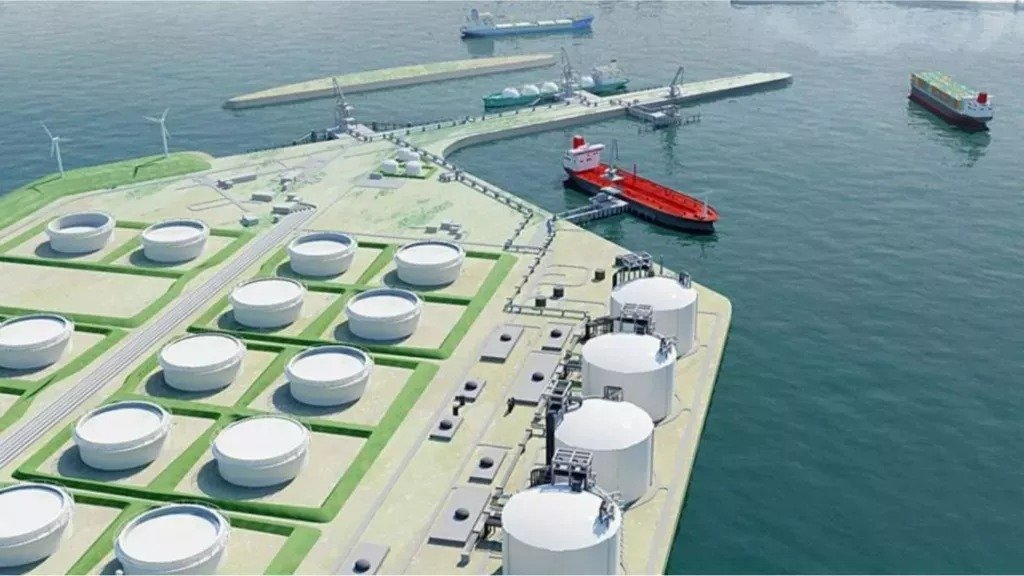
Cyprus’s stalled liquefied natural gas terminal project at Vasilikos faces further significant delays after the new project manager identified serious flaws in the original design and construction work, according to sources with knowledge of the situation.
The project, owned by the Natural Gas Public Company (ETYFA), has remained stagnant for 13 months, with unofficial information suggesting the terminal’s completion could be pushed back to 2027 or beyond following a preliminary assessment by new project manager Technip Energies.
Technip report reveals incomplete design and construction gaps
After delivering a report to ETYFA following evaluation of key project documents and design plans, Technip Energies has raised several critical concerns about the half-completed terminal project.
The French engineering company has concluded that the original design for the various sub-projects comprising the terminal is neither complete nor satisfactory and cannot be utilised without comprehensive reassessment to identify gaps and deviations from work already constructed.
Technip has warned ETYFA that making critical decisions for next steps without detailed evaluation of the original design or filling gaps with additional design studies carries “very high risk for a new failure”.
The company considers reassessment of existing design essential, noting this work could lead to identification of gaps, errors, and deviations between the design and construction work completed by Chinese contractor CPP.
Should Technip’s concerns prove justified, this would automatically create the need for new or supplementary Front-End Engineering Design (FEED) studies, requiring several months to complete.
Project completion could be pushed back to 2027 or beyond
Given these findings, ETYFA and the project manager have concluded it would be impossible and commercially very risky to tender Engineering, Procurement and Construction (EPC) contracts now for project completion, as there is a serious likelihood that construction companies would not express genuine interest. Additionally, there would be a risk of new construction defects.
To mitigate these risks, the trend emerging within ETYFA’s board and service is to conduct a Gap Analysis within 2-3 months to identify gaps and deviations between design and construction.
If this analysis reveals no significant problems or construction defects, a comprehensive tender would be issued for all outstanding works. Such a process is estimated to require nearly one year to complete contractor selection.
However, if the Gap Analysis reveals serious deficiencies in the original design that Chinese contractor CPP undertook to implement, or problems with construction quality, or inadequate equipment and materials left by the Chinese contractor, matters would become even more complicated.
In such cases, supplementary FEED studies would be required, taking 5-6 months or more. Based on new FEED studies, new documentation would be prepared within several months for a fresh tender.
Should ETYFA reach this conclusion, it is evident that a new contractor could be found, assuming serious interest exists, within 2027.
The construction time for remaining works is very difficult to determine at this stage, sources indicate.

