


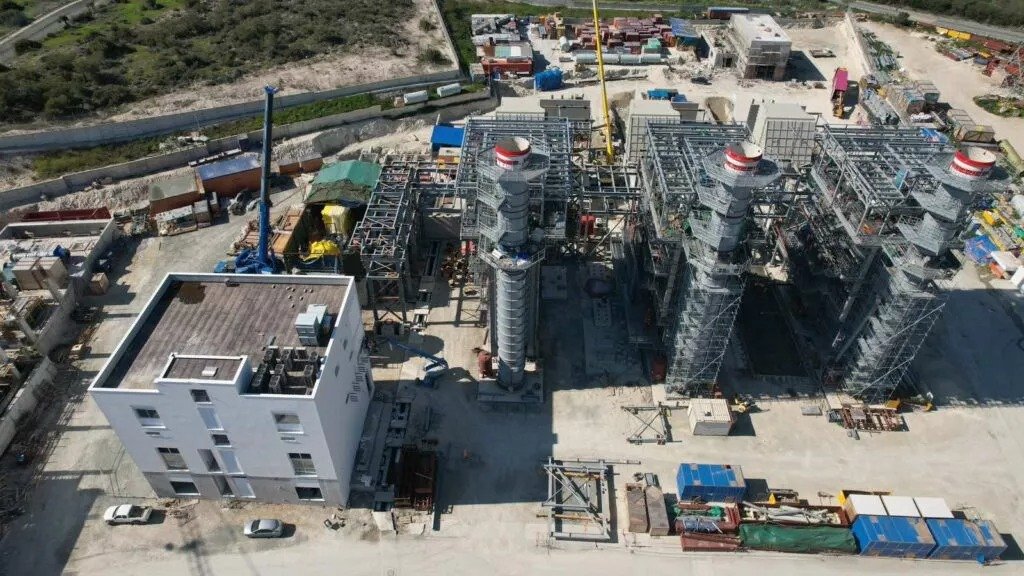
The Audit Office has released a report revealing that a new private power plant in Vasiliko, owned by PEC (part of the Cyfield Group), cannot legally operate because significant supporting infrastructure was built on land not owned by the company and without required permits.
In the report, the Audit Office highlighted that even the initial planning permit for the main power station infrastructure is considered inactive by state agencies due to these irregularities.
The unauthorised structures include a building constructed on the Vasiliko coast, a pumping station on state-owned land leased to the Electricity Authority of Cyprus (EAC) since 1995, and a water intake and discharge pipeline used for cooling the plant’s generators.
The report emphasises that the original planning permit granted by the Town Planning Department covered only the main power station construction, with a stipulation that failure to secure permits for supporting infrastructure would invalidate the primary permit – which is now the case.
The Audit Office documents in detail how various government departments and agencies repeatedly turned a blind eye to violations of permit regulations for this major project in an energy-sensitive coastal industrial area adjacent to Mari naval base, the EAC power station, an under-construction natural gas import facility, and petroleum storage installations.
Authorities also failed to conduct required on-site inspections for construction works both on land and at sea, which began in 2019-2020 and were completed in late 2022 or early 2023.
The Audit Office criticised state agencies, particularly the Interior Ministry and its Director General Elikkos Εlia, for attempting to retrospectively authorise PEC’s works rather than pursuing legal action or taking measures to suspend operations and address violations.
The report notes that the Interior Ministry and its Director General convened meetings with relevant authorities to achieve retrospective authorisation for the company under pressure to complete and operate the 260-megawatt generator station.
“We consider it essential to address all illegalities identified in our audit, which render Planning Permit No. LAR/00286/2013 inactive,” the report states.
“Retrospective submission of applications to relevant departments/services for required permits is not permissible and creates a bad precedent for similar situations that may arise in the future”.
The Auditor General indicated that “decisions/actions by public officials with decision-making authority may involve disciplinary/criminal responsibilities,” adding that the report would be forwarded to the Attorney General to determine if any offences were committed.
The report also identified “substantial weaknesses in the central coordination of responsible state authorities,” creating “opportunities for exploitation and non-compliance with legal procedures”.
Through comments submitted to the Audit Office via the Town Planning Department, PEC stated that the pumping station construction and pipeline installation works began in 2019 and were completed about a year ago “with the full knowledge of relevant authorities” at a cost of several million euros.
The company claimed all structures and works were done “with the direction, approval and consent” of the Cyprus Republic through the Ministry of Defence, to which it submitted relevant studies, plans and specifications.
PEC also noted it had provided “compensatory measures” benefiting the Defence Ministry worth over €1.5 million, and expressed surprise at how these issues could be raised now, suggesting the EAC was trying to prevent a competitive power station from operating.
Read more:

