


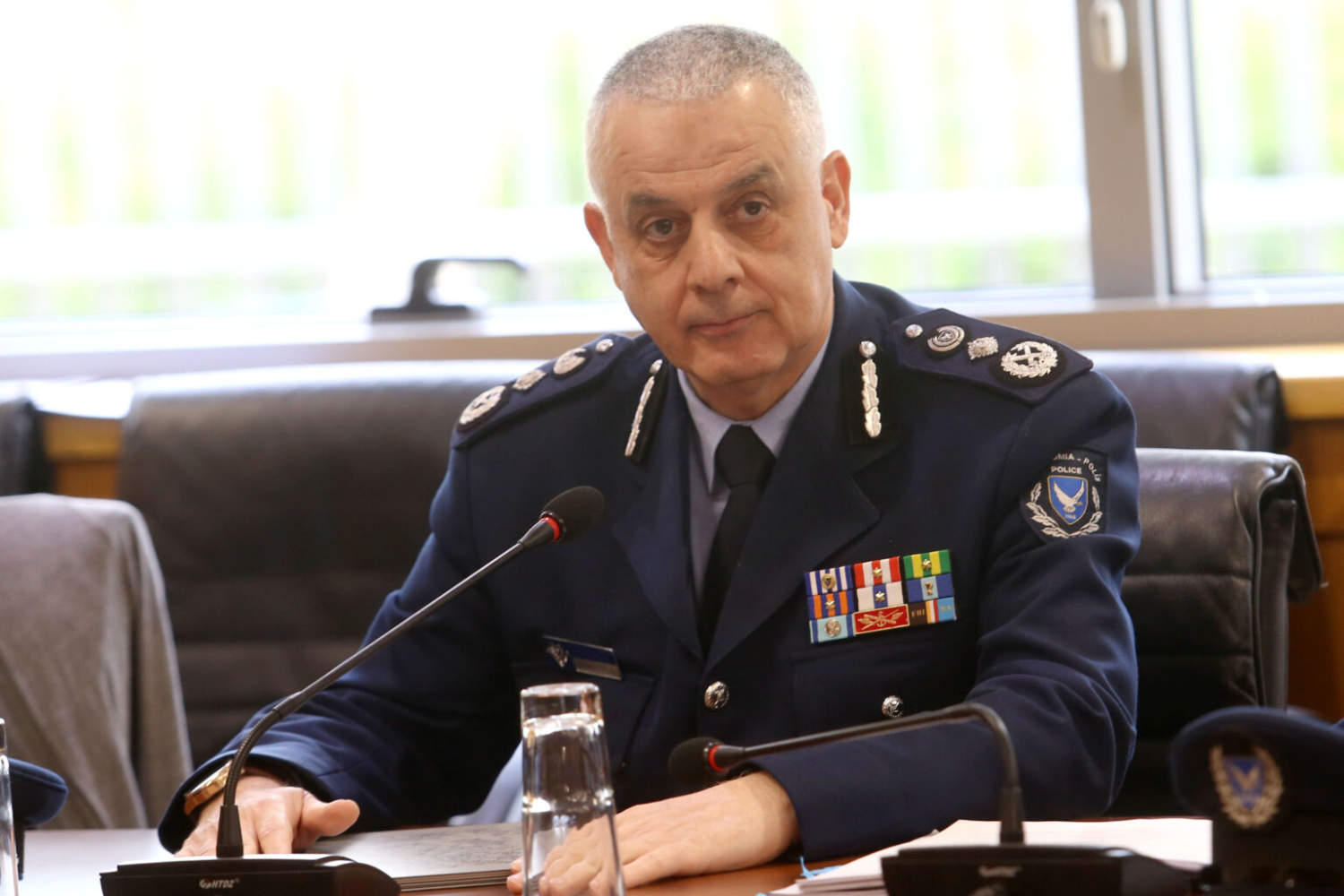
Cyprus Police Chief Themistos Arnaoutis has outlined his plans to modernise the force, dismantle organised crime networks and strengthen public safety through technology, intelligence-led policing and structural reforms.
In an interview with Phileleftheros, two years after taking office, Arnaoutis discusses his priorities and vision for the police force as it seeks to move beyond outdated practices and transform itself by 2030.
Arnaoutis acknowledges that modernisation has been slow in a force that has seen criminals consistently stay one step ahead. However, he says he is determined to change that through the use of technology.
He also sends a clear message to organised crime: no criminal network should consider itself untouchable or believe it can operate above the law.
On drug trafficking, he stresses that arrests and seizures alone are not enough.
“We must tackle the entire trafficking chain, from international networks to those financing and distributing drugs,” he says.
Arnaoutis also renews his call for legislation allowing the interception of telephone communications, subject to strict safeguards. He says the success of the ongoing police reform will ultimately be measured by its results and whether people feel safer in their everyday lives.
His vision for the new police force is clear: strong against crime, compassionate towards citizens and open to society.
The fight against organised crime
Can the newly established Directorate for Combating Organised Crime tackle criminal networks that have been entrenched for decades?
It is precisely because organised crime has developed extensive connections, financial power and complex structures that we need a strong, specialised unit to tackle it.
The directorate, which became fully operational on 12 October 2026, represents an important strategic decision. It brings key operational and investigative capabilities under a single command, with nationwide responsibilities.
Major operations, including Shield and Grid, have already taken place. We are also making use of our cooperation with Europol and other international agencies.
Our objective is not simply to arrest those who carry out criminal acts, but to identify who organises them, who finances them and who profits from them.
How would you describe the current state of organised crime in Cyprus?
Organised crime has evolved considerably. It makes use of technology, international connections and new methods of transferring money and illicit proceeds.
In Cyprus, it operates in areas such as drug trafficking, extortion, protection rackets, illegal betting, fraud and money laundering.
We cannot tackle organised crime as a series of isolated incidents. We need a comprehensive understanding of the situation, intelligence analysis, specialised police operations and international cooperation.
Is it possible to dismantle criminal gangs?
It is possible to dismantle criminal organisations, disrupt their activities and significantly restrict their capabilities. However, we must recognise that organised crime is constantly evolving. When one network is dismantled, new ones may emerge.
That is why we place particular emphasis on financial investigations. A criminal network is genuinely weakened when it is deprived of its illicit profits, financiers and the resources that allow it to continue operating.
Through the Directorate for Combating Organised Crime, intelligence-led policing and international cooperation, we are significantly strengthening our capabilities.
I want to send a clear message: no criminal network should consider itself untouchable or believe it can operate above the law.
Do you believe legislation allowing the interception of telephone communications would help tackle organised crime?
Lawful interception of telecommunications is an important tool in investigating serious crime, and many police forces around the world already use it.
Criminal networks use modern technology to coordinate their activities. We need corresponding capabilities to tackle them effectively. However, I want to be absolutely clear.
We are not asking for unchecked powers. We are asking for a modern legislative framework with strict conditions, institutional oversight and meaningful safeguards to protect citizens’ rights.
The legislative process is under way. This is an important tool that must complement our other operational capabilities.
Can modernising the police force make a substantial difference in tackling the drug problem?
Combating drugs is one of our most important priorities because the problem has serious consequences for young people, families and society.
Arrests and seizures are not enough. We must tackle the entire trafficking chain, from international networks to those financing and distributing drugs.
Intelligence, new technologies, financial investigations and international cooperation will significantly strengthen our capabilities.
At the same time, prevention is equally important. We need to work with the education sector, families, relevant government agencies and treatment providers.
Tackling drugs requires decisive police action, but also a collective effort across society.
From police radios to C3 and intelligence-led policing
You recently presented the Police 2030 programme. What exactly does it involve, and what do you hope to change?
Police 2030 is a comprehensive programme to modernise Cyprus Police. Our aim is to create a more modern, effective and operationally capable force that is also closer to the public.
The programme rests on three main pillars: improving operational capabilities through new technologies and modern equipment; modernising the organisation through better structures and coordination; and developing our personnel through training, new skills and modern working methods.
At the same time, we want to foster a new culture of openness, communication and cooperation with society.
We want a police force that is strong against crime, compassionate towards citizens and open to society.
Do you not think the modernisation of the police has taken too long, given that the force still relies on outdated equipment and methods in many cases?
Modernising the police is an ongoing process. Significant progress has been made in recent years, but we recognise that weaknesses, shortcomings and procedures requiring substantial improvement remain.
What matters is that we now have a comprehensive plan, with specific priorities and projects already under way.
From the moment I took charge of the police two years ago, modernisation became one of our main priorities. We worked systematically, assessed our needs and proceeded with planning and implementing significant changes.
Personally, I believe we should first plan properly, prepare thoroughly and make meaningful progress on a project before announcing it. I am not satisfied with announcements that produce no results.
Today, we are in a position to present a programme that is already being implemented and has the foundations needed to move forward consistently.
What is the main objective of this major reform programme leading up to 2030?
Our ultimate objective is very clear: to continually strengthen the protection of human life, citizens and the smooth functioning of society.
That means more effective crime prevention and enforcement, faster responses to incidents, better use of our resources and improved services for the public.
It also means having a police force capable of responding to modern threats, from organised crime and cybercrime to everyday security challenges.
And, of course, it means having a police force that communicates, listens, explains and works with society.
The success of this reform will be judged by its results and whether people feel safer in their everyday lives.
A stronger police presence and faster response times
How can crime be reduced and officers respond promptly when some police stations have only one or two officers on duty at night?
This is a genuine issue that concerns us, and we are addressing it as part of our wider planning.
We are looking at how to improve the allocation of personnel and available resources to strengthen police stations and patrols, particularly in areas and at times when demand is higher.
We are also strengthening community policing and bicycle patrols to make the police more visible on the streets, in neighbourhoods and within local communities.
Adequate staffing is undoubtedly important to the effectiveness of the police. Equally important, however, is how we organise, coordinate and deploy our personnel.
Our aim is to provide a stronger and more effective police presence where it is needed, and to respond to the public more quickly and effectively.
How have police officers responded to the changes you are introducing?
During October, I held 16 meetings across Cyprus, attended by around 4,000 police personnel, representing nearly 70% of the force.
I wanted to meet our people personally, present our vision and plans to them and, above all, listen to what they had to say.
I encountered considerable interest, a positive response and enthusiasm. Naturally, there are also reservations. That is entirely normal. Any meaningful change raises questions and requires time for people to adapt.
What matters is that change must begin from within. Our people need to understand, believe in and actively participate in this effort.
Police 2030 is not a programme that concerns only the leadership. It concerns every woman and man serving in the police. It is our responsibility to move forward together.
How exactly will the new C3 Operations Centre work, and what will its role be?
C3, which stands for Command, Control and Communication, will become the police force’s central operational coordination mechanism.
It is not simply a new control centre. It represents a different approach to commanding operations and managing incidents.
It will give us a comprehensive operational picture: what is happening, which resources are available, where they are and how they can be deployed more effectively.
Information will be turned into decisions more quickly, and those decisions into coordinated action.
C3 will be integrated with intelligence-led policing, our information systems and new communications capabilities, including NG112/eCall.
What will change with the introduction of intelligence-led policing?
Intelligence-led policing represents a fundamental change in the philosophy and operation of the police force.
Today, much of our operational activity focuses on responding to incidents after they occur.
With the new model, we aim to become more proactive and targeted in our approach.
We will systematically use information from our departments, our daily contact with citizens, open sources and cooperation with other authorities.
By cross-checking and analysing that information, we will be able to identify criminal trends, networks and areas of heightened risk, allowing us to intervene earlier and more effectively.
We want to move from reaction to prevention, and from fragmented information to evidence-based operational decisions.
How will people experience the changes you are introducing in their everyday lives?
For me, this is perhaps the most important question. People must experience these changes in practice: in faster response times when they need help, in the police presence in their neighbourhoods, in road safety and in the protection of children and vulnerable people.
We want a more approachable police force that listens to people, keeps them informed and deals with their problems professionally and respectfully.
Our mission is not limited to fighting crime. Above all, it is about protecting human life and society.
Public trust is not earned through announcements. It is earned every day through our actions and results.
“I want to leave behind a more modern and stronger police force”
How do you envisage the police force when you hand over leadership to your successor?
I would like to hand over a more modern, stronger and better-organised police force, with personnel who are properly trained and prepared to meet the challenges of our times.
A police force that makes use of technology, operates with modern methods and has the operational capabilities to tackle crime effectively.
Equally important to me, however, is having a police force that is more open to society, communicates, cooperates and earns the public’s trust every day.
I want to stress that this effort did not begin yesterday. We have been working systematically for two years, with careful planning, preparation and specific projects that are already under way.
It is also a collective effort that requires cooperation at both government and departmental levels.
I would particularly like to thank the Minister of Justice and Public Order, Costas Fitiris, for his cooperation and support, as well as the Deputy Minister of Research, Innovation and Digital Policy, Dr Nicodemos Damianou, whose ministry is making a substantial contribution to the technological and digital aspects of our modernisation.
I would also like to take this opportunity to express my deepest thanks to our people: the thousands of men and women in the police who work every day, often without recognition, with dedication, professionalism and personal sacrifice.
Society usually sees and knows only what makes the news. Behind those stories, however, lies an enormous amount of work that never makes the headlines.
Thousands of actions, both large and small, every day and every night, contribute to the safety of us all.
It is also thanks to these people, who are on duty every day, that we can all sleep more soundly at night. That is something that deserves everyone’s recognition and respect.
Police 2030 is not my personal programme. It is a legacy for the police force of tomorrow.
And if there is one thing I would like to leave behind, it is a police force that evolves alongside society so that it can protect it even better.
Strong against crime. Compassionate towards citizens. Open to society.

