


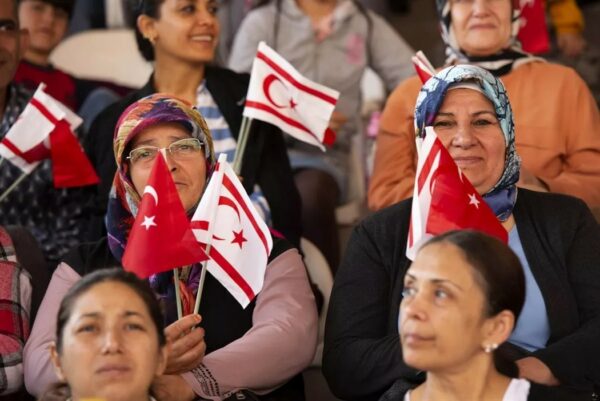
Increasing the Turkish population in occupied Cyprus is a strategic objective that Turkey has systematically pursued since 1975. Even today, settlers continue to arrive, either as seasonal workers who never leave or through the allocation of “social housing”.
The influx of settlers has become uncontrolled, yet remains part of a deliberate strategy, with Ankara pursuing policies of assimilation and settlement.
It is no coincidence that the breakaway entity refuses to disclose comprehensive population figures for the occupied territory. This is deliberate, as the transfer of settlers continues and reducing Turkish Cypriots to a minority remains a longstanding objective.
The occupying power’s strategy was clear from the outset.
First, in 1974, ethnic cleansing and the transfer of Turkish Cypriots to the occupied territories created two ethnically “pure” areas on the island.
Second, the settlement of the occupied territory through the transfer of people from Turkey began in 1975, consolidating Turkey’s presence in Cyprus.
Third, efforts to Islamise the occupied territories have continued systematically, despite opposition from Turkish Cypriots.
Complaints continue to emerge from the occupied north over the demographic situation, particularly the fact that both the number of settlers and the overall population remain closely guarded secrets.
On 6 October 2026, members of the Movement of Cypriots for Peace and Solidarity (Kıbrıslılar Barış ve Dayanışma Hareketi), during meetings in Brussels following an invitation from the European Commission, delivered a letter to Commission Vice-President and Special Representative for Cyprus Raffaele Fitto.
Signed by Şener Elcil, İzzet İzcan and Murat Kanatlı, the letter sets out the movement’s positions on the Cyprus problem while expressing concern about the demographic, economic and social situation in areas outside the effective control of the Republic of Cyprus.
The memorandum places particular emphasis on the situation of the Turkish Cypriot community, which it describes as politically weakened.
It also warns that Turkish Cypriots face the risk of demographic and cultural transformation, accusing Ankara of pursuing policies of assimilation and settlement.
The movement further accuses Turkey of transferring people to the “northern part” of the island and granting “citizenship”, thereby affecting the demographic composition and political will of the Turkish Cypriot community.
The letter also addresses the economic situation in the “northern part” of Cyprus, expressing concern about rising cases of money laundering, drugs, illegal gambling, uncontrolled property development and human trafficking.
A dossier containing 19 points accompanied the letter, intended to support the argument that the population of the occupied territories is larger than official figures suggest.
Among the figures cited were the following:
- In August 2026, there were 368,792 “insured” vehicles.
- In August 2024, there were reportedly 228,938 residential electricity meters.
- In 2026, the two mobile phone operators in the occupied north reportedly had a combined 1,193,119 subscribers, of whom 951,356 were active users.
- During the 2025–2026 academic year, there were 100,422 students at “universities”, including 13,914 “citizens” of the breakaway entity, 48,625 Turkish nationals and 37,883 nationals of third countries.
- According to figures from Turkey’s Ministry of Labour for 2025, 44,700 Turkish nationals and 83,794 third-country nationals were working in the occupied territories.
- According to figures periodically published by Turkish officials, between 35,000 and 40,000 soldiers are stationed in the occupied territories.
- According to figures from the breakaway entity’s “central bank”, 169,000 people were registered with its “social insurance” system in 2025, including 46,288 Turkish nationals and 43,545 third-country nationals.
- In Turkey’s 2023 elections, 140,111 Turkish citizens in the occupied territories were eligible to vote.
- In the 2023 “by-elections” in the occupied north, the number of registered voters stood at 210,121.
Attempts to mislead
Ünal Üstel, the “prime minister” of the breakaway entity, recently made statements regarding the population of the occupied territories, saying that “the country’s official projected population stands at 490,000”.
He explained that the figure was not based on a recent physical census but on a statistical projection used to plan public services and infrastructure.
He subsequently criticised older census methods, which required curfews and confined residents to their homes for hours.
Üstel also stressed that population monitoring should rely on modern technology, emphasising the development of electronic government services and an address-based registration system.
He defended the statistical method currently in use, questioning why a system of population projections that had worked successfully until now should be changed.
Meanwhile, Dursun Oğuz, the occupation regime’s “interior minister”, responded to criticism from the “opposition” over the failure to conduct a population census.
Speaking on 15 October 2026, Oğuz said the completion of the Address Registration System (MAKS) would allow population data to be monitored continuously and kept up to date.
He added that work on the system was continuing, with the process nearing completion in some municipalities and additional staffing support being provided to others.
The registration of streets and buildings had largely been completed, he said, with work now focusing on registering the people living in them.
Once MAKS became fully operational, he maintained, data could be updated daily, providing more recent information for planning purposes.
Oğuz also said traditional censuses, based on counting residents in their homes, were being replaced by systems of estimates and registration. Planning in the self-proclaimed “TRNC”, he added, was likewise based on population calculations and estimates.
Referring to the figure of 273,000 announced by the “Supreme Electoral Council” (YSK), Oğuz clarified that it covered “citizens” residing in the “country” and excluded those living abroad who were not entitled to vote.
Settlement is clearly a significant factor in advancing Ankara’s objectives in Cyprus. Turkey’s tight grip on the occupied territories is increasingly linked to efforts to consolidate the realities created by the occupation through relationships of dependence.
This is evident in the transfer of water through undersea pipelines and plans for electricity supplies. Settlement, however, remains the principal instrument for achieving these objectives, fundamentally changing realities on the ground.
Islamisation continues despite Turkish Cypriot opposition
Ankara’s plans also encompass the Islamisation of the occupied territories and the full alignment of their society with that of Turkey.
This is not a recent strategy. It is an ongoing process aimed at the complete Turkification of the area, involving education, religion and infrastructure projects that reinforce dependence on Turkey.
An estimated 211 mosques currently operate in the occupied territories.
For such a small geographical area with a relatively small population, this is an extraordinarily high number. Mosques are deliberately being built everywhere, not least because they help cultivate a particular culture among the population.
It is well known that more mosques than schools are being built in the occupied territories. Education and religion do not operate in isolation from other initiatives but are reinforced by them.
Why is this happening? Beyond the obvious reasons, Ankara’s objective is to transform the Turkish Cypriot community into a “Muslim” community.
Although this endeavour may be gaining some ground, it is not progressing as its architects would wish, since Turkish Cypriots do not embrace such thinking.
There is, of course, also the view that these efforts are intended to cater for the settler population. Turkish Cypriots, though not all of them, may oppose these policies, but the objective is clear and continues to be pursued on the ground.
Islamisation is linked to the integration, annexation and Turkification of occupied Cyprus.
An office in Mersin and the mass transfer of settlers since 1975: What confidential UN reports reveal
Settlement began in February 1975 but became more systematic and organised from May 1976 onwards. A dedicated office was established in Mersin to arrange the transfer of settlers to occupied Cyprus.
According to the fortnightly magazine Eikones (17 February–2 March 1978), the UN Secretary-General’s Special Representative expressed concern about the issue in a letter to Kurt Waldheim in July 1975.
He informed Waldheim that “several hundred Turks, mainly from Turkey, are being transferred every week and settled in villages in the Karpasia peninsula and in villages south of the new Famagusta-Nicosia road”.
A confidential report by the Swedish contingent of the United Nations in Cyprus, dated 2 August 1975 and entitled Immigrants through the Port of Famagusta, also recorded the movement of people through the port.
According to the report, 1,091 civilians entered through Famagusta port during the period under examination, while 472 departed. This indicated that 619 civilians had remained in Cyprus, of whom 475 were considered, beyond doubt, to be immigrants.
Information provided by a Turkish Cypriot indicated that 550 immigrants had entered through Famagusta port during the same period.
The immigrants were reportedly kept for 24 hours at a Greek Cypriot secondary school before being transferred to rural areas. They were not permitted to settle in the city of Famagusta.
Several Turkish settler families were accommodated in the village of Koma tou Gialou. An officer of the contingent, identified as NTEO, was to investigate whether other Turkish settlers had been accommodated in other Greek Cypriot villages in the district.
Captain Magnus Olander signed the report on behalf of the Famagusta area command.
Furthermore, in mid-November 1976, British Embassy officials in Ankara estimated that the Turkish Cypriot population had reached between 150,000 and 160,000, while around 900 people were travelling by ferry from Mersin to Cyprus every week.
By 1978, there were indications that 50,000 settlers had been transferred, mainly from regions of Anatolia.
In October 1976, the British newspaper The Guardian reported that “Turkish immigration into the Turkish-controlled areas of northern Cyprus is taking place on such a scale that it will soon radically alter the island’s ethnic balance and could seriously affect the prospects for a political settlement”.
The newspaper also reported that some settlers had been driven from their homes in Turkey.
As Eikones noted, this reference was reminiscent of the “method of exile” used by the Turks to transfer Turkish settlers to Cyprus following their conquest of the island in 1571.

