


Around 49,000 Democratic Rally (DISY) members are being asked to choose the party’s candidate for the 2028 presidential election, with Averof Neofytou and Giorgos Pamboridis competing for the nomination. It is the first time in Cyprus’s political history that the party’s presidential candidate is being selected directly by its grassroots membership. However, this is not the first time DISY members have chosen their candidate. Similar contests took place in 1992 and 2012, although on those occasions the decision was made by the party’s Supreme Council.
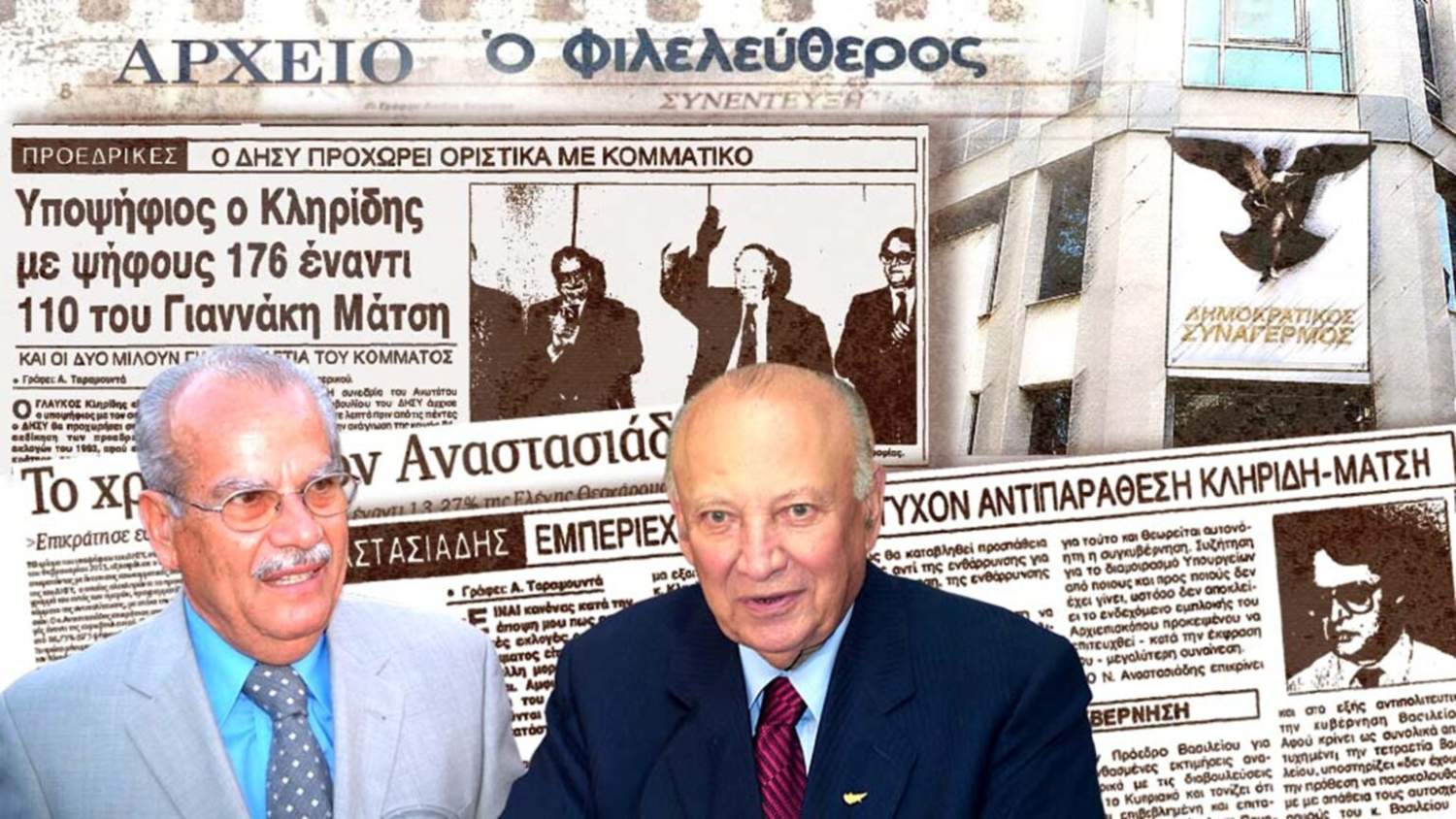
The rich archive of Phileleftheros brings those earlier internal battles back into focus through reports, articles and interviews published at the time, capturing the political climate and tensions surrounding the party.
The newspaper’s pages reveal the leading figures, rivalries, challenges and expectations that shaped DISY’s course and influenced the outcomes of the presidential elections.
DISY: Yiannakis Matsis declares he will run for president
In February 1992, journalist Androulla Taramounta reported in Phileleftheros that then DISY deputy leader Yiannakis Matsis intended to seek the party’s nomination for the 1993 presidential election.
Matsis had reportedly told those around him that he would be a candidate regardless of Glafcos Clerides’s decision, signalling his intention to challenge for the nomination and setting the stage for the strategy he would pursue ahead of a two-day meeting of the party’s Political Bureau in Ayia Napa at the end of the month. The main item on the agenda was the presidential election.
It was the first time Clerides’s candidacy had faced a challenge within DISY. Attention had also turned to DIKO, with the aim of securing cooperation between the two parties and, potentially, forming a coalition government.
Matsis was not the only DISY figure interested in the nomination. According to reports at the time, second deputy leader Alecos Michaelides had also considered running, although he eventually decided not to seek the nomination.
Meanwhile, behind-the-scenes consultations had begun within DIKO over possible candidates. DISY’s proposal to DIKO envisaged the formation of a coalition government if the two parties won the election.
Then DIKO leader Spyros Kyprianou was also considering a presidential bid and was even contemplating putting himself forward as a joint candidate with DISY. His main argument was that he could attract voters from the political centre, something Clerides could not do. People close to DIKO also argued that Kyprianou could win back voters dissatisfied with Glafcos Clerides’s handling of the Cyprus problem under the Vassiliou government.
Anastasiades: A confrontation between Clerides and Matsis could carry risks
As expected, Matsis’s candidacy caused unease within DISY. Party officials feared that a challenge to party leader Glafcos Clerides by his deputy would create divisions, introspection and confrontation.
In an interview with Phileleftheros journalist Androulla Taramounta on 15 March 1992, then party deputy leader and future president of the Republic Nicos Anastasiades sought to calm tensions.
He argued that, as a general rule, a party leader should not be challenged in presidential elections, but rather at party congresses convened to elect or replace party officials.
Anastasiades said Matsis’s candidacy was not intended to challenge the party president, but rather to offer an alternative route to an agreement with DIKO, given that Clerides’s own candidacy would create an insurmountable obstacle to cooperation.
He insisted that the submission of a second candidacy alongside Clerides’s did not necessarily constitute an internal party dispute. However, he warned that a possible confrontation between the two carried risks.
“Whether we like it or not, however calm the circumstances may be, once candidates are pitted against each other, there will be, or may be, some bitterness on the part of whoever loses the election. Consequently, this is something that worries many of us, and I do not hide the fact that efforts will be made to encourage consensus rather than encourage a challenge,” he said.
Anastasiades also stressed that the DISY Political Bureau’s decision to contest the presidential election with a party candidate would not be overturned.
He revealed that a long-term plan for cooperation between DISY and DIKO had been drawn up, envisaging the two parties alternating in government. He also did not rule out the involvement of the then Archbishop in an effort to achieve broader consensus.
He firmly rejected suggestions that DISY would dilute its positions on the Cyprus problem for party political reasons. He also made clear that he had no interest in running in that particular election, adding: “He who rushes stumbles!”
Clerides and Matsis compete for the nomination before DISY’s Supreme Council
On 27 May 1992, DISY held its internal election, with Clerides and Matsis competing for the party’s presidential nomination.
The candidacies were submitted to the party’s Political Committee at 4 pm. The committee then prepared its recommendation for the Supreme Council, which convened half an hour later.
Clerides and Matsis had agreed in advance to issue a joint statement before party officials. Debate was avoided both at the Political Committee and at the Supreme Council meeting.
A secret ballot followed. Only elected members of the Supreme Council were entitled to vote. The party president’s appointed advisers and other members participating by virtue of their office were excluded.
The party’s officials and senior figures numbered 301.
DISY had already decided that, regardless of the choice of its presidential candidate, dialogue with DIKO should continue. However, a letter from DIKO, which arrived at the party’s offices one day before the vote, placed the question of cooperation on a different footing.
DIKO reiterated that it had never directly or indirectly ruled out supporting a DISY candidate as a mutually acceptable presidential nominee. At the same time, however, it demanded a say in the selection of the person who would contest the presidency.
Clerides wins nomination with 176 votes against Matsis’s 110
Glafcos Clerides defeated Yiannakis Matsis in the internal contest and secured DISY’s nomination for the presidential election.
According to a Phileleftheros report published on 28 May 1992, Clerides received 176 votes against Matsis’s 110. A total of 289 party officials voted, out of 308 who were entitled to participate.
Following his victory, Clerides said he would continue dialogue with DIKO in an effort to form an alliance for the presidential election. Matsis said he would stand alongside the successful candidate and fight for victory in the presidential race.
Debate at the Supreme Council meeting had been avoided to prevent tensions or exchanges between party officials with opposing views on the presidential nomination.
The joint statement issued by the two candidates also helped reinforce two key commitments.
First, whoever won would become DISY’s undisputed candidate, with the support of all party officials, senior figures, members and supporters without exception.
Second, DISY would remain united and undivided at every level, with the primary objective of fulfilling the aspirations of its supporters: above all, securing a fair settlement of the Cyprus problem and bringing a DISY president to power.
Glafcos Clerides was elected president of the Republic on 28 February 1993, defeating incumbent president George Vassiliou. He was re-elected in 1998. Yiannakis Matsis became DISY president in 1993 and remained in the post until 2004.
DISY’s 1,000-member council chooses between Nicos and Eleni
The second time DISY’s Supreme Council was called upon to select the party’s presidential candidate was on 17 March 2012.
It was a particularly difficult period for the Republic of Cyprus. The country was in the grip of an economic crisis, following the deadly explosion at the Mari naval base, which claimed 13 lives. Against this difficult political, economic and social backdrop, the 2013 presidential election was considered crucial for the country’s future.
As Phileleftheros journalist Andreas Pimpisis wrote at the time, after 20 years, DISY was once again holding an internal vote to select its candidate for the presidential election scheduled for February 2013.
The nomination was contested by then DISY leader Nicos Anastasiades and former MEP Eleni Theoharous, who were due to present their positions and views on the presidential election before the 1,000 members of the Supreme Council.
The two contenders chose to keep their campaigns relatively low-key ahead of the vote.
Anastasiades had made clear that he would neither make telephone calls nor send messages seeking support for his candidacy. Theoharous, for her part, also avoided making her speech to the Supreme Council the main vehicle for promoting her positions.
Proceedings began at 10.30 am at the Hilton Park hotel. The two candidates were the only speakers, and a secret ballot followed immediately afterwards. A total of 1,005 Supreme Council members were entitled to vote.
Anastasiades secures the nomination
The contest produced a decisive victory for Nicos Anastasiades, who secured 86.73% of the vote, with 673 votes, against 13.27% and 103 votes for Eleni Theoharous.
A total of 781 members voted out of a reported 1,008 members. Turnout was considered highly satisfactory, reaching 88%.
Voting began at around 12.30 pm and ended at 4.30 pm. Glafcos Clerides was the first to cast his ballot, followed immediately by the two candidates, Anastasiades and Theoharous.
Clerides’s appearance in the conference hall was greeted with warm applause from Supreme Council members.
Anastasiades’s first message after the result was announced focused on change and cooperation with political forces other than AKEL. Standing alongside Theoharous, he expressed confidence that they would move forward together and agreed to meet for a more detailed discussion.
During his speech, the DISY leader also outlined some of the main elements of his policy programme, repeatedly signalling his willingness to work with parties in the political centre.
He thanked Theoharous for having the courage to stand, saying her decision had broadened the party’s choices.
Theoharous, for her part, said she respected the result, although she disagreed with the procedure, arguing that the candidate should have been chosen by the party’s grassroots membership.
Despite the messages of unity and respect for the outcome following Anastasiades’s clear victory, the atmosphere at the Supreme Council was tense from the outset.
Anastasiades received warm applause, while Theoharous’s reception was noticeably more subdued. Several delegates regarded her candidacy as a challenge to the party leadership.
Tensions peaked when Theoharous questioned the procedure for selecting the presidential candidate, effectively expressing her disagreement with it. Her remarks prompted jeers and strong reactions from delegates.
Anastasiades intervened immediately, calling for calm and asking delegates to allow the MEP to finish her speech. He said he did not consider that anyone was being insulted.
Nicos Anastasiades was elected president of the Republic on 24 February 2013 and re-elected in 2018. Eleni Theoharous left DISY in 2015 and founded the Solidarity Movement.

