


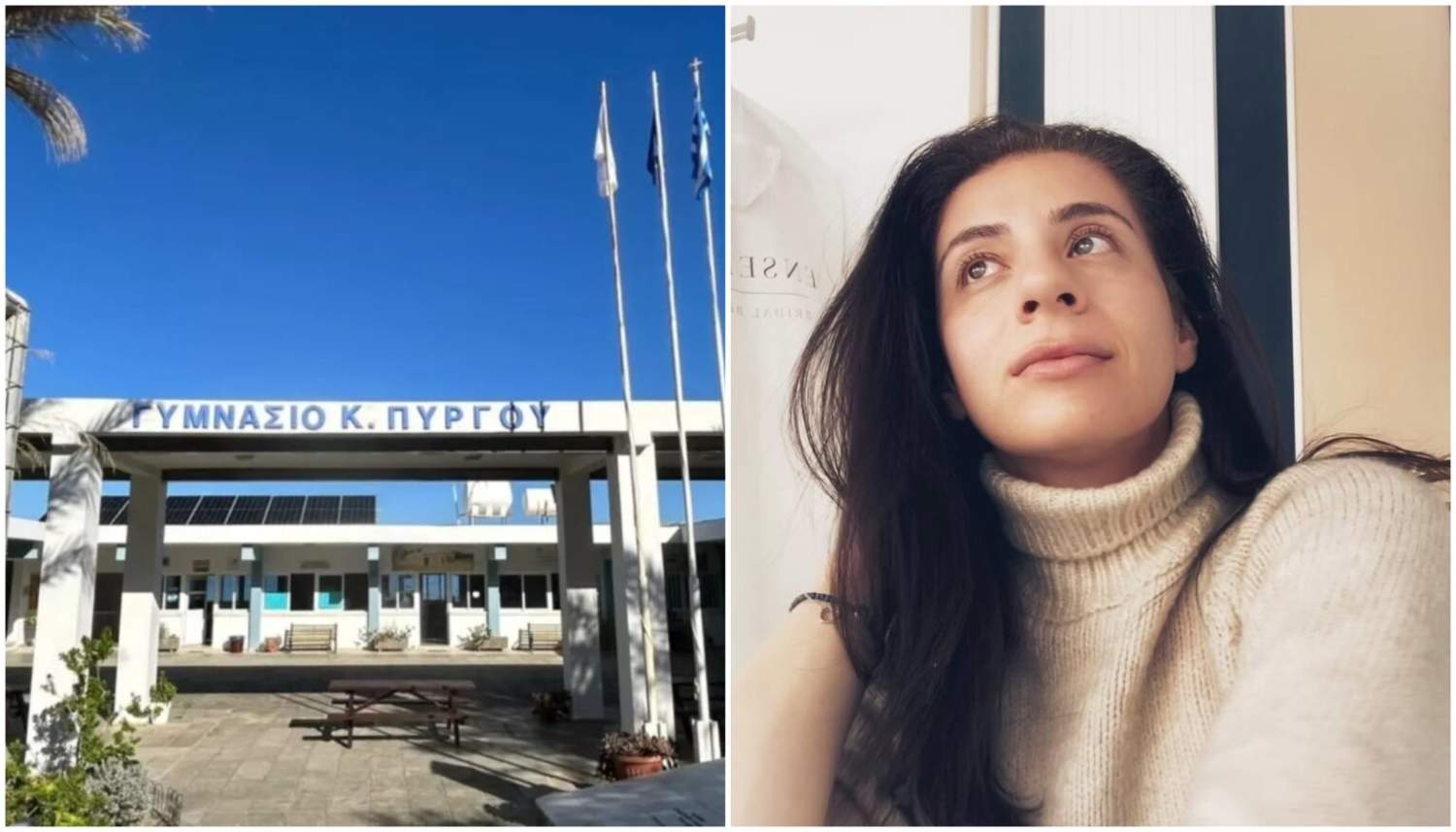
Every morning at 5.15 am, Anna Hadjistathi, a maths teacher and mother of two from Larnaca, sets off on a two-hour journey to reach her classroom at Kato Pyrgos Secondary School by 7.15 am.
Her daily commute demands patience, determination and personal sacrifice. But at the end of that journey lies a school unlike any other.
I first came across Anna on TikTok. The videos and photographs she posted from the school where she works in Kato Pyrgos, Tylliria, caught my attention. The images were strikingly beautiful, with the sea embracing the school and the surrounding landscape creating a breathtaking setting. Behind those images, however, lay a remarkable human story.
Last year, after eight years of teaching at a private school, Anna received her first appointment in state education. Her first posting was to Cyprus’s most remote state school. The news, she recalls, caught her completely off guard.
“I didn’t even know how to get there. I’d open the map and see the route going on and on. I kept wondering when I would get there. It seemed endless to me. It was something completely unfamiliar.”
Her family’s support proved crucial. Both her parents and her husband encouraged her to accept the appointment and embark on this new chapter. During the first few weeks, a colleague helped her until she became familiar with the route and felt confident enough to make the journey on her own.
A crossing point, a daily journey and the legacy of displacement
The journey to Kato Pyrgos is more than just a lengthy daily commute. To reach her school, Anna has to pass through the Zodhia crossing point, a crossing that remains an emotionally charged and sensitive issue for many people.
Anna grew up in a family of refugees. As she explains, travelling to the occupied north was never an option for her family.
“My parents had never been through a crossing point. The experience of being refugees, the invasion and everything we carry with us were deeply felt in our home. We believed that if we went, we would have to show our identity cards and recognise something we didn’t want to recognise. That was our mindset.”
Her first teaching appointment, however, presented her with a challenge: finding a way to fulfil both her professional and family responsibilities.
“I have to go to school and teach, but I’m also a mother and I need to get home during the day. Taking the route through the crossing point is the only way I can manage all my responsibilities,” she explains.
The alternative route through the government-controlled areas, travelling from Larnaca through Limassol and Paphos to Kato Pyrgos, would mean spending a total of seven hours on the road. Passing through the Zodhia crossing point therefore became her only practical option.
Yet the sights along the way evoke memories of the past.
“You see the houses and think that some of them are exactly as our families left them back then. You think, our grandfather built that house, our grandmother planted that tree. Those of us who had never been there thought everything had stayed as we left it.
“But you see that there has been development. People are cultivating the fields, planting orange trees, building universities and houses. If I hadn’t gone, I wouldn’t have known,” she says.
This year, Anna shares the journey with colleagues, making the long commute more enjoyable.
A school of 26 pupils with the sea as its playground
After two hours on the road, Anna arrives in Kato Pyrgos, where the sea and surrounding countryside provide a remarkable setting for the school.
Kato Pyrgos Secondary School covers all six years of secondary education and has just 26 pupils this year. Teaching groups consist of two to five pupils, while the largest year group, the penultimate year of upper secondary education, has only eight.
It is an entirely different educational environment, one that changes the way teachers approach their lessons.
“It’s a very special school. The children grow up differently from those who live in a city or a village close to one. They are far from Polis Chrysochous, Paphos and Nicosia. It takes a great deal of time for them to travel anywhere and take part in activities.”
Geographical isolation inevitably shapes their daily lives. Their experiences are different, and opportunities for extracurricular activities are limited. But there is another side to this reality, one that Anna finds particularly beautiful.
“The pupils are calmer. They don’t have the stress and pressure that children in the city might experience, rushing from one activity to another. They have fresh air, the sea and nature. It’s a different environment.”
Teaching, too, adapts to these surroundings.
“It’s much easier to do something creative with three children. You can tell them, ‘Today we’re going to have our lesson by the sea.’ You can’t easily take 25 children from a city school to the seaside for a lesson.
“But here we can organise lots of outdoor activities, take them cycling and swimming, and make the most of our surroundings.”
The young guardians of Cyprus’s frontier
What has particularly impressed Anna is the character of her pupils. She does not describe them as children who feel deprived of the opportunities available to their peers in cities. Instead, she sees young people who understand their circumstances, feel deeply connected to their home and have a strong desire to remain there.
“They are proud children. They know where they are and where they live. They know they are on the very edge of our Cyprus, with the occupying army right next to them.”
Their love for their country, she explains, is evident in their everyday lives.
“They take part in national commemorations, go to church and keep local customs and traditions alive. They love Cyprus very much.”
They are also children who have learnt to live close to nature. They work in the fields, help their families, chop wood and go hunting.
“They are happy living where they are. I haven’t heard them say they want to leave. On the contrary, as they grow up, they want to return to their home community. They want to support their village, their families, their farmland and their properties.”
Life, however, is not always easy. Pupils in their final year of secondary school often have to travel after school for private tuition in Paphos, Polis Chrysochous or even Nicosia.
They leave at midday and return late at night, following a routine that demands patience and endurance.
“We don’t go there just to get paid at the end of the month”
The school’s 26 pupils are more than names on a register. They are children whom their teachers know personally, along with their worries, joys, struggles and family histories.
“You get to know the children on a much deeper level. It’s not simply a matter of going there, teaching and leaving. Because the school is small, you develop an even closer bond with them.”
More than 20 teachers work at the school, supporting a small community of pupils with its own distinct needs and circumstances.
For Anna, her role extends beyond teaching maths. She wants to instil values and life skills in her pupils, including perseverance, patience and discipline, encouraging them to pursue their goals and never give up.
She knows, too, that she is not the only teacher who travels long distances to do a job she considers a vocation. Many of her colleagues leave their families every day and cover considerable distances, sacrificing personal time and rest.
“We’re not asking for anything special, just recognition of the time and moments with our families that we sacrifice to give something to these children. We don’t go there simply for the salary or the service points. We go because we love what we do. It’s a vocation.”
Anna’s story is about much more than a daily journey of 240 kilometres. When we asked what message she wanted to leave with her pupils, her answer summed up her entire philosophy.
“When you love something and truly want it, you can overcome every obstacle and difficulty.”
And perhaps that is the most important lesson she teaches every day in Kato Pyrgos. A lesson that is not written on a whiteboard, cannot be found in any maths textbook and is not graded with numbers.

