


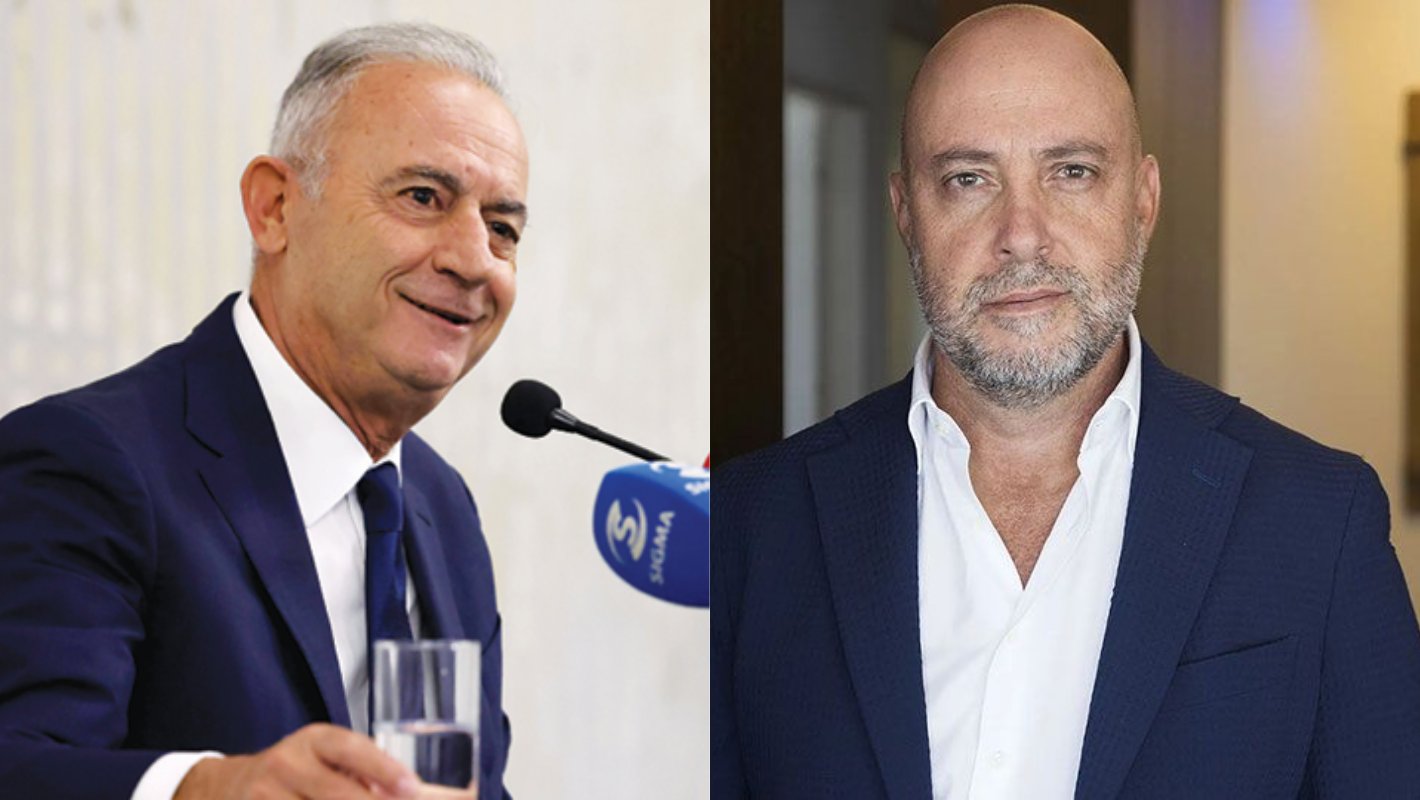
Tomorrow, for the first time in the party’s 50-year history, every member of the Democratic Rally (DISY) will be asked to decide whether Giorgos Pamboridis or Averof Neophytou is the right candidate for the 2028 presidential election. In other words, they will be choosing the party’s candidate. They will not, of course, be choosing the next president. I make the point because, amid everything we have heard over the past two or three months, the impression has somehow taken hold that DISY members are about to elect the next occupant of the Presidential Palace.
The party faithful are naturally entitled to believe that whoever is announced on Saturday night will go on to win the presidential election too. I honestly don’t know whether DISY’s headquarters on Pindarou Street still thinks so. A few months ago, the party leadership seemed sure of it. Today it probably takes a cooler view, with its 27.1% in May’s parliamentary elections and its failure to make the 2023 run-off staring it in the face.
For 2028, DISY has opted for a different way of choosing its candidate, one tailor-made for the party rather than for wider society. The result will be a party candidate. On Saturday night they may call it a “festival of democracy”, or whatever else comes to them when the result is announced.
We heard the “festival of democracy” line before, when Pindarou grandly announced that the candidate would be elected by the party’s 48,000 members. The figure is certainly impressive when you consider that DISY received 101,013 votes in May. In other words, almost one in two of its voters is also a registered member.
Numbers may stir enthusiasm, but they usually bring you back down to earth. That is already showing in the reports of colleagues on the party-politics beat. The benchmark is the last round of internal elections: in 2023, turnout reached 21,000 to elect the party leader, and shortly afterwards it fell to 17,000 for the other top leadership posts.
Measured against today’s register of 48,000, those figures amount to a turnout of 43.75% for the leader and 35.42% for the other top posts.
For tomorrow’s vote, the optimistic scenario (whose? the party’s or the reporters’?) puts turnout at around 15,000. If that proves right, one in three DISY members will vote. And those 15,000 are a mere 14.85% of those who voted DISY in the parliamentary elections.
Either way, whoever wins will represent a section of DISY, not the party as a whole. Everyone knows this, however hard they try in public to convince people that the entire Democratic Rally stands behind “the chosen one”.
I may be told that all this is being said deliberately, to cast doubt on the process, and that the arithmetic is being used maliciously.
But I am not the one who turned a purely internal party matter into a major electoral issue. Low turnout in internal party ballots is not peculiar to Cyprus; it happens almost everywhere. The problem is that DISY, by its own choices, has boxed itself into a numbers game, advertising a vote in which “48,000 members are entitled to take part”, and so on.
Those at Pindarou should have known better than anyone that these days not everyone rushes to the ballot box, however loyal to the party they may be. As it is, they have blown out of all proportion something that could have been far simpler, and created the impression that this is a mini presidential election.
But this is not a presidential election. It is the choice of a candidate. DISY’s real test begins on Sunday: whether the loser and his camp will stand behind the winner. To reach the second round, a section of the party will not be enough. A candidate needs the whole of DISY, and plenty of people beyond it.

