


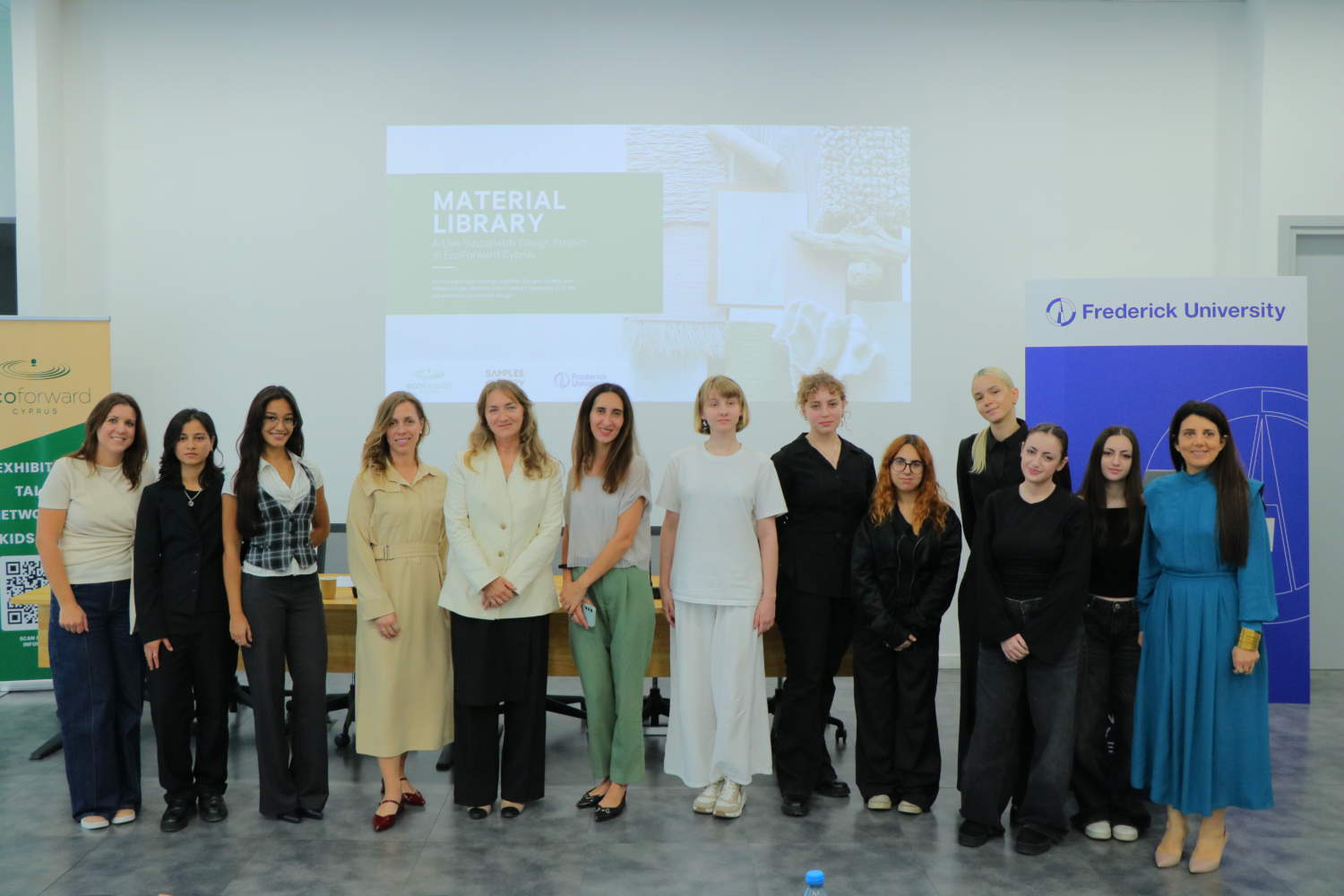
Frederick University students will build an installation from discarded materials live at the EcoForward Cyprus exhibition in Limassol on 29 November, turning textiles, marble and rope into furniture and interior objects, the university said.
The project, called Material Library, reverses the usual design process. Instead of starting with an idea and then looking for materials to realise it, the students will begin with what is available and let the materials guide their creative choices, experimenting with texture, shape and structure.
Visitors to the sustainability exhibition at St Raphael Resort will be able to watch the students’ choices, experiments and the full construction process up close.
Textiles, ropes, wires, slabs, marble and other surplus materials will form the building blocks of the installation. The university said the aim was not only to reuse materials that would otherwise be thrown away, but to show how limited resources can encourage creativity rather than restrict it.
The project is being developed with Samples Gallery and interior design students from the Department of Arts and Communication at the university’s Limassol campus, under the guidance of Assistant Professor Anna Merry-Economou.
The materials were donated by Samples Gallery, a Limassol-based design resource gallery holding thousands of samples of textiles, surfaces and finishes, and Pit-to-Table, a Cyprus company that turns discarded olive pits into panels for furniture and interior design.
The concept was presented on Monday at the Limassol campus. Speakers included Natassa Frederickou, President of the Frederick University Council, and Lusine Mirzoyan, founder of EcoForward Cyprus. Students Aglaia and Thea Filippidou presented the team’s creative approach on behalf of the 11 students taking part.
The project is part of the Frederick University Living Lab (FULL), the university’s initiative linking hands-on learning with real-world challenges through collaboration between students and organisations.
The university said the Department of Arts and Communication, which has a 40-year history in visual arts and communication, treats reuse and responsible use of resources as an integral part of students’ learning.

