


An alleged plot to assassinate Avraam-Minos Moisis in Athens is the latest chapter in the Iranian regime’s record of exporting terrorism. Moisis, a Greek Jewish businessman, former president of the Jewish Community of Athens, and board member of Intracom Defense, was reportedly the intended target.
North Macedonia’s national security service describes a network of organized criminals preparing to kill him in Greece at the direction of an Iranian national linked to members of Iran’s security apparatus. Working with Greece’s intelligence service and Mossad, investigators uncovered clandestine meetings, including some in Iran.
Behind the thwarted plot lies a method familiar to European intelligence services: intermediaries, recruited criminals, and a chain of command designed to keep Tehran out of sight.
It identifies the alleged intermediary as Edris Jahangiri Mavaneh, an Iranian national with ties to Iranian intelligence and to drug trafficker Naji Sharifi Zindashti. Tehran again denies involvement. The investigation continues.
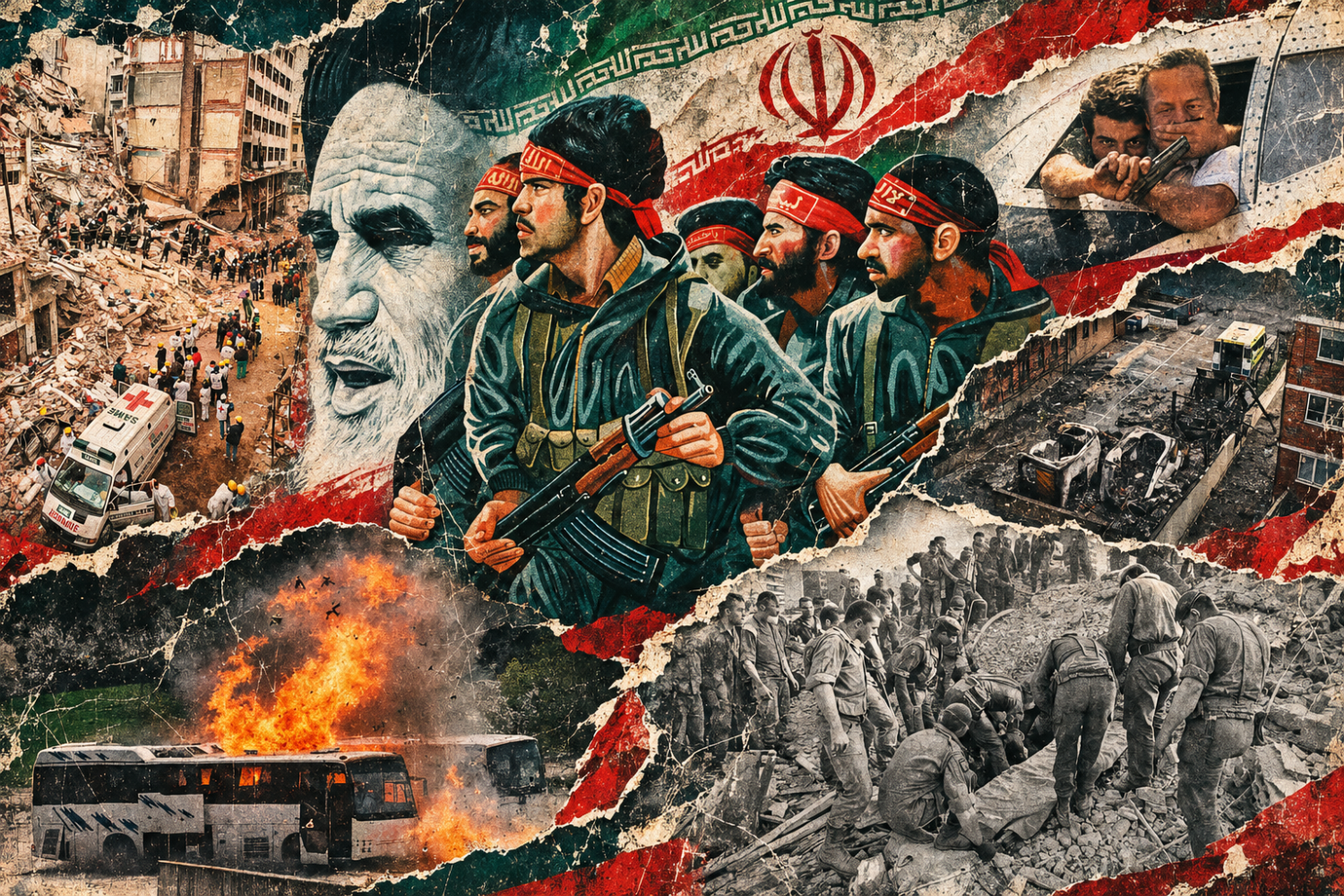
Since the 1979 Islamic Revolution, Iran has been linked to the murder of dissidents, deadly attacks on Israelis and Jews, and plots far beyond the Middle East. US intelligence describes it as the world’s leading state sponsor of terrorism. The Moisis case brings that history close to Greece and Cyprus, where the threat has left an operational footprint. The perpetrators include state operatives, members of the terrorist organization Hezbollah, and, increasingly, paid criminals who can be easily replaced.
Cyprus and Greece
In 2012, Hossam Taleb Yaacoub in Cyprus tracked the arrival of Israeli tourists, buses, and hotels for Hezbollah. He was convicted of membership in a criminal organisation and money laundering. The court found no innocent explanation for his surveillance of Israeli targets but did not convict him of attempting a specific bombing. That distinction matters: many operations are uncovered while targets are still being scouted.
Three years later, authorities found 8.2 tons of ammonium nitrate in a house in Larnaca. The arrested man, Hussein Bassam Abdallah, was linked to Hezbollah. The case showed how extensive an operational infrastructure could be built on the island before any bomb went off. A 1988 bombing near the Israeli embassy in Nicosia killed three people and has been attributed to Iran. However, that attribution was never established in court and cannot be stated as fact.
Greece has seen a similar pattern. In 2023, Greek police and intelligence announced that they had dismantled a network planning an attack on a Jewish-linked target in Athens. Two Pakistani nationals were arrested; authorities said the instructions came from someone in Iran. The use of third countries and recruited operatives resembles the latest case.
The history goes further back. Authorities linked the 1985 hijacking of TWA Flight 847 after its departure from Athens to Hezbollah, which Iran supported.
Global terrorism
On 23 October 1983, an attack on Beirut’s eight-story Drakkar building killed 58 French paratroopers and the family of its Lebanese caretaker. Another attack that day killed about 250 American servicemen. Rescuers searched the wreckage for four days and nights.
In Berlin, four Kurdish dissidents were murdered at the Mykonos restaurant in 1992. A German court concluded in 1997 that Iran’s highest political leadership had ordered the killings. This was a judicial finding after a trial, not merely an intelligence assessment. Germany suspended political dialogue with Tehran and recalled its ambassador.
Kurdish leader Abdolrahman Ghassemlou was murdered in Vienna in 1989 while meeting Iranian interlocutors; dissident Kazem Rajavi was killed in Switzerland in 1990. In France, murders of exiled opponents and deadly Paris bombings in the 1980s sent the same message: leaving Iran did not guarantee safety.
Israelis and Jewish institutions have been another category of target. In Burgas, Bulgaria, a 2012 bombing of a bus carrying Israeli tourists killed five passengers and their Bulgarian driver. Two Hezbollah members were convicted in absentia.
In London in 2015, authorities discovered a large Hezbollah-linked stockpile of ammonium nitrate before any target or date for an attack had been established.
A different face of the threat emerged in 2018: Iranian diplomat Assadollah Assadi was convicted in Belgium for his role in a plot to bomb an Iranian opposition gathering near Paris. Dutch intelligence linked Iran to the murders of two dissidents in the Netherlands in 2015 and 2017. Dutch authorities later reported indications that Iran was responsible for the 2023 attempt on Alejo Vidal-Quadras in Madrid.
In London, the threat reached the newsroom. Pouria Zeraati, a presenter for the Persian-language broadcaster Iran International, was stabbed outside his home in 2024; a British court found the attack had been carried out on behalf of the Iranian state. The station’s premises were targeted in an attempted arson attack in April 2026. On 12 November, two Iranians were convicted in Britain of spying for Iran against journalists and other targets. One had also prepared for serious violence and demanded £150,000 to “finish off” a target. According to a US indictment made public this month, the attempt against the station was part of a wider 2026 campaign. It cites the arson of four ambulances belonging to A Jewish service in Golders Green, synagogues and other London targets, and incidents in Paris and Amsterdam. Three men are accused of coordinating activities under the name HAYI in support of Iran’s Revolutionary Guards and the Iraqi terrorist organization Kataib Hezbollah. The indictment also describes a September plot against RAF Fairford, a British air base hosting US aircraft and personnel. These are allegations in an indictment, not convictions.
Sweden’s security service has warned that Iran uses criminal networks there as well.
More than 100 plots
Research by the International Centre for Counter-Terrorism records 102 Iranian external operations or plots in Europe between 1979 and 2024, including 54 in 2021–24; the total also covers surveillance and preparation. Separately, MI5 said in 2025 it had identified more than 20 potentially lethal Iran-backed plots in Britain within a year.
The suspected Athens plot reflects a decades-old method: orders cross borders and pass through middlemen and criminals until the sponsor becomes difficult to trace. A Greek businessman in Athens can find himself in the same operational landscape as an Iranian journalist in London or a dissident in Berlin. The personnel change; the strategy does not. Tehran acts as though it can pursue, intimidate, and kill anyone it calls an enemy, wherever they live. That threatens people everywhere.
Sanctions: Too Little, Usually Too Late
On 17 March 1992, a car bomb destroyed Israel’s embassy in Buenos Aires, killing 29 people, according to Argentina’s official count, and injuring more than 200. On 18 July 1994, another bomb devastated the city’s AMIA Jewish community centre: 85 people died and hundreds were injured.
Argentine courts attribute the attacks’ execution to Hezbollah and link their planning to Iran’s leadership. A 2024 federal ruling considered the two bombings part of the same strategy. In September 2026, Judge Daniel Rafecas charged seven Iranians and one Lebanese national over AMIA, opening the way for a trial in absentia. Years of investigative failures and cover-up are also part of this history.
In 2007, Interpol approved six Red Notices in the AMIA case, including for former Iranian officials and Hezbollah’s Imad Mughniyeh. Such notices help locate suspects and seek their provisional arrest under national warrants; they are not, by themselves, international arrest warrants.
American sanctions preceded the Argentina attacks. On January 19, 1984, Washington designated Iran a state sponsor of terrorism, restricting aid, arms sales, dual-use exports, and financial dealings. In 2007, it designated the Revolutionary Guards’ Quds Force for terrorism-related sanctions; in 2019, it listed the entire Islamic Revolutionary Guard Corps as a Foreign Terrorist Organisation. It has also sanctioned individuals tied to Iran and Hezbollah.
Argentina froze Hezbollah assets and took measures against Iran-linked AMIA suspects in 2019. In January 2026, it added the Quds Force and 13 associated individuals to its terrorism-financing register; in March, it added the entire Revolutionary Guard Corps.
Europe moved more slowly. Following Burgas, the EU listed Hezbollah’s military wing as a terrorist entity in 2013. In 2019, after thwarted European plots, it added two Iranians and a directorate of Iran’s intelligence ministry. On 19 February 2026, the EU listed the entire Revolutionary Guard Corps, freezing assets and barring EU entities from providing funds or economic resources.
Britain responded to the 2026 attacks in July by sanctioning HAYI, which had claimed responsibility for attacks on Jewish and Israeli targets and for Iran International. It also designated HAYI and the Revolutionary Guard Corps as national security threats under its state-threats legislation.
If Iranian direction is established in the latest Greek case, new sanctions will not follow automatically. EU listings and national measures require separate evidence and decisions.
But investigators could identify and pursue the commanders, financiers, companies and criminal middlemen behind the plot, alongside prosecutions and international legal assistance.
That is the practical test of sanctions: whether they reach beyond listed organisations to the people who could make the next operation possible for what may be the darkest regime on the planet.

