


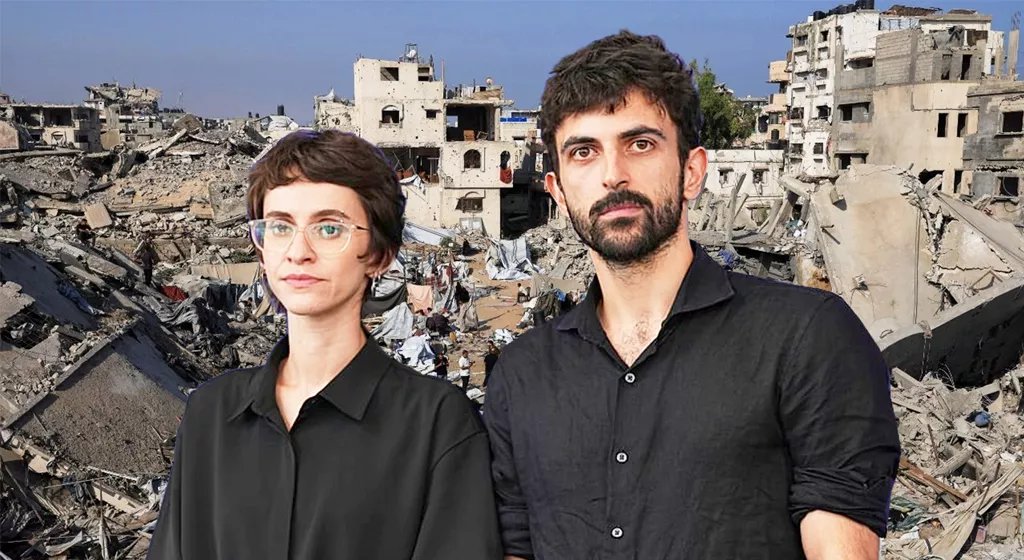
They are methodically demolishing and torching Gaza’s buildings, from north to south, so that the people who lived in them have nowhere to return to.
When the lights came up in the cinema I was very angry, but I also felt powerless, vulnerable and exposed. What we had just watched was mostly cynicism, with a few faint, almost imperceptible traces of belated conscience, perhaps even remorse, from the army and intelligence officers who spoke to the makers of the documentary NAZA. Yuval Abraham and Rachel Szor had left us dumbstruck and torn between conflicting emotions. The truth is that little of what we saw was entirely new to us, though for some of it we had not known the details or the scale. One example is the total surveillance of every Arab in Gaza through their mobile phone: where they are, what they say and who they talk to.
Just as shattering was the sense of insecurity given off, almost inadvertently and beneath the surface, as the camera drifted from the Tel Aviv rooftops where the interviews were filmed to the lit windows of the city’s tower blocks. Seeing the residents eat, watch television and move about their flats without a care, we had the chilling sense that someone was spying on our every move without our knowing. This directorial device also, obliquely but naturally, evokes the monitoring and recording of every movement and conversation of the people of Gaza, collectively and one by one: not only Hamas fighters but every civilian, every woman and child, any baby crying because it is hungry… I would like to know how the people of Tel Aviv themselves will feel, if they are ever given the chance to see the film.
Another shocking revelation, though we already broadly knew it, was the utter indifference to “collateral damage”, which is what the acronym NAZA means. When a “target” went home at night to sleep, the whole building became a legitimate target to be flattened, however many NAZA that meant, even if they were babies. The Israeli government and its mouthpieces and apologists deny any such thing. They claim it is not a documentary but a stage-managed fairy tale designed to discredit the army and the state. They say the film offers no proof, since everyone in it speaks anonymously. But only a madman would come forward and speak on the record (however psychopathic someone actively taking part in genocide may be, I doubt he would risk prison, or worse).
As some of them admit in the film, the government’s plan is to demolish, burn and wipe out every building in Gaza, starting in the north and moving south, so that the people who lived in them have nowhere to return to in future. But nobody needed to tell us that. This has been going on for many decades, and in any case we see the “proof” in every image that comes out of there: ruins everywhere, whole areas razed to the ground. The sheer number of dead reported by local authorities and international organisations (more than 74,000 in three years of fighting, a very large share of them children and women, with an unknown number of missing still under the rubble, and not counting the indirect deaths from hunger and the collapse of the health system) is also sure proof of indiscriminate killing and indifference to civilians.
It is true that we have no way of knowing for certain whether this is fact or fiction. But Israel’s rulers do not need anyone else to discredit them; they are doing a fine job of that on their own. Yet one question remains: why did these 28 people want to speak to the camera, even anonymously? They were not all alike. One described the huge adrenaline rush the killing gave him, like a video game; another said that logging a target’s details and the number of NAZA was one thing, ordering them wiped out in a bombing quite another; another cynically admitted he was simply doing his job, orders are not questioned, he was just a technician; one confessed he had watched in horror as dogs ate the corpses; and another stammered that yes, it was genocide, but…
I am no expert, but NAZA would be well worth teaching at schools of psychiatry (outside Israel, of course). Either way, one thing is beyond dispute: the aim of the two Israeli filmmakers is to denounce their government’s crimes, both abroad and at home, so that the genocide stops. Some, naturally, call that treason; others call it activism and mean it as praise. But at some point we have to separate two very different things, once and for all. It is one thing to expose your own country and your fellow citizens, and quite another to denounce a guilty and destructive government. The concept of antisemitism has existed since Hitler’s time, but not everyone who opposes the Israeli government’s policies is automatically an antisemite, just as not everyone who opposes Mitsotakis’s policies is, say, anti-Greek. Are even the Jewish makers of NAZA antisemites? Oh, give me strength!

