


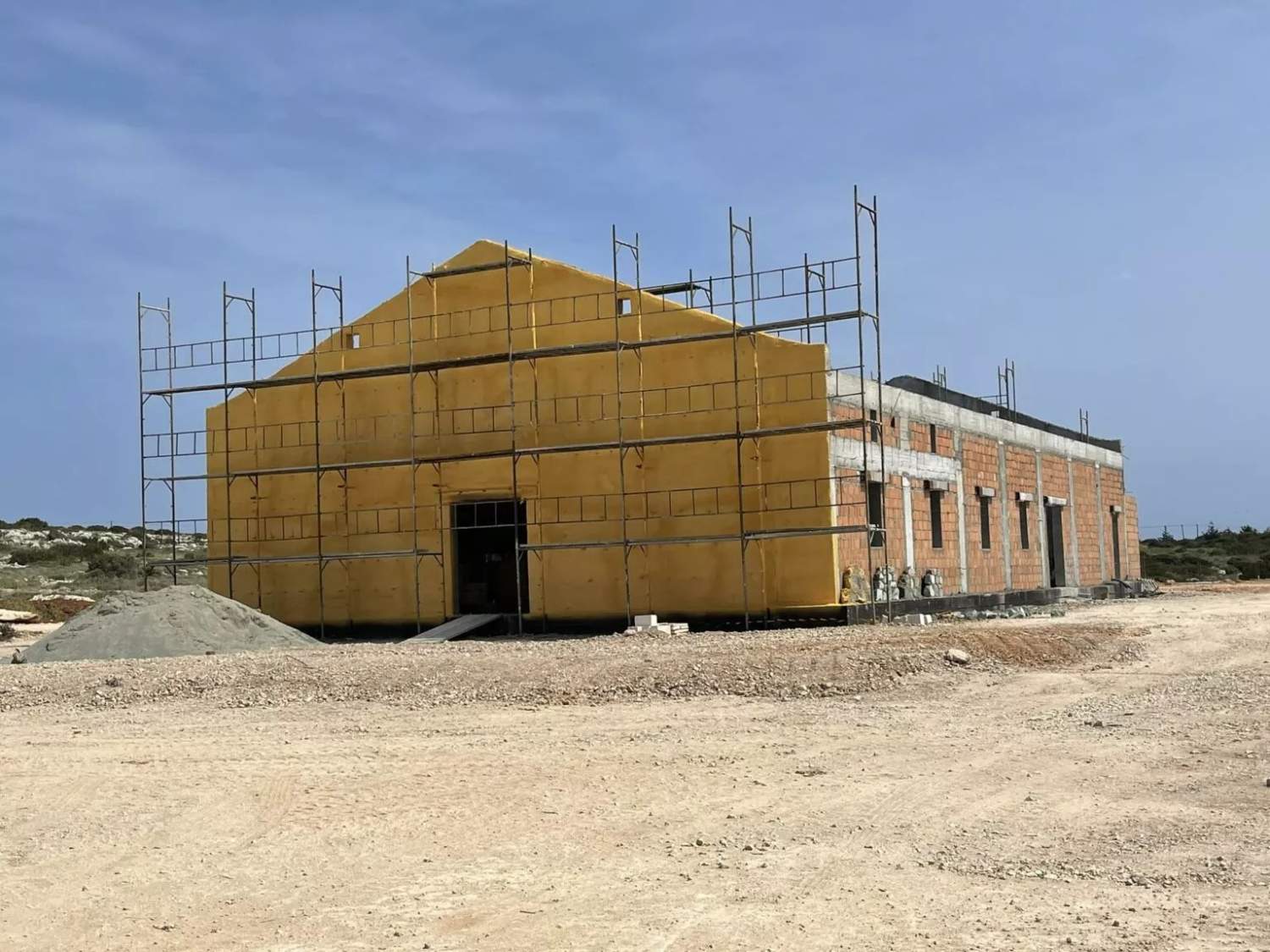
A monastery built without permits in the protected Cape Greco area has split the House Interior Committee. Its chairman said the buildings had been found illegal, while parliament members from DISY and ELAM argued the monastery should be licensed.
The Department of Environment has already issued terms for demolishing the Agioi Efraim and Aikaterini monastery, following an enforcement notice and a demolition order, deputy director Elena Stylianopoulou told the committee. The Game and Fauna Service issued an out-of-court fine of 2,000 euros.
The Environmental Authority told the Council for the Study of Planning Exemptions (SYMEPA) on 4 September 2026 that it would not assess the monastery’s planning exemption application, and recommended that the application be rejected immediately. In March 2024 the authority had said it does not assess projects that are already complete or far advanced unless planning and building laws have first been applied.
Committee chairman Aristos Damianou said he fully endorsed the account submitted by the environmental organisation Terra Cypria. He said a very large number of opinions and decisions, as well as a court ruling, had found the buildings illegal, but that enforcement was being stalled. “It is not a church that is being built,” he said.
Damianou condemned what he called two-tier treatment of citizens, under which a pergola or a room on a refugee housing estate is demolished while buildings in Natura areas and extra floors on tower blocks are overlooked.
Terra Cypria executive director Koula Michael called for all the irregularities to be removed and the unauthorised buildings demolished. She accused SYMEPA of abusing its power by examining private environmental opinions and special ecological assessments, saying it had neither the expertise nor, above all, the competence to do so under current law.
Calls for a licence
“The monastery must be licensed,” said DISY parliament member Andreas Konstantinou. He pointed to the importance of Christian churches in remote areas and asked whether the historic Apostolos Andreas monastery could have been built under today’s procedures.
ELAM parliament member Andreas Papacharalambous backed keeping the monastery. He said it was a spiritual institution linked to setting up a shelter for abused women and children, not a businessman seeking extra floors. He asked SYMEPA to examine the application free of pressure and prejudice, and asked how the demolition of a monastery could even be under discussion. “We respect legality and the environment, but we believe deeply in faith and tradition,” he said.
ELAM’s Evgenios Hamboullas also backed licensing the church. DIKO’s Panikos Leonidou said the monastery was different in character and not a business venture, adding that there was discretion to license it.
Works found without permits
Stylianopoulou said inspections carried out after a complaint about unauthorised interventions found that work was under way without the necessary permits. The department then wrote to the mayor of Ayia Napa, the Famagusta District Officer and the Metropolis of Constantia and Ammochostos, she said, before a further site visit with the Game and Fauna Service.
When SYMEPA consulted it, the department gave a negative opinion because the works had started without permits and the procedures required by law had not been followed. Stylianopoulou added that environmental impact assessments are preventive tools and cannot be carried out retrospectively except in very isolated cases.
Calls for reform
Damianou said SYMEPA’s work was open to question. He added that exemption practices had for years raised questions about whether they served the public interest or other interests and pressures.
Konstantinou said the discussion had shown the need for stricter scrutiny of exemption applications and for tools that would let authorities step in early, stressing that a permit must come before the work. He said the committee would return to how SYMEPA operates and to how quickly District Local Government Organisations (DLGOs) inform municipalities.
Hamboullas said the law had been abused for 30 years, with developers using agricultural plots for luxury homes when exemptions were meant for exceptional cases. He questioned how SYMEPA members are appointed and what their duties are, and blamed local authorities and DLGOs for failing to enforce the law.
SYMEPA chairman Sotiris Ktorides said that under the local plan for the area, which covers Natura 2000 zones, even a positive recommendation from the council must be followed by approval from the Department of Environment and the Game and Fauna Service before a planning permit can be issued. He said positive recommendations for large developments usually come with conditions, sometimes including demolition. He noted that SYMEPA is legally obliged to examine applications for unauthorised developments, and asked for a legislative tool that would stop landowners from even applying in such cases. He also argued that the Department of Environment’s legislation does not say an unfinished development cannot be examined.
SYMEPA vice-chair Elena Christodoulou, who represents the Cyprus Scientific and Technical Chamber (ETEK), said she had even thought about abolishing the council but stressed that “red lines” must be set for how it works. She criticised what she described as the reckless granting of incentives, especially in Famagusta district, and said ETEK would call a meeting on the qualifications and appointment criteria for council members.
Kyriakos Koundouros, director of the Town Planning and Housing Department, said weaknesses had been identified and amended regulations were being prepared, taking the Audit Office’s recommendations into account.
Damianou criticised the absence of Ayia Napa municipality from the session. He said nobody was above the public interest and that the committee would return to the issue in January.

