


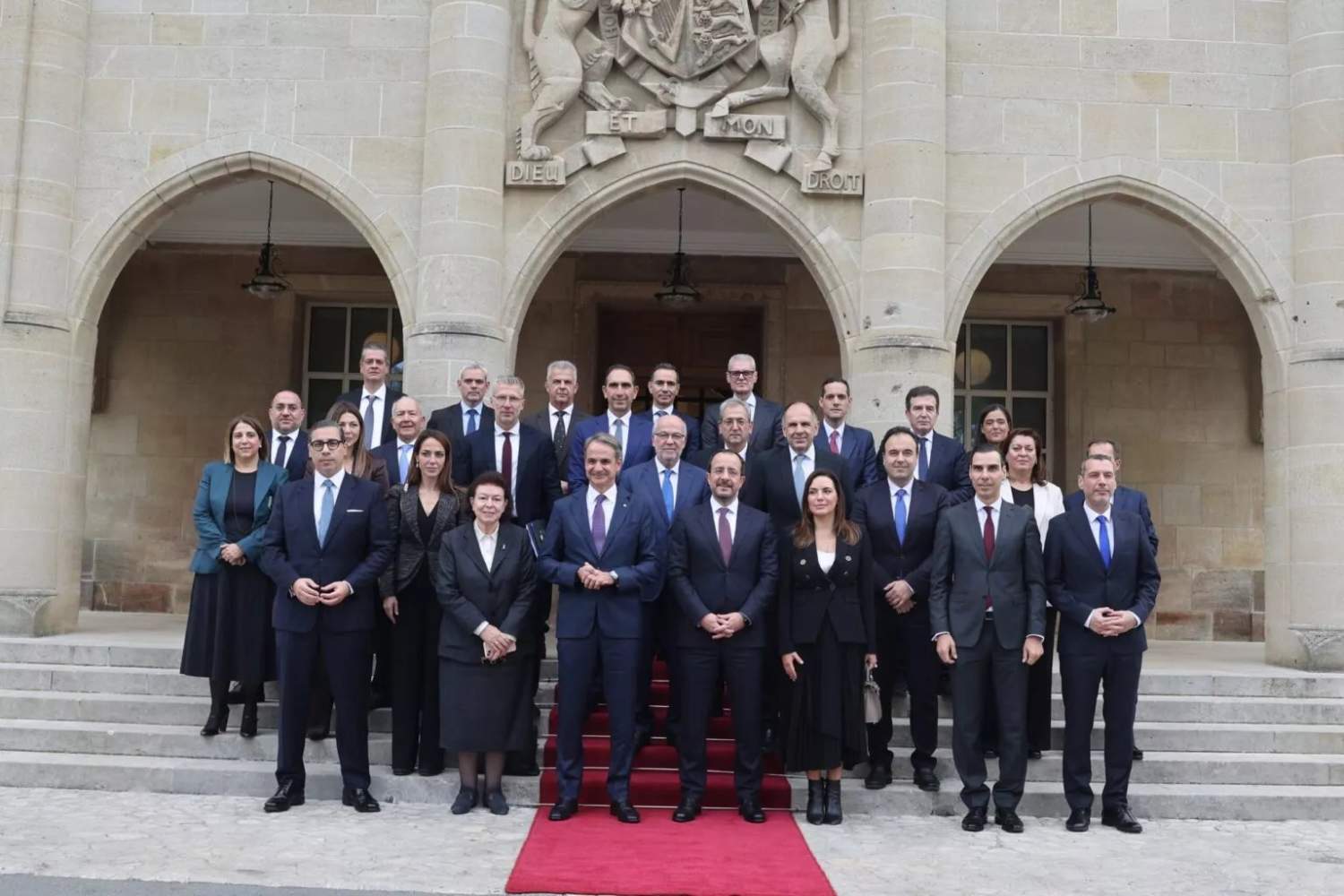
For the first time, relations between Greece and Cyprus rest on an institutional mechanism for joint government decisions, not just declarations of solidarity, their fourth intergovernmental summit in Nicosia showed on Wednesday.
With 25 ministers at the table, the two governments signed three agreements and agreed to share artificial intelligence infrastructure. The summit fulfilled a goal set by President Nikos Christodoulides and Greek Prime Minister Kyriakos Mitsotakis in March 2023.
Mitsotakis also said Cyprus would join Schengen on 1 July 2027, describing its entry as the first act of Greece’s EU presidency, which begins that day. Cyprus has already completed the preparatory work, and what happens next depends on the European Commission.
Mitsotakis said Cyprus’s entry into the passport-free area would be the first act of Greece’s EU presidency, which begins on that date. Cyprus has already completed the preparatory work, and what happens next depends on the European Commission.
The fourth Greece-Cyprus intergovernmental summit brought 25 ministers to the same table. For the first time, relations between Athens and Nicosia rest not only on declarations of solidarity but on an institutional mechanism for joint government decisions. This was the goal President Nikos Christodoulides and Mitsotakis set in March 2023.
The joint communiqué describes the summits as a “standing mechanism of political coordination” that monitors agreed actions and produces concrete results. Deputy Minister to the President Irene Piki and Greek Minister of State Akis Skertsos oversee the process through their governments’ coordination secretariats.
The summit ended with three signings. A memorandum of understanding covers the training of ambulance crews in emergency pre-hospital care. Two declarations of intent will allow Cypriots to train at the Hellenic Police officers’ school and at Greek naval schools for officers and petty officers, to staff the Cyprus Coast Guard. It is the first time the training of Cypriot security personnel has been placed on a joint intergovernmental footing.
Greece’s Ministry of Tourism and Cyprus’s Deputy Ministry of Tourism also agreed a joint action plan. The two governments also held a dedicated exchange of views on housing, an issue putting pressure on both.
Artificial intelligence
Artificial intelligence was the summit’s central theme. Mitsotakis offered Cyprus the use of Greece’s AI infrastructure: the Pharos AI Factory, the Daedalus supercomputer and Greek language models. Cyprus’s Pharos-CY AI Factory Antenna and Greece’s Pharos can now operate as a single tool for both public administrations.
Cyprus’s Deputy Ministry of Research, Innovation and Digital Policy and Greece’s Ministry of Digital Governance will coordinate all joint AI work. The cooperation covers nine areas: education, labour, health, public services, justice, shipping, tourism, culture and consular services. Proposals discussed included a pilot of EDUPLAN.AI in Cypriot schools, AI tools for cancer care, the translation of court documents, and preserving the Cypriot dialect in Pharos’s language data.
Mitsotakis also referred to Greece’s ban on children under 15 using a range of social media platforms, which takes effect on 1 January 2027. Cyprus has already put out for public consultation its own bill to protect minors online, modelled on the Greek law. It is a clear example of how the mechanism turns a Greek announcement into joint policy.
Firefighting
In the past, Greek help with wildfires in Cyprus arrived only after a crisis had broken out. This year, for the first time, a 21-strong unit from the Hellenic Fire Service was stationed in Cyprus for the whole fire season under the EU Civil Protection Mechanism.
The next step is the Cyprus Regional Aerial Firefighting Station (CRAFS) in Paphos. A Greek body will take part in the consortium being formed to run it, and the station’s funding exceeds three million euros. About four million euros has been earmarked for wider regional work. Mitsotakis spoke of sharing infrastructure and aircraft, noting that Greece will take delivery of new Canadair 515 aircraft in 2028.
Joint exercises, drones and AI for early fire detection were also on the agenda, along with lessons from Greece’s ‘AIGIS’ system.
Electricity cable and the Cyprus problem
The two biggest strategic issues were discussed at leader level. Mitsotakis welcomed the resumption last week of seabed surveys for the Great Sea Interconnector, saying Greece had insisted, and still insisted, on completing the project despite the obstacles it had faced.
Christodoulides said he was in constant coordination with Mitsotakis, French President Emmanuel Macron and the leaders of the EU institutions. The joint communiqué mentions neither the cable nor the delimitation of exclusive economic zones, which was deliberately kept off the agenda.
On the Cyprus problem, the two leaders welcomed the new momentum and the prospect of a meeting with UN Secretary-General Antonio Guterres to resume negotiations from where they broke off at Crans-Montana in 2017. Christodoulides said Nicosia was working to make the most of the current momentum.
Mitsotakis set out the goal as “a bizonal, bicommunal federation without anachronistic guarantees, without occupation forces”. The joint communiqué records Greece’s steady support for the Cypriot president’s efforts.

