


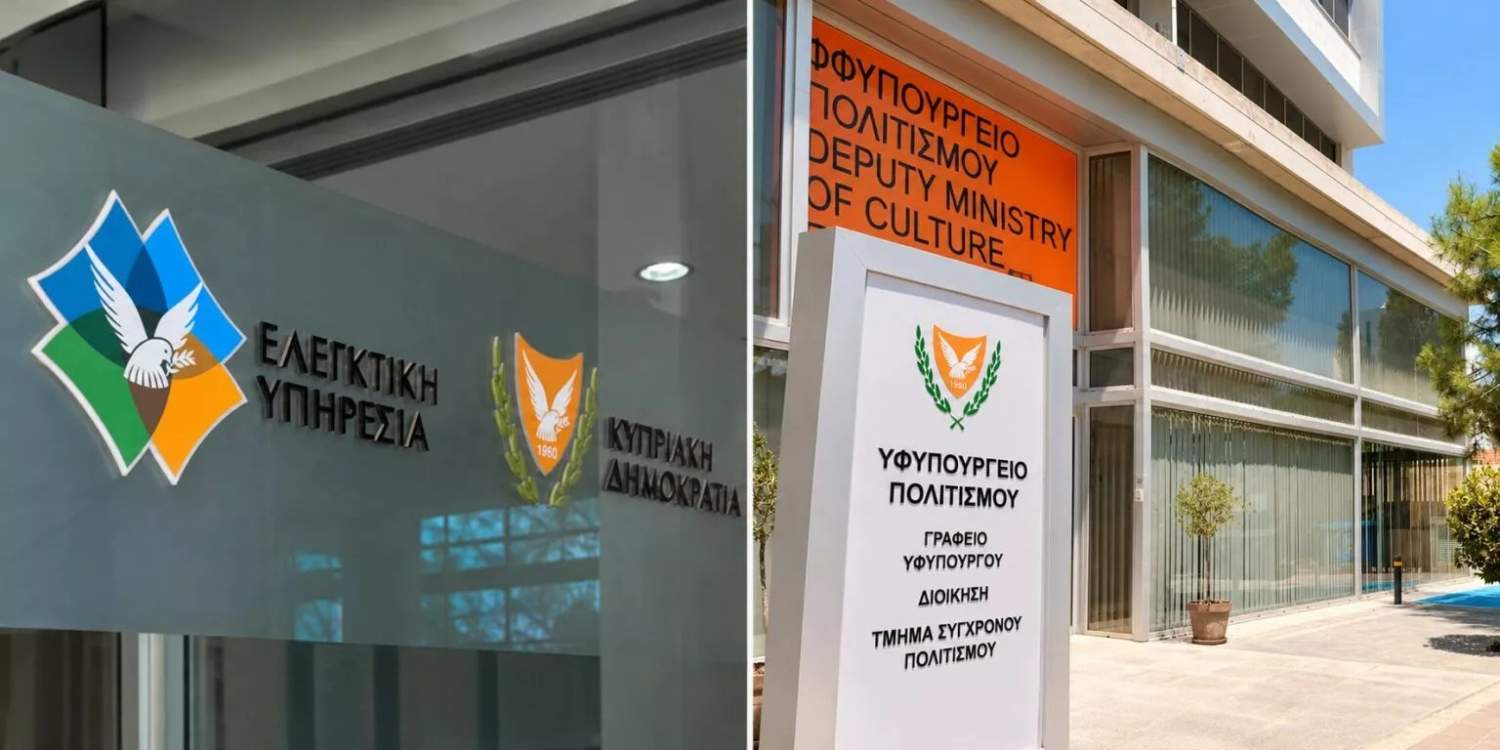
The Audit Office has found culture grants paid to ineligible bodies, potential conflicts of interest and doubts over the authenticity of some invoices, in a special report on Deputy Ministry of Culture funding schemes.
The report looks at the deputy ministry’s Department of Contemporary Culture in 2024 and 2025. It finds gaps at several stages, from the selection of beneficiaries and the assessment of applications to the checking of spending and the monitoring of funded projects. According to the report, these gaps raise concerns about transparency, equal treatment and the effective use of public money.
In its response, the department said several of the recommendations were already under way or being implemented as part of a redesign of its grant system over the past three years.
The audit examined a sample of the funding: the ‘Kypria’ programme for 2024 and 2025, and the ‘Music’ and ‘Theatre’ strands of the ‘Culture II’ grant scheme for 2025. Institutional grants that cover cultural organisations’ running costs were left out because they were audited separately.
Funding outside the rules
Under ‘Kypria 2025’, a recognised charitable foundation received a grant of 50,000 euros, although the programme’s terms expressly excluded that category.
Two bodies were funded despite written warnings from the District Administration, dating back to 2021, that they could be dissolved for failing to comply with the law that governs how they operate. The grants came to 15,000 euros in 2024, and 20,000 euros and 35,000 euros in 2025. The Audit Office said this information was on the Interior Ministry’s public register and should have been checked before the applications were approved.
Auditors also found five applications in the ‘Music’ strand of ‘Culture II’, worth 74,036 euros in total, where the bodies’ articles of association did not show that music was their main activity, as the scheme required.
Income and invoices
The report found that the department does not collect the documents behind grant recipients’ financial reports and does not carry out sample checks. The organisations’ own external auditors certify the spending, with no clear rules on how far their checks should go or how they should be done.
To test the scale of the problem, auditors examined the documents of ten organisations funded under ‘Kypria’, five from 2024 and five from 2025. In at least six of the ten, there were signs that not all income had been declared or properly documented, including money from ticket sales, other sponsorship and food and drink sales. In one case, zero ticket income was certified even though publicly available information showed tickets had been on sale through an online platform.
In 2025, invoices with electronically pasted signatures were submitted, and nothing showed that their authenticity had been checked. In 2024, invoices and payment receipts from different partners or suppliers were numbered consecutively, even though each issuer would be expected to have its own numbering.
The Audit Office said these findings did not on their own prove forgery or any other irregularity, but they did raise reasonable doubts that the department should investigate further.
At least 11 organisations in 2024 and ten in 2025 applied to both ‘Kypria’ and ‘Culture II’, and no systematic checks were found to make sure the same costs were not claimed under both programmes. This does not prove double funding, but it shows there were not enough safeguards to rule out the risk.
Scoring and rankings
Money available under ‘Kypria 2025’ was enough to fund the 14 highest-ranked applications, but in the end applications down to 18th place were funded. This followed a proposal to include at least one project from folk and traditional culture, which was ranked 18th. The Audit Office said the decision was not properly documented and that the call for applications did not require that sector to be represented.
In another case, an application first rejected under the ‘Culture-Music’ scheme was funded after repeated contacts by the organisation over about six months. Money set aside for another project that never went ahead was used to fund it. Because the organisation was second on the reserve list, the first reserve was also funded so that the ranking order stayed the same.
The report also found cases where approved proposals were cancelled and lower-scoring applicants were picked in their place, while a higher-scoring applicant got nothing. These choices were not adequately justified.
The scores given by the evaluation committees varied widely. Two applications with identical evaluator comments scored 80 per cent and 93 per cent, and two group evaluation forms for the same project gave final scores of 85.66 per cent and 94.68 per cent despite recording the same reasoning. Auditors also found scores corrected without adequate justification, and individual and group assessments that did not match.
Conflicts of interest
One member of the ‘Kypria 2025’ evaluation committee assessed an organisation on whose board the member had sat until the day their appointment to the committee was made public. The same member also assessed another organisation they had previously worked with professionally. Neither relationship was disclosed, either at the appointment or during the evaluation.
A member of the ‘Kypria 2024’ committee assessed an application from a festival in which they took part as an artist the following year. A member of the 2025 committee declared a conflict of interest because a first-degree relative was involved in certain applications and stayed out of assessing them. However, the same member went on to evaluate other applications competing directly with those.
The confidentiality and conflict-of-interest declarations for ‘Kypria 2024’ were signed in July 2025, almost a year and a half after the evaluation ended. Under ‘Culture II’, a department representative who sat on the evaluation committees did not sign a confidentiality declaration, and neither did the members of the Objections Committee.
Delays and state aid
The report notes that approvals for all the department’s 2026 grant programmes were announced around mid-May, pushing much of the year’s activity into the second half under greater time pressure. Auditors said this may hurt the quality of cultural projects. Under ‘Kypria’, however, the time taken to complete evaluations fell from 84 days in 2024 to 59 in 2025 and 38 in 2026.
The ‘Culture’, ‘Thymeli’ and ‘Kypria’ programmes were put under review again over whether they fall under state aid rules, after a letter from the Office of the Commissioner for State Aid Control in November 2025. The review was still pending at the time of the audit, and the department said the Deputy Ministry of Culture was handling the matter.
Recommendations and response
Among its recommendations, the Audit Office says conflict-of-interest declarations should be standardised and signed before evaluations begin. It also calls for compulsory minutes, eligibility checks by department officers before evaluation, indicators to measure cultural impact, and sample checks of supporting documents.
Auditors also noted that several festivals still lose money even after receiving a grant, and that some organisations have consistently relied on state support. The Audit Office recommended assessing whether applicants are financially sound, and considering a rule that a minimum share of costs must come from their own resources or other secured sources.
The department said its redesign merges separate schemes into larger, more comprehensive programmes with uniform criteria, better management of available funds and simpler procedures. It said clarifications it gave on some points in the draft report were considered sufficient.
The department acknowledged that the way it manages grant programmes needs further improvement. It said it is strengthening its internal controls with an instruction manual, standard forms and checking tools, early checks of applications, and closer monitoring of funded projects.
On measuring whether the programmes work, the department said it gathers information from evaluation reports, statistics and the organisations’ financial reports, but argued that cultural impact cannot be measured with numbers alone. It said it still plans to set key indicators for each programme, collect and process data better, and assess its programmes more systematically.

