


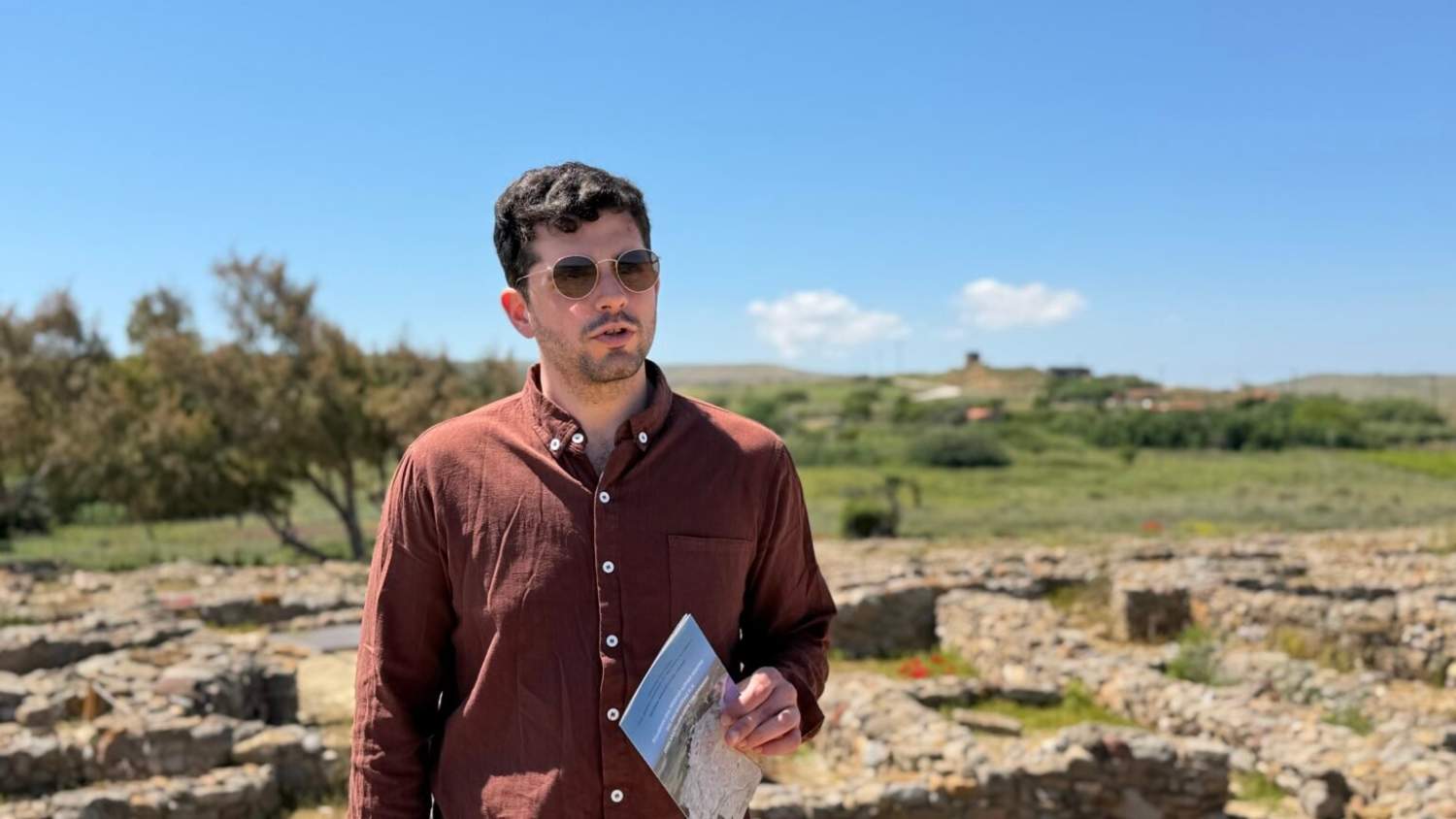
Known as The Mythologist, archaeologist and author Konstantinos Loukopoulos brings Greek mythology to modern audiences through his popular YouTube videos. Ahead of his appearance at the 5th Limassol International Book Fair, he speaks to Phileleftheros about the enduring appeal of ancient myths, what connects us to the ancient world and the timeless questions of birth, love, wealth, war, death and what it means to be human.
What exactly do we mean by Greek mythology?
It’s an umbrella term covering many different kinds of stories. Some myths held religious significance for people at the time, such as the abduction of Persephone by Pluto, which formed the basis of the Eleusinian Mysteries.
Others have a historical dimension, such as the events of the Trojan War. We classify these as mythology because we have no historical sources confirming the events described. For the ancient Greeks, however, these stories were part of their sense of identity and origins.
There are also myths that seek to explain the world, such as the Titanomachy and the Gigantomachy, through which the ancient Greeks tried to make sense of the creation of the world and various natural phenomena.
Other myths served an educational or moral purpose, teaching people how to behave and what was considered right or wrong. Then there are philosophical allegories, such as Plato’s Atlantis.
Broadly speaking, any story from ancient Greece that contains fantastical elements and cannot be corroborated by historical or archaeological evidence falls within Greek mythology, depending on its content and purpose.
Your YouTube channel, The Mythologist, gained a large following in a relatively short time. What do you think people today are looking for in ancient myths?
I would say they allow people to escape their daily routines for a while and immerse themselves in another era. They can identify with the heroes, follow how they confront difficulties and overcome them, and perhaps learn something from their experiences.
Through the stories of the ancient Greeks, they can also gain a better understanding of the people who lived at the time, their beliefs and attitudes, as well as the culture and history of antiquity.
Of course, there’s also the simple pleasure of being entertained by a compelling story, whether it’s in a book or a video.
But I think the most important thing is that myths deal with timeless themes: war, peace, wealth, destruction, birth, creation and death. They help us understand how the ancient Greeks perceived the world and humanity’s place within it.
So when we read these myths, we often come across things that remain just as relevant today.
Which is particularly striking when you consider how different the societies that produced these myths were from our own…
Absolutely. We live in a completely different era, and an enormous amount has changed. Yet, at their core, human emotions remain the same.
We might think that the 2,500 years separating us from antiquity represent an immense stretch of time, but it’s not long enough to change the way people experience joy, sadness, love or fear.
What process do you follow when researching an ancient myth before presenting it to your audience?
I begin by looking for all the available sources and studying the different versions of the myth. I identify their similarities and differences and try to understand why those variations exist.
I then develop a narrative that draws on the most interesting aspects of the myth while incorporating as many different versions as possible.
When it comes to interpreting and discussing the myth, I don’t rely solely on my own perspective. I also consult scholarly books and studies, along with analyses by academics and other researchers who have examined the subject.
How do you assess the reliability of each source?
Generally, the older the source, the better. That doesn’t mean, however, that myths found in later sources are somehow less valuable.
Every version matters because, in ancient Greece, there was never a single, established version of a myth.
Nevertheless, I always give priority to ancient Greek sources before turning to later ones, while keeping an important distinction in mind.
A Roman source, for example, cannot be used as evidence that the ancient Greeks told a particular myth in exactly the same way.
Every source needs to be examined within the historical and cultural context in which it was produced.
How did the Romans adapt Greek myths?
They drew heavily on Greek mythology, often producing different versions of existing myths and creating new stories that reflected their own values and beliefs.
Of course, there were also gods and myths of distinctly Roman origin. Nevertheless, Greek mythology was a major source of inspiration, and some gods came to occupy a different place in the Roman world.
Take Ares, for example. He did not occupy the same central position in religious worship in ancient Greece, but he became particularly important to the Romans, who associated him closely with their warrior ethos and imperial identity.
Do inaccuracies bother you when an ancient work is adapted for the cinema, as in Christopher Nolan’s The Odyssey?
Personally, I saw the film twice and thoroughly enjoyed it. I don’t know whether it will become a classic, like Troy, for example, which was made years ago, but my own experience was very positive.
That’s because I went to the cinema without expecting complete accuracy. I knew I was going to see Nolan’s Odyssey, not Homer’s Odyssey.
I believe a film is a work of art, and its creator has every right to approach the original material from their own perspective, develop their own interpretation and convey the messages they want to communicate.
They are therefore under no obligation to reproduce the original work with absolute fidelity.
What I saw was a film that respected Homer while successfully conveying the messages its director wanted to express.
If someone asks me whether it’s worth seeing, I’ll certainly say yes.
But if they’re looking for something closer to Homer’s Odyssey, I’d direct them towards an earlier screen adaptation.
And if they want to experience the work with complete fidelity, I’d suggest they read Homer himself, rather than expect Nolan to reproduce exactly what the ancient poet wrote.
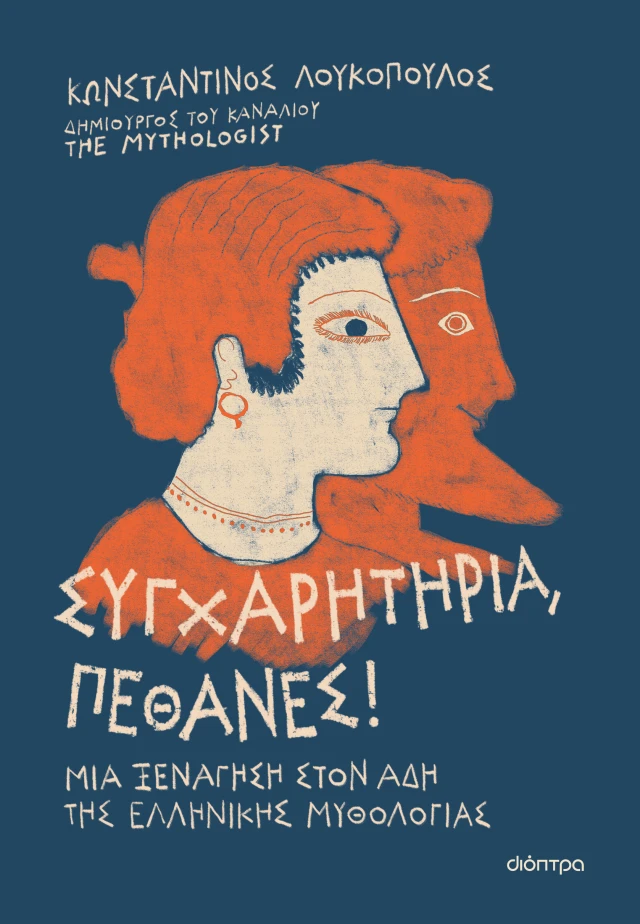
In your recent book, Congratulations, You Died!, you take readers on a journey into the Underworld. What drew you to the subject of death?
Death is obviously a difficult subject, particularly when it involves losing someone close to us. Yet even through such a traumatic experience, we can arrive at profound insights into life itself.
The ancient Greeks explored death extensively, and as I studied their beliefs, I realised that all these stories, myths and ideas aren’t really about death at all. They’re about life.
They’re about how we live, what it means to be a good person, how we contribute to society, how we make the most of the time we have and how we avoid wasting our time in this world.
That is, after all, the central question explored in the book: how to avoid reaching the end of your life having been nothing more than a number or a statistic, and instead having done something meaningful with the time you’ve had.
The book obviously wasn’t written for the dead. They already know what comes next. It was written for the living.
Through humour, storytelling and the plot I created around the Guide and the Soul, I wanted, in a way, to help dispel the fear of death.
At the same time, I wanted readers to discover how the ancient Greeks understood death, but above all, to reflect on the value of life and how we choose to live it.
Cyprus has its own mythological tradition, perhaps most famously the story of Aphrodite’s birth. How does Cypriot mythology relate to wider Greek mythology?
Every region has its own variations of myths. In mainland Greece, for instance, we can talk about Greek mythology as a whole, but also about individual mythological cycles, such as the Theban cycle, or traditions associated with particular regions.
Similarly, Cypriot mythology combines elements of the wider Greek tradition with distinctive local characteristics.
The particular myth of Aphrodite’s birth is recorded in Hesiod’s Theogony.
When I researched the subject, my assessment was that Aphrodite, as a deity of eastern origin, probably reached Cyprus first. The island appears to have been an important centre of her worship before she reached mainland Greece.
In that sense, the association between her birth and Cyprus may therefore have some basis.
This tradition became linked to the well-known myth in which Cronus castrated his father, Uranus, and threw his genitals into the sea.
Aphrodite was born from the foam that formed, and ancient sources also refer to her as Cyprogenes, meaning “Cyprus-born”.
If you came to Cyprus to film an episode of The Mythologist, where would you choose to go?
Without a second thought, I’d visit the places associated with the goddess Aphrodite, the story of her birth and the ancient sources that refer to her.
I can already picture an episode with shots of the sea, foam breaking against the rocks and the story of her birth unfolding through the narration.
But I’d also love to explore other mythological figures associated with Cyprus, such as Pygmalion and Adonis.
Why stop at one episode? We could make an entire series devoted to Cypriot mythology!
What can participants expect from your masterclass, “How do we really research and interpret an ancient myth?”, at the Limassol International Book Fair?
We’ll have the opportunity to explore together how people today can approach and study Greek mythology.
We’ll examine different versions of myths and discuss why so many exist, which versions the ancient Greeks knew and accepted, and how we can utilise ancient art to understand them better.
We’ll also explore questions such as whether the ancient Greeks themselves believed the events described in myths had actually happened, and how we can interpret those stories today.
We’ll approach all of this through ancient texts and works of Greek art.
But I didn’t want to turn up and spend hours talking at the participants. I want it to be an interactive, collaborative experience where everyone can get involved, work directly with ancient sources and exchange ideas.
What would you like participants to take away from the experience?
I’d like them to leave with the tools they need so that the next time they encounter an ancient myth, whether in a book or online, they’ll know which questions to ask to approach it and understand it more deeply.
They should be able to investigate who recorded a particular version and when, whether other variations exist, how the story relates to everyday life in antiquity and what it can reveal about people’s beliefs and culture.
In short, I’d like them to develop the ability to study and interpret a myth by looking beyond the story itself to understand the historical and social context in which it emerged.
If you could meet one figure from mythology and ask them a single question, who would you choose, and what would you want to know?
If I could enter the world of Greek mythology, I’d want to meet the judges of the Underworld.
Having studied them extensively for my book, I’m fascinated by the thought that millions of souls have appeared before them over the centuries, and that they’ve had to decide which would be sent to Tartarus, which would remain in Hades and which would find a place in the Elysian Fields.
I’d love to know what criteria they used to make those decisions and to hear about their experiences with all the souls they’ve encountered, their lives and their stories.
Event information
On Sunday, 22 November, Konstantinos Loukopoulos (The Mythologist) will lead the masterclass “How do we really research and interpret an ancient myth?” as part of the 5th Limassol International Book Fair, from 11am to 2pm at Stage 5 (Xydadiko).
He will also take part in a discussion with Christos Michalaros from 5.30pm to 7pm on the Main Stage at the Carob Mill complex.

