


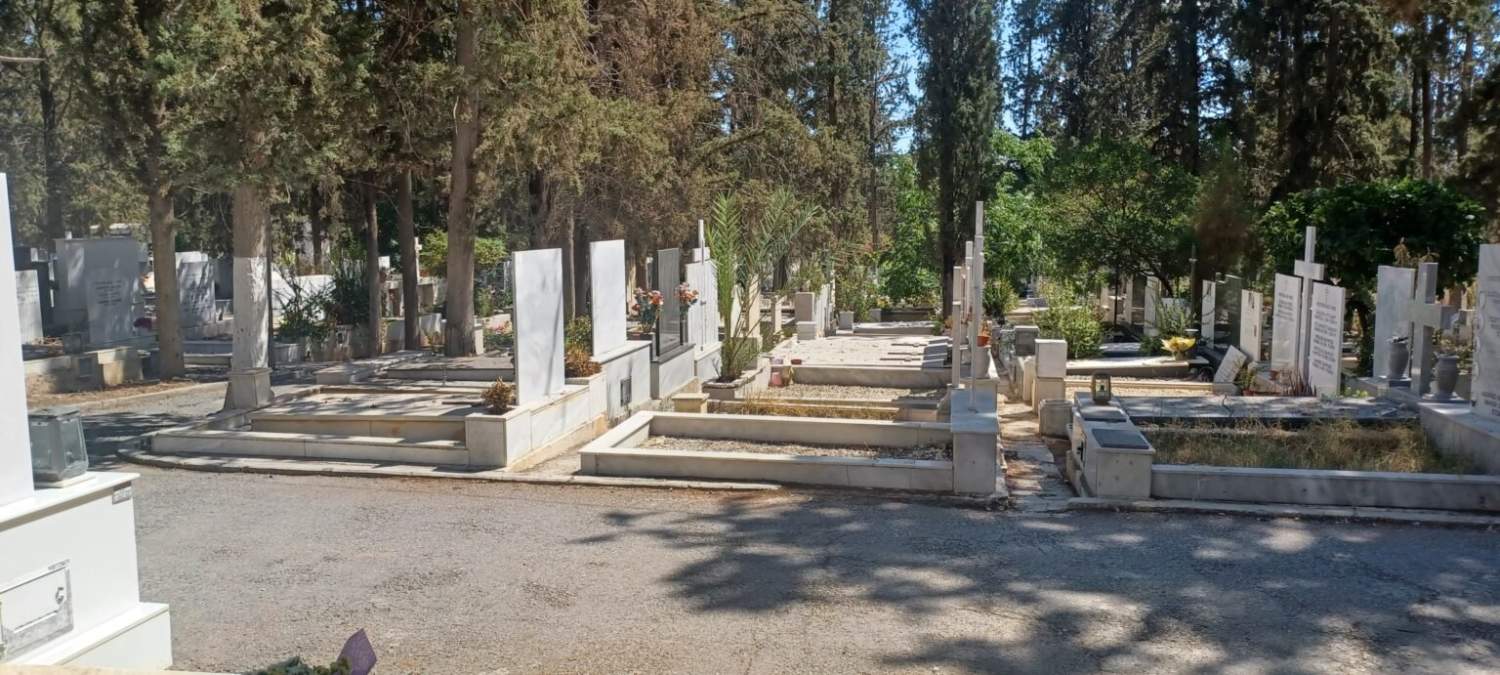
A church worker at a Nicosia cemetery allegedly kicked the crosses on neglected decades-old graves and resold the plots if no relative complained within a month, the cemetery’s church committee was told.
According to information put before the committee of the church at the Agioi Konstantinos and Eleni cemetery in Pallouriotissa, the worker would go round looking for graves from the 1930s and 1940s, and others where burials had taken place decades earlier, that appeared abandoned.
He allegedly kicked their crosses until they leaned towards the ground. If no relative complained about the damage or straightened the cross within a month, this was taken as a sign that nobody was looking after the grave, which opened the way for it to be sold.
The worker also allegedly altered receipts to hide the sales, Andreas Karagiorgis, secretary of the church committee, told Phileleftheros. He said the worker gave the buyer a genuine cemetery receipt, so the buyer believed everything was in order.
But he placed a piece of cardboard inside the duplicate receipt book so that neither the sale nor the amount appeared on the copy. Once the customer had left the counter, Karagiorgis said, the worker removed the cardboard and wrote on the copy, which carried the same number as the original, “five pounds for water payment”.
The water was in theory used for watering flowers on graves and for cleaning. As a church worker, the seller was above suspicion, Karagiorgis said.
Karagiorgis told Phileleftheros on Tuesday that between 700 and 750 graves at the cemetery may have been sold more than once over the years. He said one of those involved returned about 40,000 Cyprus pounds to the church after the affair came to light.
How it came to light
The scheme was uncovered after a police officer extended his family grave, Phileleftheros was told. A driver accidentally hit the grave with his car. When the officer pointed this out, the driver said the grave was his, so there was no issue.
Each insisted the grave belonged to him, and they agreed to compare their titles, which showed that the officer’s family grave had been sold again, to the driver. This led to an investigation, which the police also joined.
Around the same time, a CyBC employee went to bury a relative in her grave, and someone present discovered that it had also been sold to another person.
In another case, Phileleftheros was told, a man whose mother had died showed a cemetery official the title to a grave he had inherited from his godfather. It emerged that the mother of a prominent lawyer had been buried there. That grave had been sold for 15,000 Cyprus pounds.
A well-known Nicosia businessman went to the cemetery with the title to his family grave to try to find it. A cemetery worker approached him, asked why he was there, and took the title, saying he would check the records and that the businessman should come back in two days. When the businessman returned, the worker had already sold the grave and told him: “Your grave is sold.”
A man from Potamia paid 6,000 pounds for a grave, but someone intervened in time and the money was returned. Another man who had returned from England bought a grave so that he could be buried in Cyprus, but was sold one that had already been sold.
Cypress trees planted along the cemetery’s paths were also cut down to make room for new graves.
Burials in the paths
As well as selling graves more than once, some people used the cemetery’s paths to sell graves, officially or unofficially, without the church authorities being told. Karagiorgis said the arrangement began with good intentions but later took a different turn.
At one point the cemetery had no room for more burials, and Nicosia residents asked for a solution, as there was no other cemetery in the capital at the time. A person who now works at the cemetery told Phileleftheros that he had approached the then Archbishop Chrysostomos I with a proposal to use graves from before 1950 for burials. The Archbishopric’s lawyer said this could not be done, because the graves belonged to individuals, families or their heirs.
As an emergency alternative, the Archbishopric allowed burials in the paths on a temporary basis, until the new Nicosia cemetery at Chalepianes opened. At first some of these graves were sold properly, “with receipts and names”. Most, however, appear to have been sold with forged titles, without the Archbishopric being told.

