


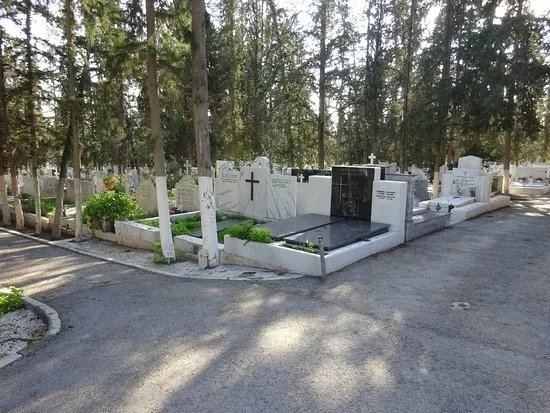
Between 700 and 750 graves at the Agioi Konstantinos and Eleni cemetery in Pallouriotissa, Nicosia, may have been sold more than once, a church official has said. The estimate followed a complaint to Phileleftheros from a man who said someone from another family had been buried in a plot his family bought in 2003.
“Our position is full transparency, and insofar as the complaints are true, I will be relentless,” Archbishop Georgios said.
Andreas Karagiorgis, secretary of the church committee at the cemetery, said the graves had been sold more than once over the years. He said those who sold them may have made hundreds of thousands of euros. The most expensive grave went for 15,000 Cyprus pounds and others for between 6,000 and 11,000 pounds, he said. According to Karagiorgis, the sales took place in two separate phases, carried out by different people. One sold graves cheaply, for up to 300 pounds, while the other charged thousands of pounds for each one.
The complainant, Andreas Ionas, told Phileleftheros that he arrived at the cemetery one morning and found that part of his family’s grave had been opened to bury someone from another family. He said that out of courtesy he did not object, and the funeral went ahead. Afterwards he contacted Phileleftheros, which had reported on similar cases in the past.
The 1961 and 2003 receipts
In a letter to Phileleftheros, Ionas said his family bought the original plot in 1961. The certificate is headed “Greek Cemetery of Nicosia” and “Purchase of Space”, gives the plot’s size as 9.5 by 7 feet, and bears the cashier’s signature over a Republic of Cyprus stamp.
According to his letter, the plot was on a corner with free space next to it. In 2003 his mother bought that space, measuring 9 by 2 feet, to extend the family grave. The receipt records a price of 150 pounds and describes the space as an addition to square 30, the original family plot. Ionas showed Phileleftheros both receipts when they met at the cemetery.
Response
When Phileleftheros put the complaint and the receipts to Karagiorgis, he said he was certain that the 2003 title was forged and that the complainant had been deceived.
Archbishop Georgios expressed the hope that this was not a new case and that it fell among those investigated before he was elected. “I call on anyone who has faced such practices to contact us so that we can deal with the matter,” he said. He also asked anyone who believed they had been exploited, or affected by actions that do not fit how the church operates, to submit evidence.
The extension
Ionas said in his letter that a cemetery official told him the extension had been sold about five years ago to another, named person. That person recently buried a relative there. Ionas said he had no problem with that person, who had apparently bought the plot without knowing it belonged to another family.
Ionas said that when he visited the family grave one day, there was no sign that it had been sold or that any work was planned. He said that the grave was apparently opened that afternoon and a member of another family was buried there the next day.
He said his family’s ownership of the extension was well known. When his mother was buried in the family grave about five years ago, he asked the officials to cut down trees on the extension so the burial could take place there. According to Ionas, he was told this could not be done, but some time later someone cut the trees down.
When his father died in February this year, Ionas suggested burying him in the extension, but was told to bury him with the rest of the family. When he insisted, Ionas said, he was told that the priest at the time had not recorded the sale in the register. Ionas cited the priest’s signature and the Archbishopric’s receipt.

