


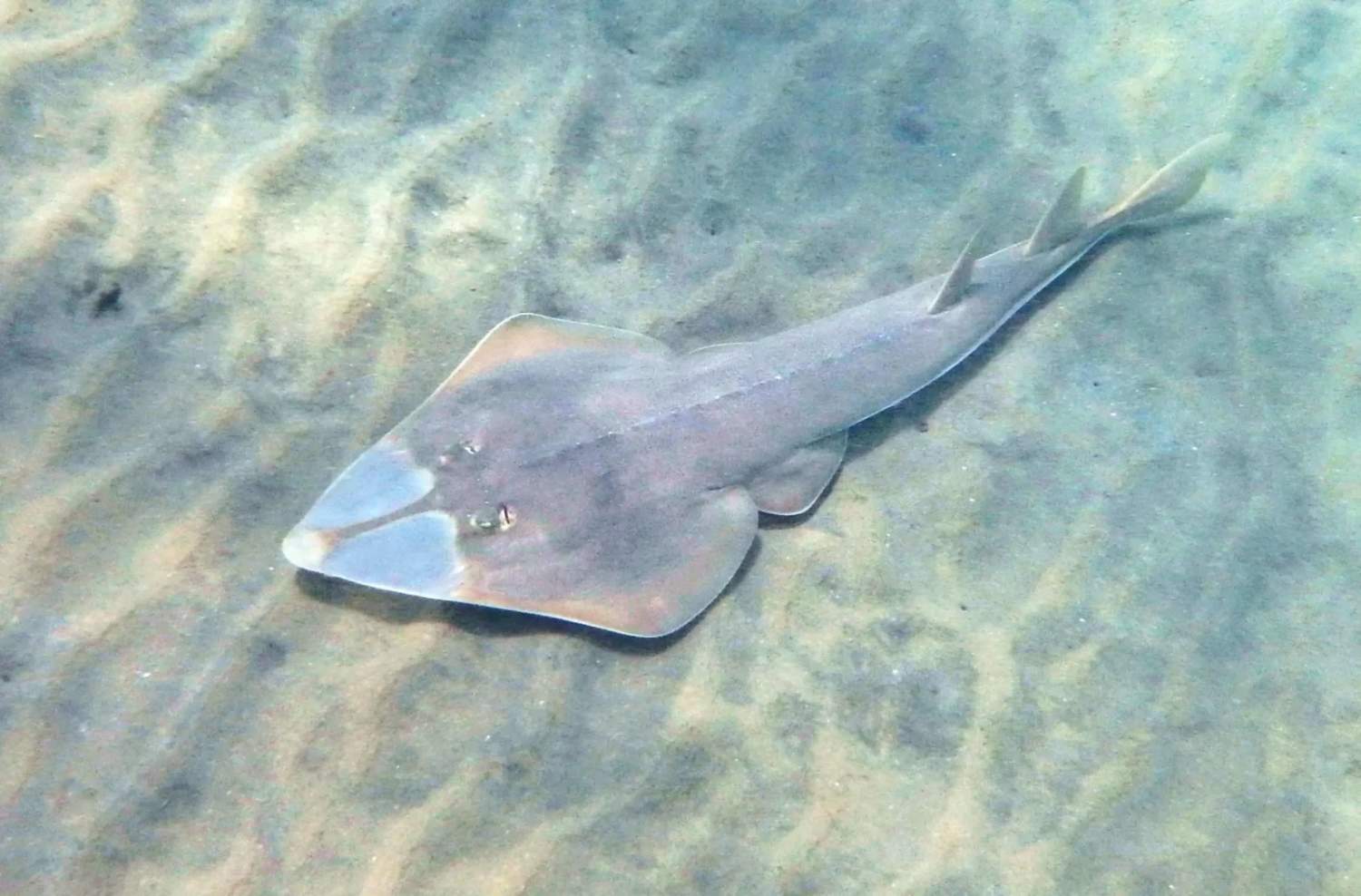
Scientists at Marine & Environmental Research (MER) Lab in Cyprus are tagging blackchin guitarfish, one of the world’s most threatened rays, to learn how fast they grow, where they move and how often they return to the same coastal areas. They are asking anyone who spots one to report it.
The blackchin guitarfish (Glaucostegus cemiculus) is classified globally as critically endangered, meaning it faces an extremely high risk of extinction in the wild. It is one of 60 species of sharks and rays recorded in Cyprus’s waters, made up of 32 shark species and 28 ray species.
Cyprus is an important Mediterranean refuge for the species, according to MER. Repeated records of newborn and juvenile guitarfish highlight the importance of the island’s coastal waters for reproduction and early life.
The species is strictly protected in Cyprus. Targeted fishing, retention and trade are banned, and any individuals caught by accident must be released promptly and carefully.
Working with fishers, the research team records each animal’s length and sex, along with the date and location of capture. The fish are fitted with external “spaghetti” tags, which are small, flexible tags carrying a unique code, internal PIT microchips read with a dedicated scanner, or both. Trained staff carry out the tagging under authorisation from the Department of Fisheries and Marine Research, and the animals are then released.
Each time a tagged guitarfish is found again, a new measurement shows how much it has grown, and its location shows whether it has stayed in the same bay or moved elsewhere. As more records are collected, the researchers say, they can better understand which areas the species uses and help inform more targeted conservation measures.
MER has released a new video showing the process step by step on the Cypriot coast, from recording biological data and attaching tags to releasing the animals. The guitarfish in the video were caught accidentally during recreational shore fishing.
MER is asking people who fish, dive, swim or visit the coast to send a photograph or video of any guitarfish they see, with the date and location. If an external tag is visible, a photograph of its code can link the sighting to the history of an animal that has already been tagged. People should observe the animals from a distance, and any guitarfish caught by accident should be released without removing the tag.
Sightings can be reported to [email protected] or on +357 99 264335 and +357 96 598310.
The tagging is part of sampling under LIFE PROMETHEUS (LIFE23-NAT-IT-LIFE-PROMETHEUS, 101148295), an EU co-funded project promoting the reduction of shark and ray bycatch, alongside the “Mark, Measure, Conserve” initiative.

