


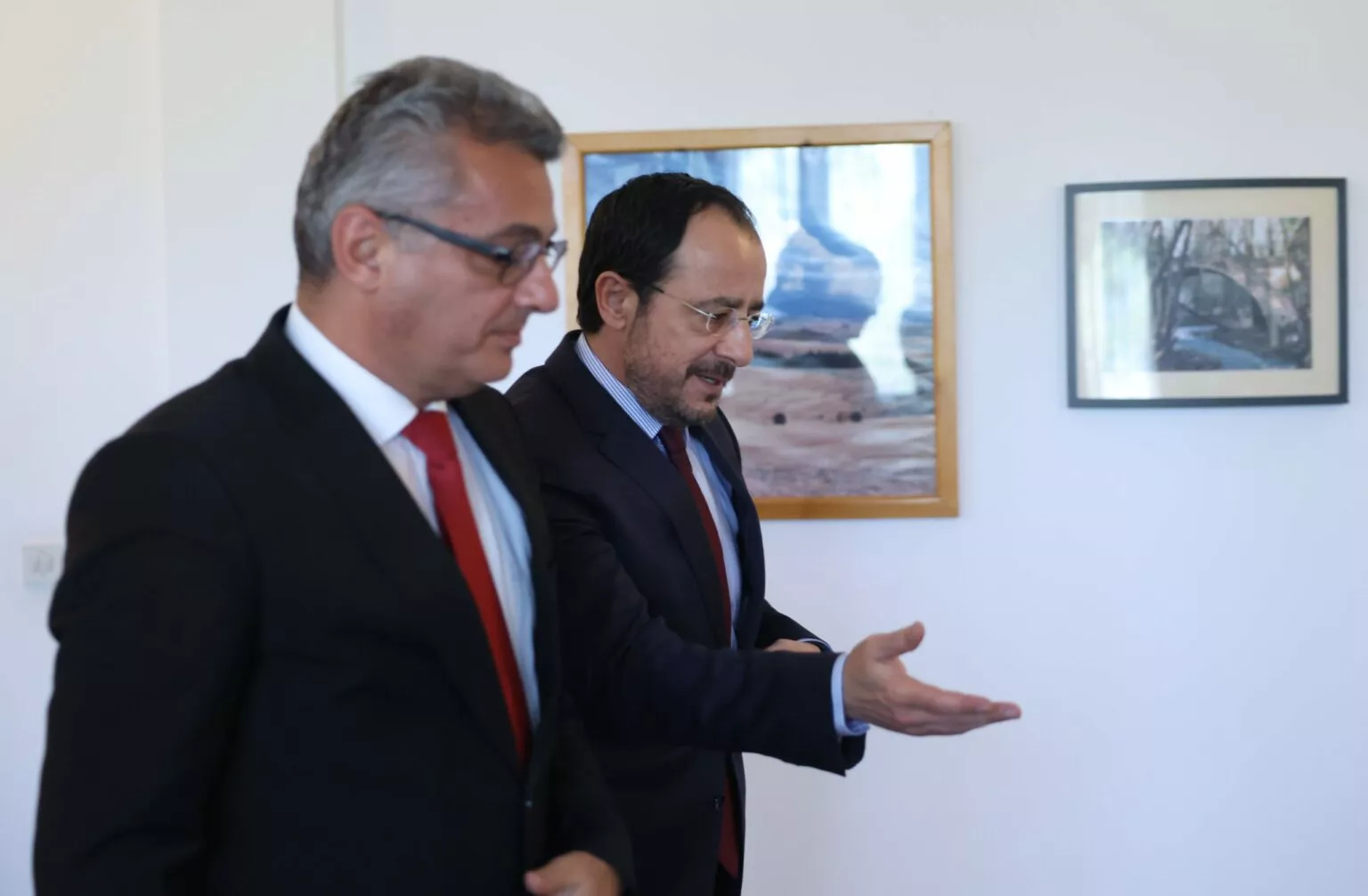
President Nikos Christodoulides has presented a 19-point proposal to Turkish Cypriot leader Tufan Erhürman and the United Nations, combining confidence-building measures with proposals addressing the substance of the Cyprus problem, in an effort to pave the way for the resumption of comprehensive negotiations.
The package, revealed in full by Phileleftheros for the first time, seeks to combine practical measures with progress on the core issues of the Cyprus dispute, creating the conditions for broader discussions that could eventually lead to an agreement.
Some of the 19 proposals have already been accepted, while others have been implemented.
UN Secretary-General António Guterres received an outline of the package in a letter from Christodoulides and was also briefed verbally.
The president initially presented the proposals verbally to Erhürman and the UN Secretary-General’s Personal Envoy for Cyprus, María Ángela Holguín. He subsequently handed both of them written copies during their latest meeting.
The National Council was also briefed on the content of the proposals at its most recent meeting.
Particularly significant is the final proposal, which sets out a possible negotiating process.
Christodoulides proposes two days of talks with Erhürman focusing on confidence-building measures, followed by an expanded meeting involving the European Union and the three guarantor powers — Greece, Turkey and the United Kingdom.
The expanded discussions would address the substantive issues of the Cyprus problem in the presence of either Guterres or his personal envoy.
Geneva, specifically the United Nations premises in the city, has been discussed as a possible venue.
The 19 proposals
The full package of proposals, published here for the first time, is as follows:
1. Louroujina and Kokkina crossings: Acceptance of the Louroujina crossing point, together with passage through Kokkina, initially for residents of Pyrgos.
2. Louroujina–Karavostasi route: Acceptance of Louroujina as a crossing point, with a route running through Kampos, Ampelikou and Karavostasi.
3. Restarting Imagine: Reactivation of the bicommunal Imagine educational programme. This was agreed and included in the statement issued after the latest Christodoulides–Erhürman meeting.
4. Return of Varosha: Return of Varosha, with Famagusta port operating under the auspices of the European Commission, in line with proposals made during Finland’s 2006 EU Council presidency.
5. Mine clearance: Demining of suspected hazardous areas covering 70,000 square metres on each side.
6. Military dialogue: Establishment of dialogue between the National Guard and the Turkish occupation forces, in the presence of the United Nations Peacekeeping Force in Cyprus (UNFICYP).
7. Pyla agreement: Examination of the two documents concerning the agreement on Pyla, with a view to bringing them into alignment.
8. Religious heritage and access: Free access to churches restored by the Technical Committee on Cultural Heritage, alongside increased visits to mosques in government-controlled areas.
9. Greek place names: Restoration of Greek place names on road signs.
10. Bicommunal cooperation: Joint meetings on youth issues, cultural heritage and the Civil Society Advisory Group, along with the establishment of a new group dealing with natural disasters.
11. Pyla festival: Joint participation in the bicommunal festival in Pyla on 17 October. This has already taken place.
12. Cross-cutting negotiations: Negotiations across several interconnected chapters of the Cyprus problem, including territory and property, governance, and security and guarantees.
13. Previous convergences: Use of the document recording previously agreed convergences as the basis for restarting negotiations, including the discussions held at Crans-Montana.
14. Rizokarpaso: Restoration of the school in Rizokarpaso and allocation of the former Cooperative Bank building to the community for use as a cultural centre.
15. Maronite community: Restoration of three churches and appointment of a teacher for the kindergarten, responding to requests from the Maronite community. The issue was mentioned in the statement following the latest Christodoulides–Erhürman meeting.
16. Armenian monastery: Restoration of the Armenian monastery, known as Armenomonastiro. This was also mentioned in the statement issued after the latest meeting between the two leaders.
17. Buffer zone: An end to violations in the UN-controlled buffer zone.
18. Football diplomacy: Organisation of friendly football matches.
19. Expanded negotiations: A two-day meeting between the leaders focusing on confidence-building measures, followed by an expanded meeting involving the EU and the guarantor powers, with the aim of announcing the resumption of negotiations. The UN Secretary-General or his personal envoy would also attend.
The opening of the Athienou–Aglantzia and Mia Milia crossing points had been considered agreed on the basis of a UN proposal, after earlier obstacles were overcome.
However, developments at the latest meeting between the leaders, following Turkish Foreign Minister Hakan Fidan’s visit to the occupied north, indicate that the Turkish Cypriot side has backed away from that understanding.
The immediate question is what happens next.
The next move now rests with the United Nations, which must arrange a joint meeting between Guterres, Christodoulides and Erhürman.
The leaders agreed to such a meeting during their latest talks in Nicosia, following consultations with Guterres through Holguín.
An announcement of the date is therefore expected.
The UN Secretary-General wants to secure a commitment from the Turkish Cypriot side to restart negotiations, allowing the process to continue under his successor.
Guterres discussed the issue with Turkish President Recep Tayyip Erdoğan in Antalya, on the sidelines of the climate summit.
For its part, the Turkish Cypriot side continues to insist on its maximalist positions, demanding sovereign equality and equal international status as what it describes as the only remaining options after so many years.
Nevertheless, it remains open to discussions.
In other words, it is not rejecting dialogue outright. It is, however, obstructing discussions on the substance of the Cyprus problem.
Turkey’s recent moves reveal Ankara’s intentions
Two recent moves by Ankara offer a clearer indication of its intentions.
The first was Turkish Foreign Minister Hakan Fidan’s brief visit to the occupied north on 6 November, apparently to give instructions on how the Cyprus issue should proceed.
Fidan’s visit overturned announcements that had been expected following last Monday’s joint meeting between the two leaders.
The second indication came from Erdoğan’s attitude towards the Republic of Cyprus and its president during the climate summit in Antalya.
Erdoğan left the reception hall at the leaders’ gathering for the 31st United Nations Climate Change Conference (COP31), avoiding the prospect of welcoming the Cypriot president.
The gesture sent several messages, both politically and in terms of diplomatic conduct.
Above all, it signalled Erdoğan’s unwillingness to have any contact with the Republic of Cyprus.
Although such actions are largely symbolic, they reinforce an already familiar reality: the Turkish side is prepared to discuss the Cyprus problem only on its own terms.
Erdoğan, Antalya and the diplomatic gain for Cyprus
Ankara has long promoted the claim that the Republic of Cyprus is a defunct state.
Turkey does not recognise the Republic and behaves as though it does not exist.
But what has this approach achieved?
Despite repeated efforts, Ankara failed to prevent the Republic of Cyprus from attending the United Nations Climate Change Conference (COP31).
Nor has Turkey ever succeeded in preventing Cyprus from maintaining international contacts or participating in international organisations and conferences.
Before the Republic of Cyprus joined the European Union, Turkey threatened an unlimited reaction if the country were admitted.
Cyprus nevertheless became an EU member state in 2004.
Turkey, meanwhile, remains outside the Union, with little prospect of joining any time soon.
One might expect Ankara to have realised by now that it cannot make the Republic of Cyprus disappear. Yet it continues to pursue the same approach.
As for the diplomatic fiasco in Antalya, Erdoğan’s manoeuvres produced precisely the opposite result to the one intended.
By leaving the hall to avoid welcoming the Cypriot president, Erdoğan gained nothing.
Instead, his behaviour drew attention to the presence of both the Republic of Cyprus and its president at the summit.
This was, after all, a summit at which Ankara had not wanted Cyprus to be represented.
EU ready to link Cyprus talks to Turkey relations
What Fitto will take to Ankara and the billions at stake in annual trade
The European Union’s involvement in the Cyprus problem is no longer confined to theoretical discussions.
Brussels is signalling to Ankara that it is prepared to establish a practical link between progress on the Cyprus issue and relations between Turkey and the EU.
That connection now appears to have taken a more concrete form: the opening of talks on upgrading the EU–Turkey Customs Union would be linked to the resumption of negotiations on the Cyprus problem.
Ankara is also interested in visa liberalisation and participation in the EU’s Security Action for Europe (SAFE) defence financing programme. These issues are by no means insignificant.
However, the Customs Union is of particular interest to both the EU and Turkey.
Trade between the two sides reached €217.5 billion in 2025.
An upgraded Customs Union could increase annual trade to at least €500 billion, according to the projections cited in the discussions.
The potential economic benefits would therefore run in both directions.
It is increasingly clear that coordination between Nicosia and Brussels is aimed at linking the EU–Turkey agenda to progress on the Cyprus problem.
This is the approach that European Commission Executive Vice-President and EU Special Representative for Cyprus Raffaele Fitto is expected to pursue during his visit to Ankara on 20 November.
Fitto is due to meet Turkish Foreign Minister Hakan Fidan, with the Cyprus issue expected to feature on the agenda.
Last Thursday, the European official held a lengthy telephone conversation with Christodoulides.
Their discussion focused on these developments, particularly Fitto’s forthcoming visit to the Turkish capital and the EU’s intention to raise the Cyprus problem during his meetings.
The Turkish authorities have already been informed that the issue will be discussed and will therefore have time to prepare their response.
For Ankara, the Customs Union is an especially important issue because of its economic implications.
What does Turkey stand to gain?
The opening of negotiations on upgrading the agreement — something Ankara has long sought and which the Europeans also want.
However, the progress and eventual outcome of those negotiations would also depend on developments in the Cyprus settlement process.
And what does Ankara stand to lose?
In practical terms, very little, apart from having to agree to the resumption of Cyprus negotiations, which it is currently obstructing.
Neither the opening of EU–Turkey discussions nor the resumption of Cyprus settlement talks would, in itself, guarantee an outcome.
Negotiations on upgrading the Customs Union would certainly not be completed in a matter of days. They would take years.
Nevertheless, Turkey has a strong interest in restarting a dialogue with the EU that has remained frozen.
The two processes would therefore be linked as they move forward.
That, as already noted, is Brussels’ objective.
It is also what Nicosia has sought from the outset, explaining the diplomatic initiatives it has undertaken.

