


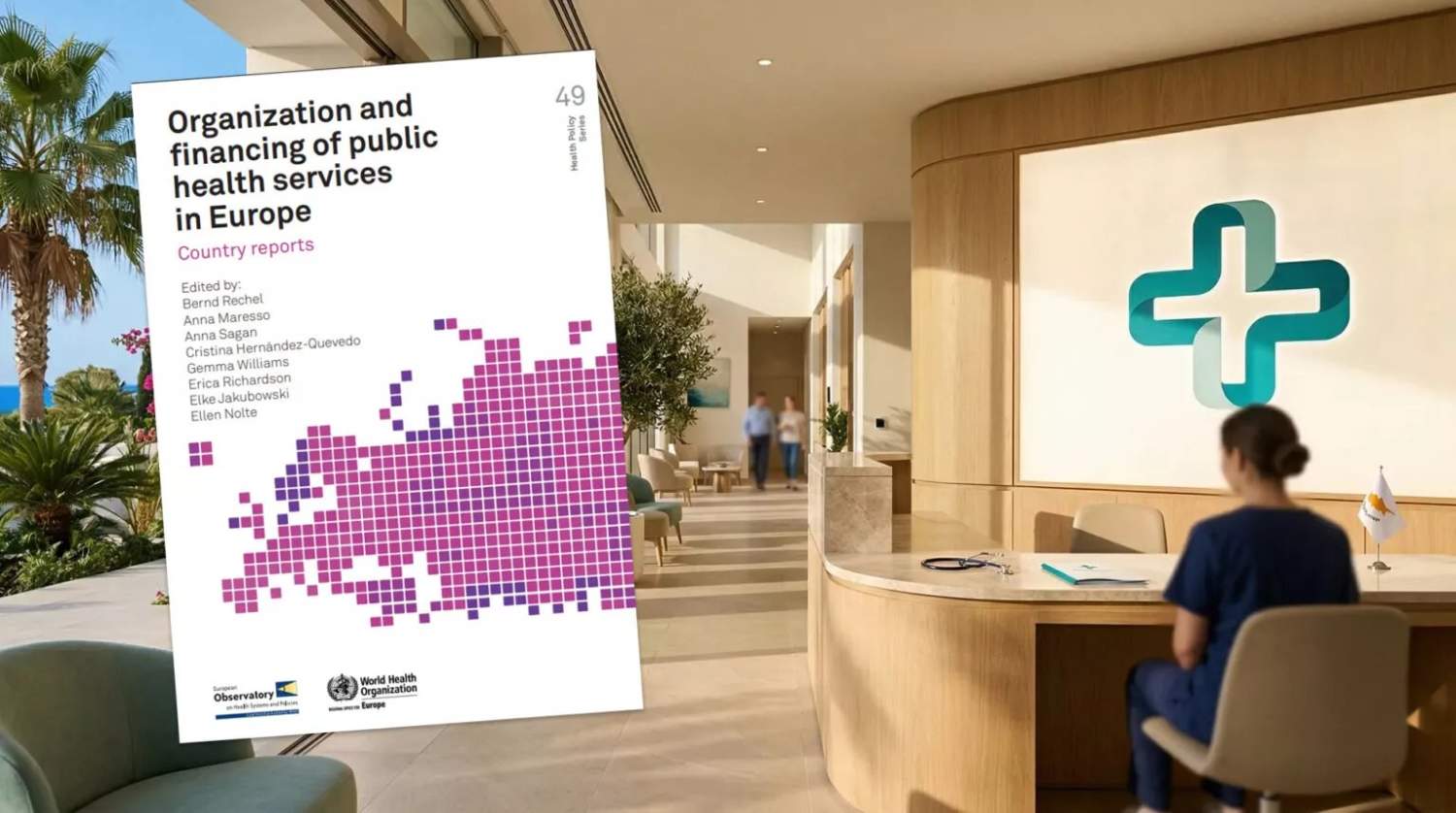
The share of Cyprus’s health spending funded collectively, through government schemes and compulsory insurance, rose by about 30 percentage points between 2013 and 2023. That compares with an average rise of 2.6 points across 31 European countries, according to a European Observatory on Health Systems and Policies report.
Cyprus has also bucked the trend in most European countries, where people are paying ever more out of their own pockets for healthcare. In Cyprus, out-of-pocket payments per person fell between 2014 and 2024, a change Phileleftheros links directly to the introduction of the General Health System (GHS).
Measured as a share of health spending, out-of-pocket payments in Cyprus fell from 44 per cent in 2018 to 18 per cent in 2023, according to a separate report, the Cyprus Country Health Profile 2025. These payments cover money paid when using health services or buying health products. They exclude compulsory GHS contributions, so their fall does not mean an equal fall in what people contribute overall.
Collective funding includes government schemes, compulsory social health insurance and, where it exists, compulsory private insurance. In Cyprus, this includes GHS contributions paid by employees, employers and other contributors, so the state has not taken on the extra cost alone. The rise reflects a shift in how much healthcare is funded collectively, not a 30 per cent increase in government spending. Across the 31 countries, the collectively funded share rose from 73.6 per cent to 76.2 per cent. Bulgaria, Hungary, Ireland, Malta and Poland recorded rises of between five and seven points.
European comparison
In 2024, household out-of-pocket payments made up 35.1 per cent of total health spending in Greece and Bulgaria and 34 per cent in Latvia. They were 9 per cent in the countries with the lowest share, and the 31-country average was 19 per cent.
The share of government spending going to health in Cyprus rose from about 7 per cent in 2013 to 15 per cent in 2023, against a European rise from 13 per cent to 14 per cent. In 2023, Greece, Hungary and Latvia devoted less than 10 per cent of their budgets to health, while Germany, Ireland, Sweden and the United Kingdom were at around 19 per cent. This measure shows health’s place in the state budget, not spending per person or the quality of services.
Remaining payments
Private payments have not disappeared. The report notes that even in systems with universal coverage, people pay for some services, often including adult dental care. In Cyprus, out-of-pocket payments are also recorded for outpatient care, home care and rehabilitation services. This does not mean those services fall entirely outside the GHS.
The next challenge, the report says, is to maintain financial protection, close gaps and keep the system sustainable, so that cost does not become a barrier to care.
The report, ‘Health financing in Europe: Collection, coverage, pooling and purchasing’, is by the European Observatory on Health Systems and Policies. The Observatory works with the World Health Organization, and the report examines 31 European countries.

