


Maria Angela Holguin, it seems, would rather not see these… inconvenient people, let alone meet them. That is why, for a year now, she has not answered a request from, to take just one example, the mayor and municipal council of occupied Famagusta. Nor, it appears, has the UN Secretary-General’s personal envoy on the Cyprus problem met any of the other refugee municipalities. That is her method: she picks and chooses whom she meets on the island.
And she doesn’t see them because she would obviously hear something different from what she is told at the get-togethers she holds with the so-called representatives of civil society. These “civil society” figures, who all sing from the same hymn sheet, represent nobody but themselves. She is free, of course, to see and listen to whomever she pleases. But it has to be said that the narratives she is used to hearing cut almost no ice with the public at large.
So the mayor and council of occupied Famagusta are still waiting for an answer from Maria. The reason is obvious: if she met them, she would have to raise subjects that upset the apple cart. Subjects such as the return of the fenced-off area of Famagusta. In her own words, the issue “must be addressed during formal negotiations”!
This, let it be said in passing, is an issue that has been discussed for decades. It was on the agenda then and it is on the agenda now. The fenced-off zone has a history that explains exactly why it has never left the table.
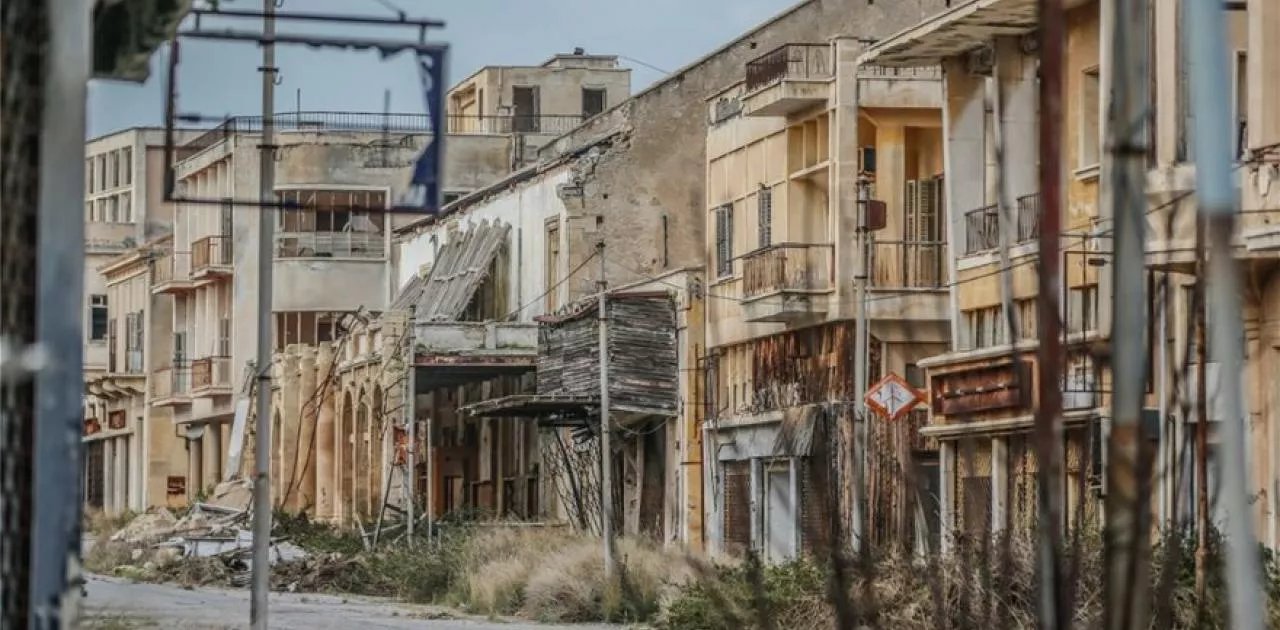
When Turkish troops captured Famagusta in August 1974, the area was looted, the “spoils of war” were shipped off to Turkey, and it was then sealed off with barbed wire. It was “cut off” from the rest of the town, which was filled with settlers. It was said at the time that the sealed-off quarter had been kept free of settlers so that Turkey could use it as a bargaining chip. Judging by what followed, Turkey had not yet decided when to… cash it in. The occupying power left the area to rot. It was deserted, its buildings fell to ruin, and for many years the only people allowed in were Turkish officers going for a swim.
After the talks collapsed at Crans-Montana in the summer of 2017, Turkey changed tack on Famagusta. The occupying side set about methodically opening up the area, with the aim of gradually settling it. Step by step, from June 2019, came the… tourist access to the “ghost town”. Once a bargaining chip, the fenced-off zone is now being wielded by the occupying power as a tool of blackmail against the Greek Cypriot side. By settling it, Turkey aims to bury the territorial chapter for good.
Famagusta has long been discussed as a confidence-building measure, and it was widely seen as a first step on the Cyprus problem too. None of that came to anything, of course, because since 1974 the occupying power has refused to budge even an inch.
The occupied municipality of Famagusta put a request to the UN envoy. Famagusta’s elected representatives, like those of other refugee municipalities, are asking for a meeting to make their case, and to hear hers. And by listening, they would no doubt get the measure of the UN official’s intentions.
Holguin chooses to see a closed circle of people. She chooses to weigh in with public statements, articles and interviews. But it is plain that she is not listening to the Cypriots, whose name she invokes whenever it suits her.

