


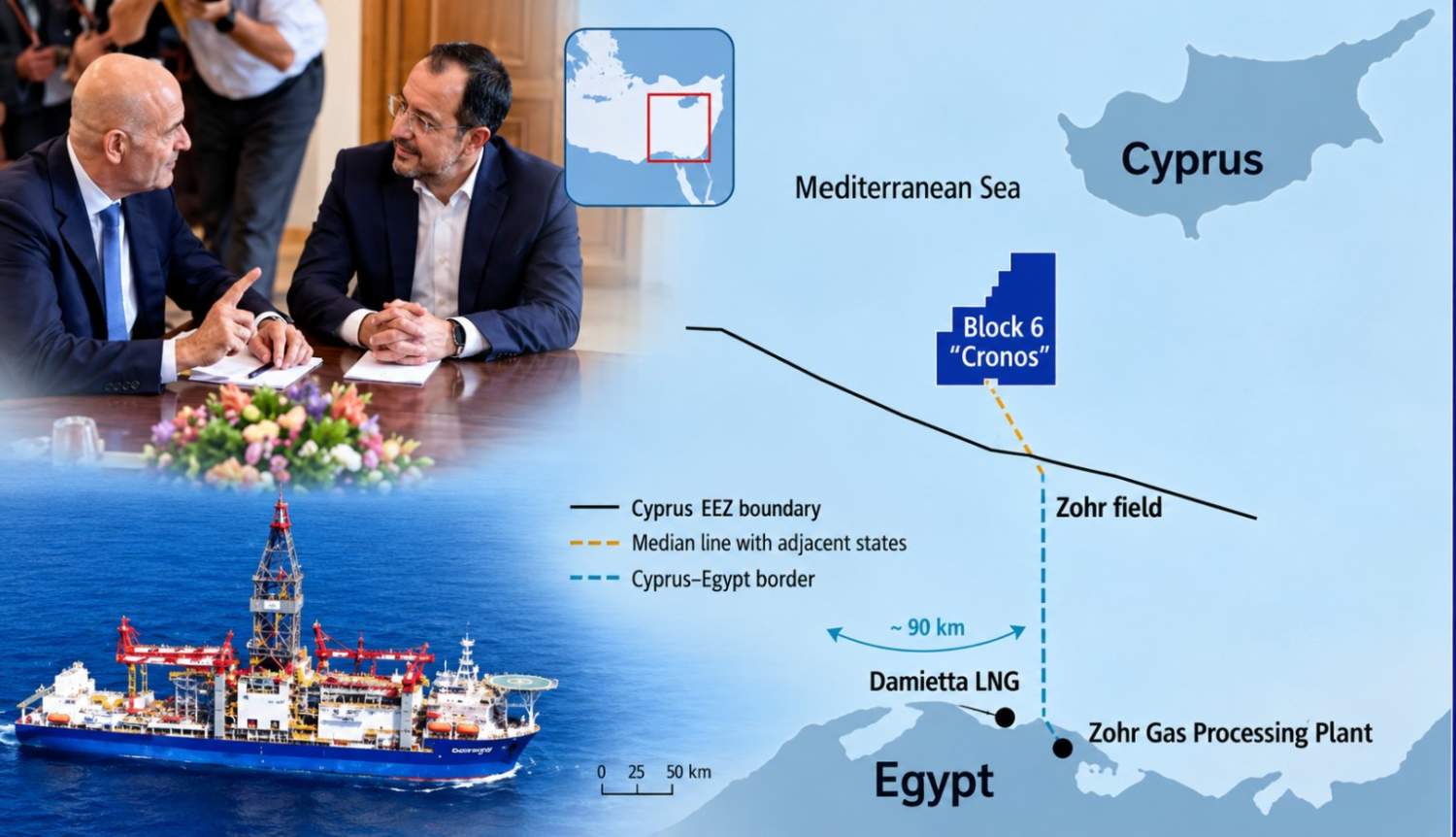
Italian energy company ENI will sign contracts worth up to 1.8 billion dollars in Nicosia on Monday to develop Cyprus’s Cronos gas field, The Wall Street Journal reported. The deal clears the way for production to begin in the first half of 2028.
A senior government source confirmed the report to Phileleftheros and said the contracts would be worth between 1.3 billion and 1.8 billion dollars. They cover the subsea infrastructure needed to extract and process the gas and to carry it by pipeline to Egypt.
President Nikos Christodoulides will meet an ENI delegation led by chief operating officer Guido Brusco at the Presidential Palace at noon. The signing ceremony for the engineering, procurement, construction and installation (EPCI) contract will follow immediately afterwards.
ENI and France’s TotalEnergies jointly operate the Cronos field. According to The Wall Street Journal, and confirmed by Nicosia, the two companies decided in July to go ahead with the project and prioritise its rapid development, largely because they could use existing pipelines and processing facilities.
In September, Halliburton said it had won the drilling contract for the project, and McDermott said it had been selected for the subsea work, estimated at between 500 million and 750 million dollars.
Route to Europe
Using existing Egyptian infrastructure at the neighbouring Zohr field makes the project cheaper. ENI will only need to build pipelines connecting the Cronos wells to the Zohr network, plus one more pipeline linking the Zohr gas processing plant to the Damietta LNG terminal. From there, the liquefied natural gas will be shipped to Europe.
Initial estimates put the field’s reserves at more than three trillion cubic feet of gas. Production is expected to plateau at around 500 million cubic feet a day, according to The Wall Street Journal.
ENI also operates another block in Cyprus’s exclusive economic zone (EEZ) and holds stakes in two more operated by TotalEnergies.
Europe’s search for supply
The agreement is a vote of confidence in Nicosia and strengthens Cyprus’s energy profile, with wider significance for Europe. Cypriot gas will contribute to the European Union’s efforts to reduce its dependence on US and Russian gas.
Conflict in the Middle East, mainly the continuing standoff between the United States and Iran in the Strait of Hormuz, has unsettled international gas markets and is forcing Europe to seek alternative supplies urgently. It is the second such crisis in five years, after Russia’s full-scale invasion of Ukraine in 2022.
The Wall Street Journal noted that Europe relies increasingly on imports of US liquefied natural gas, and that developing fields closer to the continent is expected to ease some of its energy security concerns.
A geopolitical gain for Nicosia
For Nicosia, the gain is mainly geopolitical, as revenue from selling Cypriot gas is not expected any time soon.
Government sources said ENI’s decision was in line with what Cyprus has urged its EU partners to do for years: give greater weight to energy sources within the bloc to reduce reliance on outside suppliers such as the United States and Russia.
With the situation in the Middle East and the fallout from the Iran-US conflict, finding alternative sources of energy has become a pressing need for Europe, and European energy majors appear to be taking a leading role.
Busy period in the region
The Wall Street Journal said the project is moving ahead during a period of intense oil and gas activity in the wider region.
It reported that US company Chevron is in talks to advance the Aphrodite gas project off Cyprus, which it owns jointly with Israel’s NewMed Energy and Britain’s Shell. Shell has agreed to sell its stake to Hungary’s MOL Group, in a deal expected to close in early 2027, the newspaper said.

