


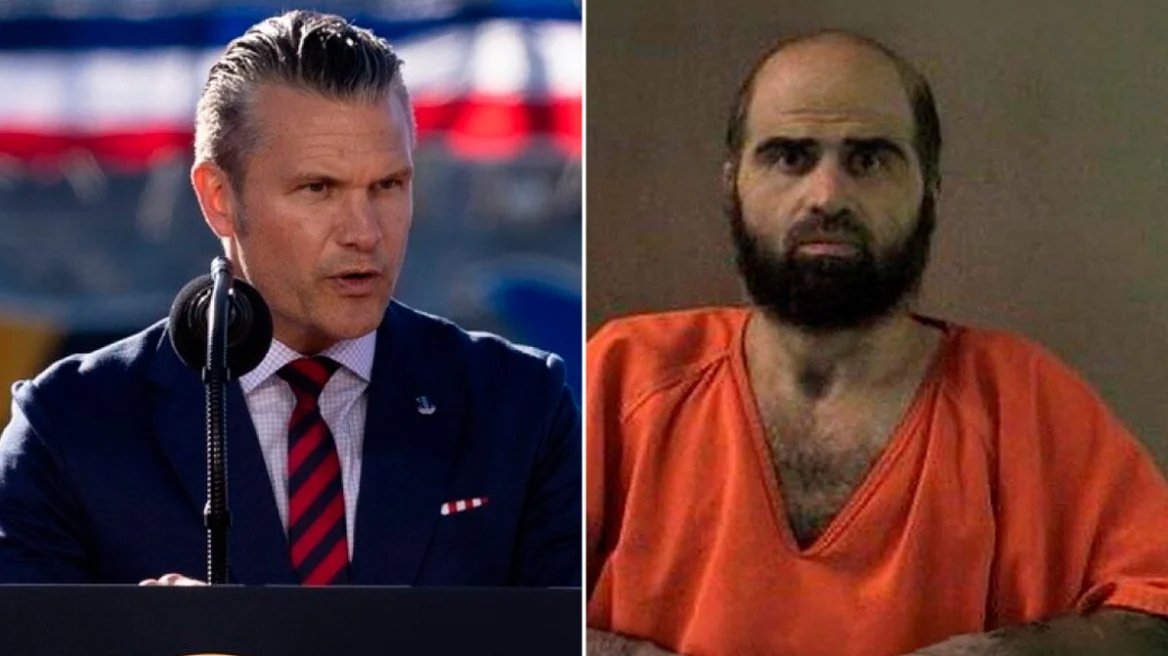
US President Donald Trump on Thursday scrapped plans to livestream the execution of the former Army major who killed 13 people at Fort Hood, overruling Pentagon chief Pete Hegseth after the proposal drew opposition from Republicans, religious leaders and the public, Reuters reported.
Hegseth had announced plans to broadcast Nidal Hasan’s execution by firing squad, set for 3 December at the Fort Hood military base in Texas, where Hasan carried out his attack in 2009. No other country is known to televise or livestream judicial executions.
A military jury convicted Hasan, a former US Army psychiatrist, of premeditated murder for shooting dead 13 unarmed soldiers and wounding 32 others at a medical facility on the base. He was shot by law enforcement during the attack and paralysed from the waist down, and now uses a wheelchair.
In a social media post, Trump said streaming the execution might have been a strong deterrent, showing the world how the United States dealt with terrorists, but that many well-meaning people would rather not watch Hasan die. “He will die, as scheduled, by firing squad, but this event will not be streamed,” he wrote.
The victims’ families will be able to watch the execution in person if they wish, as is standard at US executions. A White House official, speaking on condition of anonymity, said Trump and his advisers had not known about the livestream plan.
A split with Hegseth
The reversal was Trump’s first major public split with Hegseth, one of his closest allies, although it was unclear whether it would put Hegseth at political risk given their strong ties.
The Pentagon said Trump had spoken to Hegseth about the decision before announcing it on Truth Social. “The Secretary supports the President’s decision, and they are completely aligned,” chief Pentagon spokesman Sean Parnell said.
Hegseth had argued that broadcasting the execution would make sure people understood that “there’s serious consequences for these types of things”.
Opposition to the plan
Some Republicans, including Vice President JD Vance, and religious leaders had expressed views ranging from doubt to outright condemnation of the plan. Opinion polls showed most Americans were against it.
Archbishop Timothy Broglio, who oversees the spiritual care of Catholic members of the US armed forces, raised objections, while Pope Leo condemned capital punishment in all its forms.
Republican Senator John Curtis of Utah called the cancellation “the right move”. Democratic Representative Richard Neal of Massachusetts said the original plan was “a profound failure of moral judgment and basic human decency”.
A lawyer for Hasan could not immediately be reached for comment, and it was unclear whether legal challenges might delay the execution.
The death penalty in the United States was already under renewed scrutiny after Tennessee’s failed attempt last month to execute Christa Pike, convicted of murder in the 1990s. She survived two lethal injections but was left badly injured and needed hospital treatment.
The decision comes ahead of the 3 November midterm elections, which will decide whether Republicans keep control of Congress, as opinion polls show growing disapproval of Trump’s policies.
(Reuters)

