


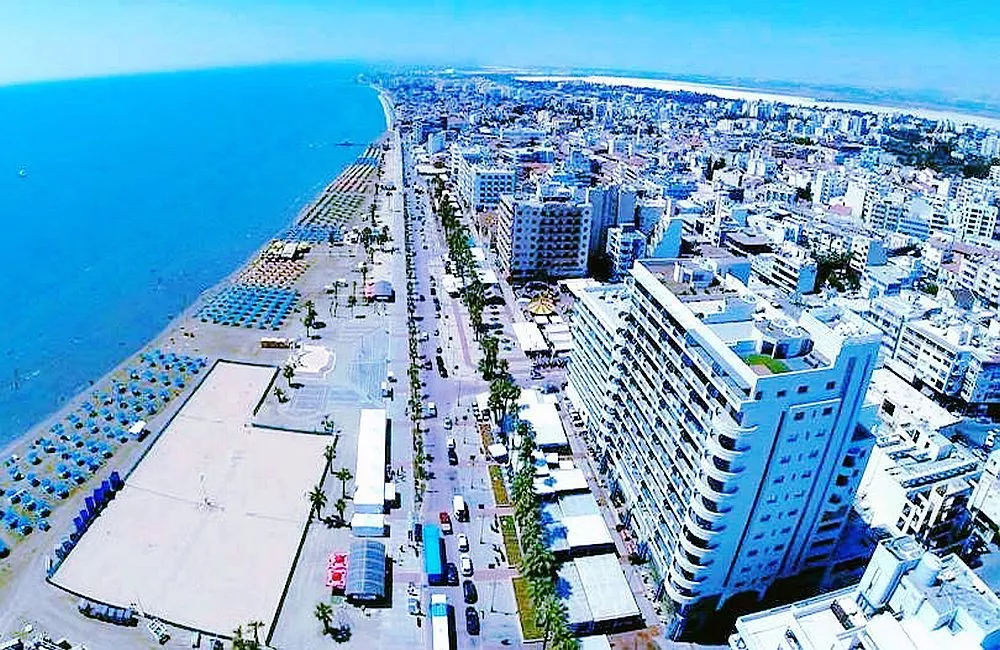
Property prices in Larnaca have risen by between 20% and 30% in just two years, driven by growing demand from Cypriot and particularly foreign buyers, leaving many local couples unable to afford a home in the city.
Estate agents told Phileleftheros that property prices have climbed sharply, while apartment rents have reached levels comparable to those in Nicosia. The pressure is increasingly pushing prospective buyers and tenants towards surrounding communities, where prices are also rising.
The trend has raised concerns that Larnaca could face a housing affordability problem similar to that in Limassol if prices continue to increase.
According to the Council for Registration of Real Estate Agents, monthly rents in Larnaca now range from €600 to €700 for a one-bedroom flat, €700 to €800 for a two-bedroom flat and €900 to €1,000 for a three-bedroom flat.
“It is now a fact that property prices in the city of Larnaca have risen significantly, to the point where they are approaching Nicosia levels,” council president Marinos Kineyirou told Phileleftheros.
Kineyirou said there were signs that prices within Larnaca city were beginning to stabilise, but the situation was different in the suburbs.
“The picture is completely different in the suburbs, where prices continue to rise unabated,” he said.
Property values are increasing rapidly in areas including Tersefanou, Alethriko, Pervolia and Kiti.
Kineyirou highlighted the rapid development of Livadia, largely attributed to the removal of oil storage tanks from the wider area.
“We can say that in some cases, property values in Livadia have tripled in recent years,” he said.
As for apartment rents, Kineyirou does not expect further widespread increases. However, he warned that tenants whose older rental agreements are now expiring could face higher costs when renewing them.
“Where we inevitably expect to see increases is in older rental agreements that are expiring around this time. When they are renewed, rents are adjusted upwards to reflect current market conditions,” he said.
Larnaca’s most expensive neighbourhoods
Property prices are rising across Larnaca, particularly in sought-after coastal areas and growing residential suburbs.
Apartment prices vary significantly across Larnaca, with Mackenzie still the city’s most expensive neighbourhood, although another coastal area is expected to overtake it.
According to Vassos Zakos, director of the Fox estate agency’s Larnaca office, new properties within Larnaca municipality sell for an average of around €4,000 per square metre, compared with €6,000 per square metre in Mackenzie.
“It remains the most expensive area because of limited availability,” Zakos said, adding that property prices are also high around Agios Lazaros and in the city centre.
But an even more expensive property market is emerging along the seafront at the former oil refinery site, where developments worth hundreds of millions of euros are planned.
According to Zakos, initial indicative prices for some developments in the area start at €10,000 per square metre, approaching the levels seen in Limassol.
“There are effectively no established prices for this area anymore, particularly for seafront plots. The first indicative prices we have been given for some developments start at €10,000 per square metre. This will undoubtedly be the most expensive area in Larnaca in the future,” he said.
Young couples increasingly priced out
Zakos said property prices in Larnaca had risen by between 20% and 30% over the past two years, making home ownership increasingly difficult for residents.
“What worries me is that it is now almost impossible for a couple to buy property in Larnaca,” he said.
“What I have started seeing is people buying outside Larnaca, particularly in Alethriko. Kiti and Pervolia used to be options too, but prices there have also risen and are approaching Larnaca levels.”
Foreign buyers are a major factor behind rising demand.
While Israelis and Lebanese buyers account for a substantial part of Larnaca’s property market, Zakos said interest from other European nationals had also increased significantly.
“Everyone talks about Israelis and Lebanese buyers, but recently we have also seen large numbers of Europeans, including French, Italian, Polish and German nationals,” he said.
“They are starting to see Larnaca as a good European destination in which to develop their careers and live. Many are also digital nomads, because services in Cyprus are of a high standard.”
Building permits jump 53% as construction accelerates
The scale of Larnaca’s construction boom is reflected in figures provided to Phileleftheros by the Larnaca District Local Government Organisation (EOAL).
During the first eight months of 2026, the number of building permits issued rose by 53%, while planning permits increased by 42%, compared with the same period last year.
Between 1 January and August 2026, the authority issued 3,957 building permits and 2,502 planning permits.
During the corresponding period in 2025, it issued 2,586 building permits and 1,759 planning permits.
The figures underline the sharp increase in development activity taking place across Larnaca as demand for property continues to grow.
Local authorities seek affordable housing solutions
Rising property prices have also alarmed local authorities, who acknowledge that housing is becoming increasingly unaffordable for many residents.
Larnaca Mayor Andreas Vyras said the municipality was exploring ways to provide homes at affordable prices, while stressing that local government could not solve the problem alone.
“The increase in prices is a concern for us, and it is one of the issues we need to address in our city,” he said.
“However, we are preparing projects that will help people facing serious difficulties, either through affordable housing or student accommodation.”
One proposal involves a land exchange between Larnaca Municipality and the Bishopric of Kition in the area of the new GSZ stadium, allowing the municipality to develop homes at affordable rents.
Vyras said the municipality had already commissioned a team from the Cyprus Scientific and Technical Chamber (ETEK) to prepare the terms of an architectural competition, with the aim of securing funding from a dedicated EU affordable housing programme in the next programming period.
However, he stressed that government support would be essential.
“We need the state’s help, and we have also submitted proposals through the Union of Municipalities because this is a nationwide problem,” he said.
“One of these proposals is for state land to be made available so that we can build housing units. The government tells us it cannot lease us land for this purpose, and that is something we disagree with.”
Calls for government incentives
Angelos Hadjicharalambous, president of the Larnaca District Local Government Organisation, also expressed concern about rising property prices and called for incentives from central government.
He stressed that residents of Larnaca district have the lowest wages in Cyprus, making the increase in housing costs particularly difficult.
Hadjicharalambous said the organisation had recently met representatives of the Cyprus Land Development Corporation (KOAG) to discuss ways of supporting housing projects already under way.
He highlighted the importance of a decree issued by the Interior Minister concerning financial contributions from property developments in Larnaca city and district.
Under the arrangement, substantial funds are expected to flow into KOAG’s accounts to support housing initiatives.
“The Cyprus Land Development Corporation is planning projects in Larnaca, and in November we will hold a joint press conference to announce them,” Hadjicharalambous said.
“We are working together to provide affordable housing for residents, whether through purchasing or renting.”

