


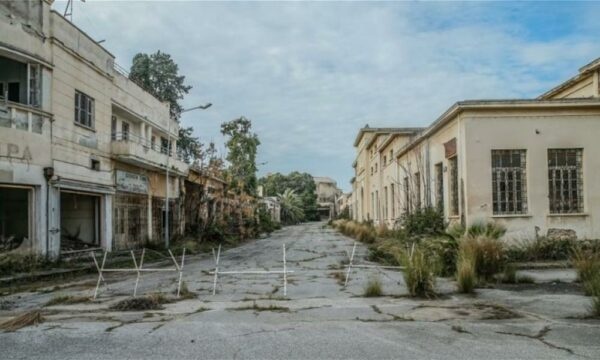
President Nikos Christodoulides has put Famagusta back on the table as a confidence-building measure, reviving an approach that would link the return of Varosha with the operation of Famagusta port under European Commission supervision.
The proposal is being put forward as Nicosia looks for ways to generate movement in the Cyprus problem amid continuing difficulties in efforts to restart substantive negotiations.
The initiative draws on earlier proposals developed during Finland’s presidency of the EU in the second half of 2006.
In broad terms, the plan envisages the fenced-off area of Varosha initially being placed under United Nations administration, followed by the return of its lawful residents.
At the same time, Famagusta port would operate under European Commission supervision.
The Finnish proposal had also included the lifting of Turkey’s restrictions preventing Cypriot ships from using Turkish ports and aircraft from using Turkish airspace.
Turkey rejected that initiative at the time, leading to the cancellation of planned technical and political-level meetings. Finland had also been seeking to unblock Turkey’s EU accession negotiations.
Other proposals also on the table
Christodoulides has meanwhile presented a series of other ideas to both the United Nations and Turkish Cypriot leader Tufan Erhürman.
They include measures affecting the everyday lives of people on both sides, issues previously raised by the Turkish Cypriot side and proposals intended to make discussions easier and allow efforts to move forward more quickly.
According to the information available, several of those ideas have been received positively by UN Secretary-General António Guterres and his Personal Envoy on Cyprus, María Ángela Holguín.
The source argues, however, that Erhürman has limited room to engage with such proposals because of Ankara’s position.
It says there have been cases in which the Turkish Cypriot leader appeared prepared to discuss an issue before changing his position the following day. Similar shifts have also been attributed to Turkish Cypriot negotiator Mehmet Dana.
The broader assessment in Nicosia is that Ankara remains the main obstacle to progress and that Turkey’s position limits the Turkish Cypriot leadership’s freedom to manoeuvre.
Fitto missions put EU-Turkey ties in focus
The European Union is also becoming more directly involved through Raffaele Fitto, the European Commission’s Special Representative for Cyprus.
The Commission appointed Fitto in July to support the UN-led settlement process, work with Holguín and engage relevant parties to help prepare the ground for a resumption of negotiations.
His upcoming contacts are expected to focus particularly on Ankara and the wider EU-Turkey relationship.
Brussels is seeking to open and maintain channels with Turkey, while issues including the modernisation of the EU-Turkey Customs Union remain on the agenda.
The Customs Union has clear economic importance for both sides, but progress is not automatic and Turkey would have to meet outstanding obligations, including those relating to Cyprus.
Ankara is also pressing for progress on trade, roaming charges and visa liberalisation, although the latter continues to face reservations from some EU member states.
The EU-Turkey relationship is therefore still viewed by Nicosia as a potential lever in efforts to move the Cyprus issue forward.
Holguín seeks movement before Guterres leaves office
Holguín is also seeking progress in the remaining months of Guterres’ term.
According to the source, she wants to continue her Cyprus mission after her current mandate ends, although any extension would depend on the next UN secretary-general being persuaded that developments justify continuing her role.
Her expected visit to Cyprus this month is also linked to instructions from Guterres to exhaust every possibility for progress before his term ends in December.
Holguín initially appeared reluctant to support the preparation of a document formally recording previous convergences between the two sides.
Such a document has been prepared but has not been tabled because the Turkish Cypriot side does not want it submitted at this stage.
The UN position, according to the source, is that the convergence document could be presented once formal negotiations begin.
Holguín has instead floated new ideas in previous contacts as she looks for common ground, including proposals drawing on older approaches to a settlement.
Great Sea Interconnector surveys expected to restart
Separately, survey work connected to the Great Sea Interconnector between Crete and Cyprus is expected to resume in mid-October, according to information cited in the source.
Athens maintains that Greece alone will authorise work on the project under international law.
Greek Foreign Minister Giorgos Gerapetritis has said the company involved would apply only to the Greek government for permission and that Turkey could be informed of the work rather than asked to authorise it. Recent Greek reporting has also confirmed Athens’ position that only Greece has licensing authority over the project.
Turkey has rejected that approach and says activities in areas it claims as its continental shelf must be coordinated with Ankara.
The Turkish Defence Ministry said this week that Turkey would not allow unauthorised activity in what it describes as its continental shelf in the Eastern Mediterranean.
Turkey sends Oruç Reis towards Cyprus
The tension has been compounded by Turkey’s decision to issue a NAVTEX for the research vessel Oruç Reis to carry out surveys linked to a planned natural gas pipeline between southern Turkey and the Turkish-occupied north of Cyprus.
The NAVTEX, issued on 1 October, covers waters extending from Turkey’s southern coast towards northern Cyprus and remains in force through late October.
The planned subsea pipeline is around 97 kilometres long and is intended to connect Turkey with the occupied north. Turkish preparations for the project were already under way before the NAVTEX was issued.
Nicosia regards the move as illegal and as another attempt by Ankara to consolidate faits accomplis in and around Cyprus.
The source also links Turkey’s pipeline activity to the wider dispute over the Great Sea Interconnector and Ankara’s “Blue Homeland” doctrine.
Attention will now turn to Turkey’s response when the Great Sea Interconnector surveys are expected to resume in mid-October.

