


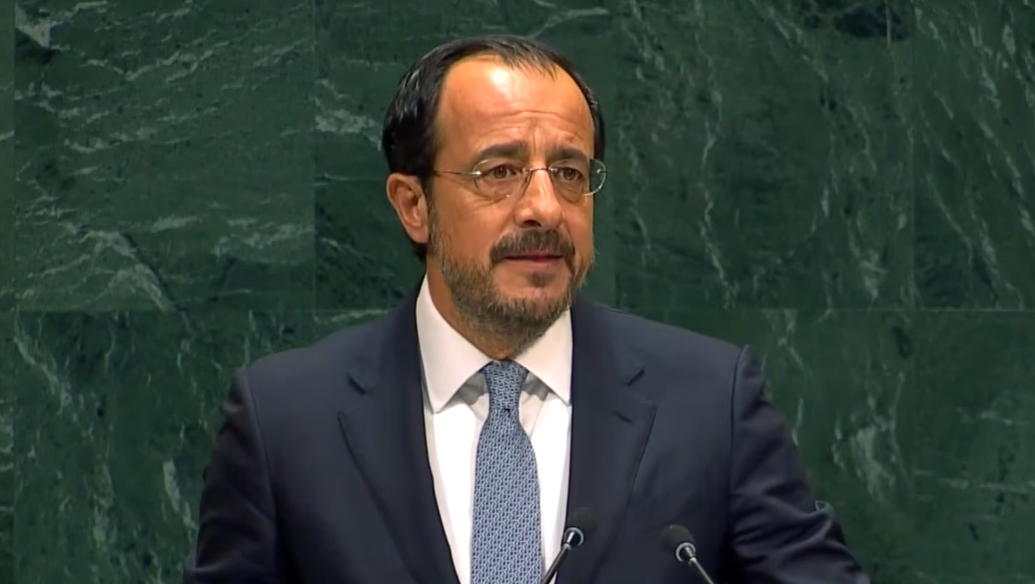
President Nikos Christodoulides accused Turkish President Recep Tayyip Erdogan of “hypocrisy of the highest form” in a speech to the UN General Assembly in New York on Wednesday, saying Turkey was doing in Cyprus the exact opposite of the principles Erdogan had invoked on Tuesday.
Erdogan had spoken about international law, respect for the sovereignty and territorial integrity of all states, illegal occupation and the plight of refugees, and had quoted at length from the UN Charter, Christodoulides said. “Mr. Erdogan, if you want to quote from the Charter, you must first apply it,” he said, adding that politicians were judged by their deeds, not their words.
Christodoulides said he was ready to resume negotiations within the agreed UN framework from where they left off in 2017, building on the substantial work already done, and called on Erdogan to give the green light for substantive talks. He also urged his Turkish Cypriot compatriots to see a shared future as an opportunity for prosperity.
A bizonal, bicommunal federation with political equality, the framework set by the UN Security Council, remained the only basis for a comprehensive settlement, he said. He argued that the common ground already existed in Security Council resolutions, international law and the laws, values and principles of the European Union, and that what was needed now was political will from all parties.
Any settlement should reunify the country and allow Greek Cypriots, Turkish Cypriots, Maronites, Armenians and Latins to live together in peace, security and prosperity, Christodoulides said. Division, he added, would never be accepted.
He told the Assembly that sovereignty and territorial integrity could not be applied selectively depending on who the perpetrator was, and that UN resolutions could not be upheld in one case and ignored in another. This went to the credibility of the international system itself, he said, particularly for states whose security rested on international law rather than the balance of power.
Turkish occupation
More than a third of the Republic’s territory remains under Turkish occupation 52 years after the illegal Turkish invasion, Christodoulides said. Tens of thousands of displaced people and their descendants are still prevented from returning home, he said, and Varosha remains sealed off, with Turkey still defying its obligations under UN Security Council resolutions.
He also cited human rights violations, the destruction of religious and cultural heritage and the organised transfer of settlers, which he said amounted to demographic change. Relatives of missing persons are still demanding to know what happened to their loved ones, he said.
Regional role
Christodoulides described Cyprus as an active and responsible member of the international community, contributing to crisis management, humanitarian aid and regional cooperation. Small and medium-sized states had to work together while pursuing strategic autonomy, he argued. “We cannot compel. But we can coalesce,” he said.
He pointed to the Amalthea Maritime Humanitarian Corridor, which Cyprus proposed after the Hamas attack of October 7, 2023 and the humanitarian crisis in Gaza. Through cooperation, including with the UN2720 Mechanism, the idea became a working humanitarian route that is still delivering, he said, adding that Cyprus has dedicated more than 25 per cent of its humanitarian aid budget to Palestine.
In the past three years, Cyprus has helped evacuate thousands of third-country nationals, from 70 countries, out of the region, he said. Through CyprusAid, it was among the first responders to the earthquake in Venezuela and the flash floods in Nepal, and has directed a large share of its earmarked resources to Sudan and the wider Sahel.
On climate, he cited Cyprus’s Regional Initiative on Climate Change and the EU-backed Cyprus Regional Aerial Firefighting Station at Paphos Air Base, which brings together partners from the Middle East, North Africa and the Gulf.
He also mentioned the Cyprus Center for Land, Open Seas and Port Security (CYCLOPS), set up jointly with the United States, which he said has trained thousands of government officials from more than 50 countries in its four years of operation.
Christodoulides said that during its presidency of the Council of the European Union in the first half of this year, Cyprus, a country of fewer than one million people, steered the work of a union of 450 million European citizens, and that its size had not diminished its ability to lead.
The need for institutions to adapt to new realities was the essence of this year’s theme, ‘Restoring trust, managing transformation: a United Nations that delivers for all’, he said. He described the UN80 Initiative, the Pact for the Future and the 2030 Agenda as part of efforts to ensure multilateral cooperation could respond to today’s needs.
He also acknowledged the leadership of Secretary-General Antonio Guterres, who is approaching the end of a decade in the post.

