


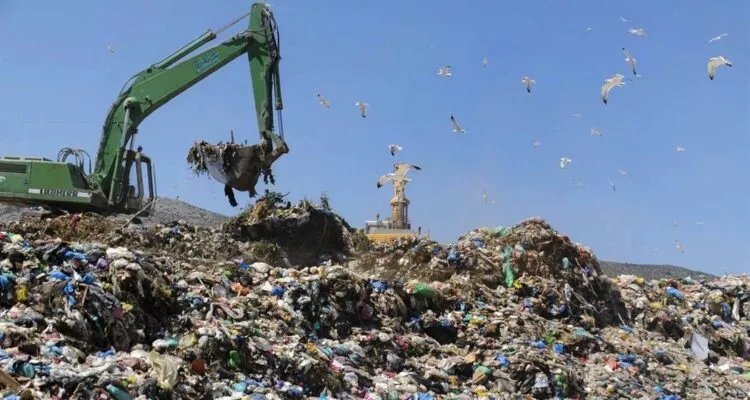
Nicosia’s District Local Government Organisation (DLGO) has told a House committee it will not accept the shifting of responsibility for the country’s long-standing lack of adequate infrastructure and its failure on waste management.
The responsibilities in question are legal, financial and administrative. In a memorandum to the chairman and members of the House Committee on the Monitoring of Development Plans and Control of Public Expenditure, DLGO president Konstantinos Giorkatzis set clear “red lines”. The memorandum also highlights the immediate risk of financial penalties from the EU because Cyprus continues to rely on landfill.
The European Commission sent Cyprus a reasoned opinion in July 2026, along with 11 other member states, for failing to meet binding recycling targets. With the two-month deadline to comply expiring, Cyprus is on the verge of facing the EU Court. The DLGO recalled the precedent of case C-387/97, Commission v Greece, in which prolonged non-compliance on waste management drew a daily fine, and stressed that the financial risk to the state is huge.
According to figures Giorkatzis submitted, the DLGO is being asked to take over and manage a broad network of infrastructure that would cost almost 50 million euros over two years, including management, with no state provision to cover the resources needed. “They are loading infrastructure worth millions with no state resources,” Giorkatzis said.
The network comprises eight existing Green Points and three more to be built, ten Green Kiosks in the mountain district, ten reuse shops, one reuse centre, two community composters, 14 restored landfill sites plus the Kotsiatis landfill, and the Koshi waste management facility.
The annual running cost of the eight Green Points is 1 million euros, according to the same figures, with 40 per cent of it going on managing waste streams under often monopolistic conditions. Aftercare and construction work at the restored landfill sites come to at least 500,000 euros a year, excluding possible biogas investment. For the other planned infrastructure, the state has presented local government with no official cost study.
The Ministry of Agriculture, Rural Development and Environment counters the concerns and objections raised by local government about costs and infrastructure gaps with its own plan and the actions under way. Briefing the parliamentary committee, it said meeting the European and national targets is a national priority. Those targets are to cut landfill to below 10 per cent, from 63 per cent now, and to raise recycling and composting to 65 per cent by 2035, on the basis of the approved Municipal Waste Management Plan 2022-2028.
To prevent the collapse of the reform effort and an unjustified financial burden on residents, the DLGO put nine conditions to parliament and the relevant ministries. On liability, it says it bears no responsibility for the lack of national infrastructure, because the planning predated its creation, and wants an explicit provision barring European fines or sanctions from being passed on to DLGOs and local government.
On funding, it will take over no infrastructure management unless the ministry hands over the necessary financial and material resources, and it wants national and European funds guaranteed for fast construction of waste treatment and recovery units at district or national level. It also wants the landfill tax and every other financial measure tied to a binding implementation timetable and specific state investment in infrastructure.
On process, it wants a consultation mechanism between the state and DLGOs before legislative or tax decisions, timely, clear and regular information on the infringement procedure and compliance measures, and active DLGO participation in planning national waste infrastructure. It is also pressing for strict enforcement of extended producer responsibility and Green Dot, so that collective schemes collect and manage more than 40 per cent of recyclables.
The DLGO denounced the state’s practice of imposing higher fees and taxes on citizens with nothing in return. In 2012, the entry fee at the Koshi facility jumped from 7 euros to 40 euros a tonne, raising the annual cost for Nicosia Municipality, for example, from 230,000 euros to 1,320,000 euros. It is also noted that the state failed to deliver the goals for which citizens were asked to pay more, such as introducing the “Pay As You Throw” tool, that the facilities did not operate efficiently, and that recycling was not strengthened.
The DLGO also warned that the planned landfill tax, starting at 10 euros a tonne and rising to as much as 70 euros, risks working purely as a revenue-raising measure and a levy unless it comes with substantial treatment infrastructure. It said the state is planning 160 million euros of spending on temporary improvements at the Koshi and Pentakomo facilities, which have already outlived their life cycle and handle quantities beyond their capacity.
Among the ministry’s actions, it plans to introduce Pay As You Throw within 2027, with 25 million euros in funding to support local authorities. It also plans a transitional upgrade of the Pentakomo and Koshi facilities at a total cost of 162 million euros. The final technological solution will be determined by the Infrastructure Network Viability Study, expected to be completed in 2028.
It is also promoting an extensive network of complementary projects and Green Points to strengthen the circular economy and separate collection. On illegal dumps, it acknowledged serious environmental impacts and fire risks from uncontrolled dumping, and noted that, although legal responsibility for identifying and cleaning them up lies with local authorities, the state provides substantial financial support.

