


By Ilias Pantelidis
Attila, the codename of the Turkish invasion, entered the town of Aigialousa on Saturday, August 17, 1974, without a fight, strolling in and laughing. On another Saturday, August 2, 1975, the church of Agia Fotini at Agios Andronikos did not celebrate its feast day, because it lay under slavery. Around 8,000 Greek souls lived in Karpasia at the time.
Everyone learned new words: enclaved, prisoners, missing, and many more. Agia Fotini, on that day, opened its eyes and helped some of them read the Third Vienna Agreement, which Turkish Cypriot leader Rauf Denktash deliberately, methodically and maliciously violated by driving the enclaved out by force.
The agreement of August 2, 1975 recorded that “Denktash reaffirmed, and it was agreed, that the Greek Cypriots at present in the north of the island are free to stay and that they will be given every help to lead a normal life, including facilities for education and for the practice of their religion, as well as medical care by their own doctors and freedom of movement in the north.”
In 1881 the Karpasia district had 13,590 inhabitants. In 1946 it had 30,690. In 1973 there were 21,199 Greek Cypriots and 6,043 Turkish Cypriots. All of them spoke Greek. What followed the agreement is known.
The great and unpunished betrayals of 1974 all but wiped out the Greek presence in Karpasia.
Today a few dozen Greeks live at Agia Triada of Yialousa, the local name for Aigialousa, on the peninsula of Saints and Heroes, and two or three hundred at Rizokarpaso. Trikomo has been concreted over with giant Babylonian towers. A large marina has operated at Yialousa for years and hotels are springing up like mushrooms, colossal ones at Vokolida and Trikomo and smaller ones near Apostolos Andreas. A new road links the beach at Aigialousa, Achaion Akti, with a concreted Kyrenia.
The long march of the 291st Infantry Battalion
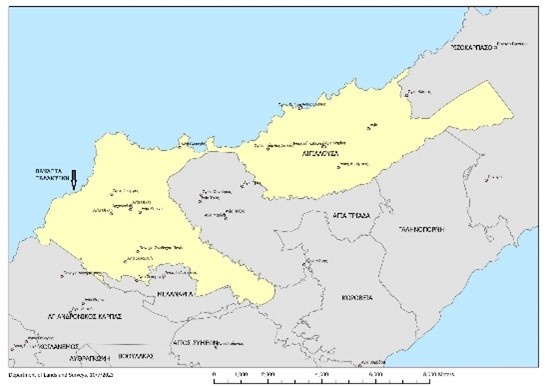
In central Karpasia the Galateia and Platanissos enclave had a northern coastal front, and in southeastern Karpasia the Greek-speaking villages controlled by TMT were Agios Symeon, Koroveia and Galinoporni. The coastal front ran about 10 kilometres, and at its middle once stood the famous castle of Nitovikla.
Less than 14 years after the Republic of Cyprus was founded, the 291st Infantry Battalion, based at Akrades, was ordered to withdraw. It was Wednesday, August 14, 1974. Colonel Konstantinos Zarkadas of the infantry commanded the 1st Higher Tactical Command, and Lieutenant Colonel Kyriakos Mavros of the infantry commanded the 291st. The battalion left Akrades for Anglisides and ended up on the outskirts of Athienou, where it almost disbanded.
On Saturday, August 17, 1974, while Turkish forces walked and swept through Famagusta and Karpasia, a battle was starting southeast of Athienou. Ilias Pantelidis, then an infantry sergeant, was there, serving as assistant to Major Themistoklis Stathis. Stathis’s stand saved Athienou, because about 100 men of the 291st and of the Famagusta recruit training centre stayed and stopped the capture of a hill that would have helped Attila II encircle Athienou, abandoned and prosperous.
Aigialousa’s nine became twelve, but they are nineteen
In Karpasia there lives a town called Aigialousa, with a larger electoral roll than four occupied municipalities. Nine of its people “disappeared” on August 19, 1974. The Turks held a list of names in their hands and took nine prisoners. Their traces were lost from that day, and those left behind searched for them for many years, with great fear and with hidden hope.
Among the nine was Judge Takis Hadjinicolaou, whose arrest Denktash admitted by name. All of them were taken to an unknown place. Years later they were found in a mass grave at Galateia and identified in the summer of 2007.
The nine immortals of Yialousa are:
Adamou (Lambrou) Pieris Adamos, born September 11, 1936
Ilia (Panagi) Odysseas Ilias, born November 1, 1941
Kemekkis Panagiotis (Panikos) Michail, born April 6, 1954
Kosma Christos Savvas, born February 16, 1939
Paraschou (Siaourta) Michail Paraschos, born July 7, 1941
Savvides Stelios Neofytos, born March 31, 1942
Hadjidimitri Pavlos (Pavlakis) Evagoras, born February 10, 1945
Hadjipanteli Savvas Kallis, born January 17, 1938
Hadjinicolaou Christos (Takis) Panos, born April 11, 1939
Three men arrested unlawfully a few days later remain missing: Christodoulos Kaoutzianis, Koumis Mavrommatis and Ioannis Charalamboudis.
Days after the great seizure, dozens more disappeared from Eptakomi and Komi Kebir, dressed in mourning, and from other beloved places of a betrayed Karpasia. They vanished from the face of the earth. Many others fell on the battlefields:
Konstantinos Konstantinou, son of Antonios, born March 30, 1956, killed at Panagra
Leonidas Leonidou, son of Kostas, born March 2, 1955, killed at Voni
Giannakis Liasi, son of Savvas, born May 4, 1953, killed at Klepini
Giorgos Raftis, son of Christos, born February 26, 1945, killed at Agios Symeon
Vasileios Siamptanis, son of Diogenis, born January 1, 1953, killed at Aspri Moutti
Petros Charalamboudi, son of Andreas, born September 13, 1955, killed at Mia Milia
Kostas Giangou, son of Savvas, born June 13, 1951, killed at Fotta
It is no accident that Karpasia is called the peninsula of Saints and Heroes. That is why it is wise for the generations that are leaving to remember, and for the generations that are coming to learn, that there is a peninsula stretching from Akanthou to Apostolos Andreas and on to the Kleides islets, a peninsula blue, green and beloved. A peninsula that smells of mastic, thyme and the sea.
Every restless blue wave brings to Achaion Akti a murmur of thousands of years that tears at our soul and rises to the heavens, a voice that thunders: Aigialousa lives!
Ilias Pantelidis is president of the community council of the town of Aigialousa.

