


Memory, cultural heritage, and the stories of ordinary people come together to offer a new way of understanding Larnaka—revealing the city as a living tapestry of shared experiences and collective memory that connects its past, present, and future.
What ultimately defines a city? Is it its buildings, monuments, and streets, or the people who have brought it to life? Is it the major historical milestones, or the countless personal stories that often remain unseen?
These are the questions explored by Human Traces, one of the flagship projects of Larnaka 2030 – European Capital of Culture, which transforms the city into a living landscape of memory and storytelling.
“We are the voices of many people.” This simple yet powerful statement encapsulates the philosophy of the Home of Memory (H.O.M.), Larnaka’s museum of people’s stories, where history emerges through personal belongings, testimonies, and lived experiences. Its mission is to re-examine the world through the perspectives and experiences of its people, positioning memory as a shared place of encounter.
As project lead Joseph Hadjikyriakos explains, “H.O.M. proposes a new way of understanding the relationship between art, memory, and public space. It is a large-scale participatory project that collectively creates a portrait of Larnaka.”
The Home of Memory is envisioned as an open, digital, and evolving meeting place. Through temporary and travelling exhibitions, personal objects, artistic interventions, and public programmes, its archive will extend beyond the walls of the museum, engaging with the city and its communities on a daily basis.
“In this way,” Hadjikyriakos notes, “memory is no longer confined to a single location but becomes an active part of everyday life.”
The Phoebos Stavrides Larnaka Archives will play a central role in the project, with the Home of Memory housed at the Common Ground Cultural Center. Human Traces will officially launch in 2030, demonstrating how H.O.M. brings together cultural heritage and contemporary artistic practice.
The City as a Living Archive
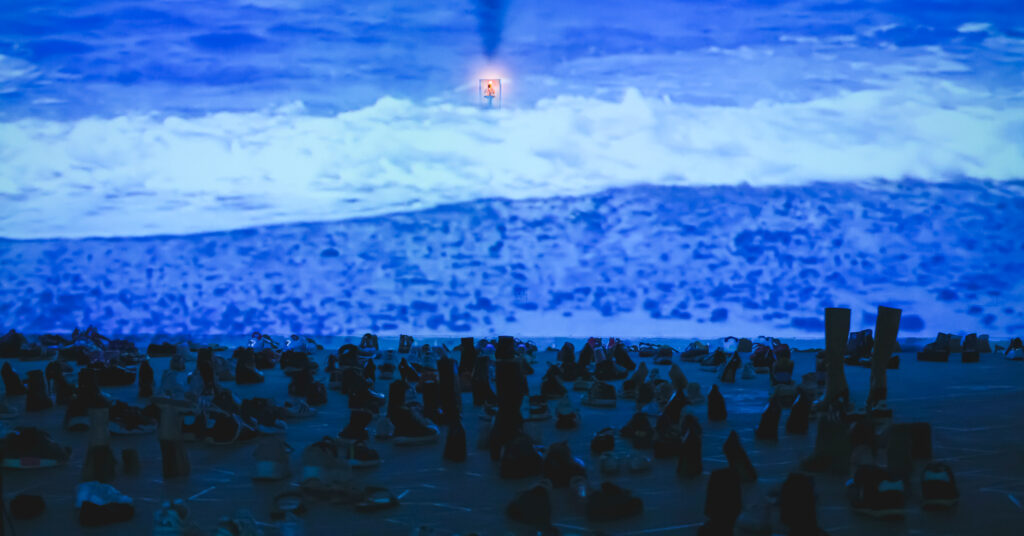
Human Traces presents a portrait of Larnaka that unfolds across the entire city—a living artwork shaped by its people and embedded within its urban landscape.
Conceived by visual artist Marios Spiliopoulos, Professor at the Athens School of Fine Arts and one of Greece’s leading practitioners of socially engaged art, the project will involve 1,500 participants from diverse ages, communities, and cultural backgrounds. Participants will contribute personal stories, memories, photographs, treasured objects, and a pair of shoes, while local artists will also play an active role in the project’s development.
The shoes become the starting point for a series of walking routes that connect residents and visitors with artistic interventions throughout the city. At every stop, new “memory capsules” emerge, where art revisits and reinterprets the past, fostering reconciliation between people, places, and shared experiences.
Along these routes, Human Traces invites participants to reflect on three central questions:
- How can we revisit the past without fear, but with a spirit of reconciliation?
- How can art bring people together rather than divide them, transforming differences into creative dialogue?
- How can European cities become living laboratories of coexistence through art and culture?
From Monuments to Human Stories
The artistic interventions of Human Traces extend throughout Larnaka, transforming monuments, neighbourhoods, and everyday public spaces into places of dialogue and reflection.
At Hala Sultan Tekke, a luminous installation displays Euripides’ words, “Happy is the one who has learned from history,” in both Greek and Turkish.
At the Salt Lake, seven flamingo sculptures highlight migration as a timeless human search for safety and survival.
In the Turkish Cypriot Quarter, abandoned houses left behind since 1974 are given voice once again. Sounds in the Turkish language, shoes placed along the streets, and traces of footsteps evoke the presence of those who once lived there, while reminding visitors of the lost experience of coexistence.
The Medieval Castle of Larnaka, bearing layers of Venetian, Ottoman, and British history, becomes a space where art engages with the memory of violence.
Meanwhile, Saint Lazarus Square brings together two major religious traditions, while Zouhouri Square becomes a symbol of visual and acoustic coexistence through the dialogue between church bells and the call to prayer from the nearby minaret.
Memory as a Bridge to the Future
For both the Home of Memory and Human Traces, memory is not a static archive but a living organism that evolves alongside society. The archive reaches beyond the museum through exhibitions, digital initiatives, artistic interventions, and public encounters, continually returning to the city that created it.
“Historical consciousness is shaped not only by major historical events,” says Joseph Hadjikyriakos, “but also by the countless personal stories that together form the collective experience of a community.”
Towards the end of 2028, an international open call will invite local and international artists to inhabit these spaces through concerts, poetry and literary events, as well as site-specific artistic projects designed for each location.
Through this ongoing process, Human Traces places Larnaka at the heart of the wider European conversation on memory, diversity, and reconciliation. It invites residents and visitors alike to experience the city as a place where memory and coexistence are lived every day—a city where art creates connections, strengthens dialogue, and activates collective experience.
Media sponsor: Phileleftheros
Read more:

